Key Takeaways
| E-E-A-T Component | Description | Action for New Websites |
| Experience | First-hand experience in using, doing, or solving the issue. | Show “How-to” steps from direct experience. Review products/services you actually own. |
| Expertise | Recognized knowledge and skill in a specific field. | Create a clear “About Us” and “Author Bio.” Cite credible sources. |
| Authoritativeness | Reputation and standing within the industry. | Get mentioned (Backlinks) by quality sites. Display certificates/awards. |
| Trustworthiness | Safety, accuracy, and transparency of the website. | Use HTTPS. Have a clear Privacy Policy. Display verifiable contact info. |
New Websites vs. Conquering Google’s Trust
When you launch a new website, the biggest challenge isn’t just creating content—it’s building Trust in Google’s eyes. This is especially true after Google’s recent Core Updates, which have placed a massive emphasis on E-E-A-T (Experience, Expertise, Authoritativeness, Trustworthiness).
New websites are often categorized as “Untrusted” until they prove themselves. This is why many fresh domains take months to see significant rankings (often called the “Sandbox” effect). But here is the good news: there are strategies designed specifically to accelerate this process.
You don’t need a 10-year-old domain to conquer E-E-A-T. If you understand the right principles, you can make your site Google-friendly from the very first page you publish.
For those looking to plan a comprehensive online marketing strategy from scratch to high-level credibility, Minimice Group is a team of Digital Marketing experts ready to consult and execute this entire process for you.
E-E-A-T Implementation Guide for New Websites
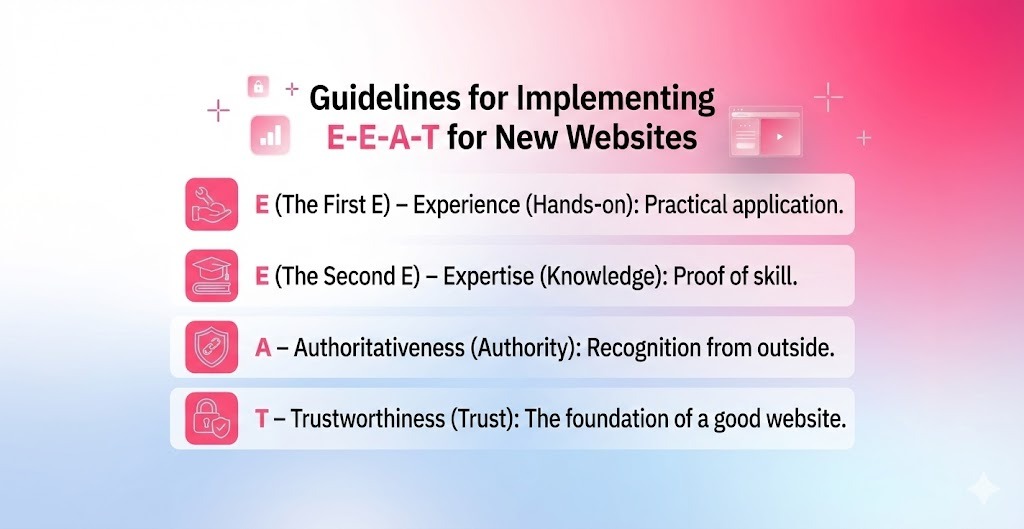
The method for building E-E-A-T for a new site must focus on demonstrating empirical evidence as much as possible.
1. E for Experience: The Power of “Doing It Yourself”
The first “E” was added in 2022 and has become a key for new websites. Experience is proof of action. You must show Google that your content doesn’t just come from researching other Google results, but from you actually “using,” “trying,” or “solving” the problem yourself.
For New Websites:
- Focus on First-hand Content: If reviewing a product, use your own photos or videos, not stock images. If teaching a method, show detailed steps with actual results.
- User Perspective: Write content like “I tried this, and here is what happened,” rather than “This is what should happen.”
- Case Studies: If you are a service website, use Before/After case studies to demonstrate successful problem-solving.
📌 Summary:
- Experience is evidence that you have actually done the task.
- New sites should focus on original images/videos.
- Write from the “User” perspective, not just the “Knower.”
- Strictly avoid copying other people’s experiences.
2. E for Expertise: Proving Your Knowledge
Expertise demonstrates deep knowledge on the topic. This is often linked to the background or qualifications of the content creator (Author). Google wants to ensure information is accurate and safe to use, especially for YMYL (Your Money Your Life) topics.
For New Websites:
- Build Strong Author Bios: Every article should have a clearly identified Author with education history, work experience, or relevant certifications.
- Link to Social Proof: Connect authors to their LinkedIn or Social Media profiles to prove they are real people with consistent professional history.
- Content Depth: Explain complex concepts in simple language but maintain Academic Soundness.
💡 Tips: Expertise doesn’t always mean a PhD. It can be 10,000 hours of experience. Use industry jargon appropriately but explain it to the reader. Always use Author Schema markup. Update your knowledge constantly.
3. A for Authoritativeness: External Recognition
Authoritativeness is about being recognized broadly by your community or industry. It’s like a “majority vote” saying your website is a trusted source. Google uses Backlinks (links from other sites) as a primary indicator of Authority.
For New Websites:
- Quality over Quantity: A backlink from a reputable site in your industry is more powerful than links from irrelevant forums or directories.
- Create Linkable Assets: Produce Infographics, deep research, industry statistics, or free tools that others want to reference.
- Mentions: Being mentioned (Brand Mentions) in news or other media, even without a link, still helps build authority.
📌 Summary:
- Authoritativeness is when others (websites) validate you.
- Key strategy: Outreach to get links from quality sites.
- Create content that serves as a reference point (e.g., new research).
4. T for Trustworthiness: The Foundation
Trustworthiness is the most fundamental component. It covers everything from site security to data accuracy. Google must be sure users are not at risk when visiting your site.
For New Websites:
- Always use HTTPS/SSL: Encryption is non-negotiable.
- Complete Policy Pages: You must have clear, accessible Privacy Policy and Terms and Conditions pages.
- Verifiable Contact Info: Display a real phone number, email, and physical office address.
- Transparency: Cite your sources clearly.
| Trust Element | How Google Checks | Impact on New Sites |
| HTTPS | Valid SSL Certificate | Mandatory. No ranking without it. |
| Core Policies | Existence of “Privacy Policy” & “About Us” | Assures the site isn’t a scam. |
| Data Accuracy | Citations and Updates | Shows responsibility for published info. |
💡 Tips: E-commerce sites must have clear Return/Refund policies. Make contact info visible in the Footer. Use Schema Markup (Organization/Person) to tell Google who you are. Fix Technical SEO errors immediately.
The Triple-Threat Strategy: Accelerating E-E-A-T
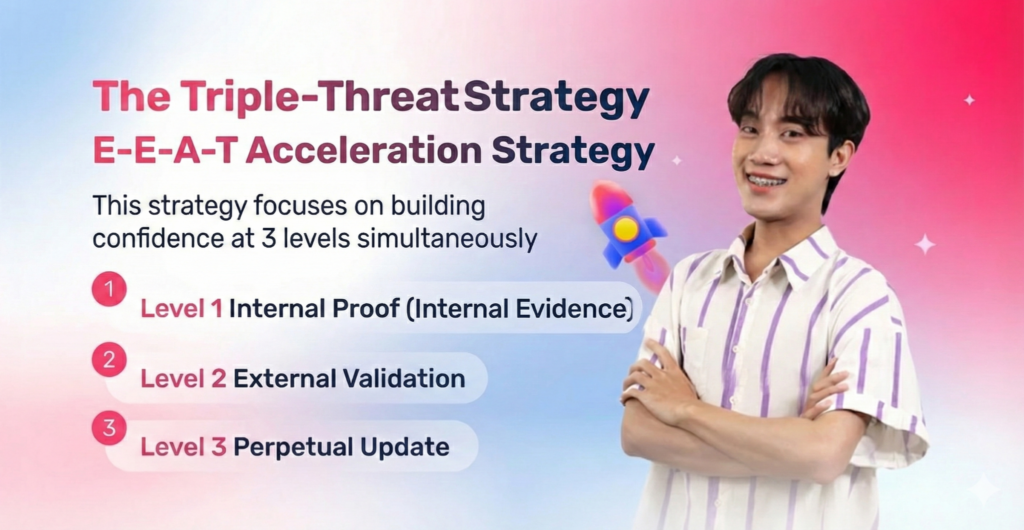
For a new website, passive E-E-A-T building is too slow. You need a proactive approach called “The Triple-Threat Strategy.”
- Level 1: Internal Proof: Focus on filling Experience and Trustworthiness within your site (Author Pages, HTTPS, Hands-on Content).
- Level 2: External Validation: Focus on Authoritativeness via Backlinks and quality Mentions (Guest Posting on high Domain Authority sites).
- Level 3: Perpetual Update: Focus on Expertise by refreshing old content every 3-6 months to show Google you are current.
Minimice Group Case Study: Building E-E-A-T for Niche Markets
The Problem: A client of Minimice Group was a newly founded Health-Tech company. This falls under YMYL, where Google is extremely strict about E-E-A-T. Standard SEO wasn’t moving the needle.
- E-E-A-T Audit: We found content was mostly definitions, lacking specific Experience and Author Expertise.
- Expert Content Strategy: Minimice advised utilizing internal doctors/specialists to write articles, enforcing Author Bios with visible medical licenses (Expertise & Trustworthiness).
- Data-Driven Experience: Every tech article required citations from published medical journals and presented successful Case Studies (Experience).
- Authority Building: We focused on Digital PR, sending insights to top health media outlets to earn high-authority Backlinks.
The Result: Within 6 months, the website’s Trust Score skyrocketed, and it began ranking in the Top 3 for highly competitive Health-Tech keywords because Google viewed it as a “Truly Experienced and Expert Source.”
Beginner’s Glossary
- YMYL (Your Money Your Life): Content that can impact a user’s health, financial stability, safety, or well-being. Google applies the strictest E-E-A-T standards here.
- Search Quality Rater Guidelines: The handbook Google uses to train human raters, which is the source of the E-E-A-T concept.
- Author Schema Markup: Code added to your HTML to explicitly tell Google who wrote the article.
- Backlinks: Links from other websites pointing to yours. Think of them as “votes of confidence.”
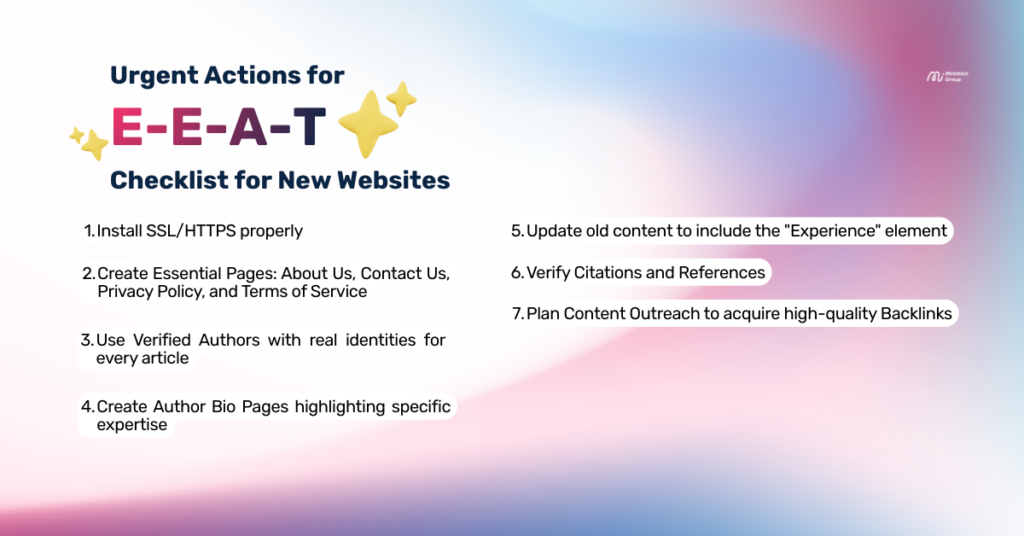
Immediate E-E-A-T Checklist for New Sites
- [ ] Install SSL/HTTPS.
- [ ] Create complete About Us, Contact Us, Privacy Policy, and Terms pages.
- [ ] Identify a real human Author for every article.
- [ ] Create an Author Bio Page detailing expertise/experience.
- [ ] Update content to include Experience elements (real photos, videos, steps).
- [ ] Verify Citations for all statistical or academic claims.
- [ ] Plan Content Outreach to acquire quality Backlinks.
FAQs: Frequently Asked Questions about E-E-A-T
Q1: How can a small, unknown website build E-E-A-T?
Answer: Start with the first “E” — Experience. Become the expert in your specific Niche. Create content no one else can, such as experiments, product usage tests, or deep reviews based on direct experience. When you have the “best” content based on reality, Authority will follow.
Q2: Is E-E-A-T more important than On-Page SEO?
Answer: Not exactly. E-E-A-T is part of On-Page SEO focusing on content quality and publisher credibility. Technical On-Page SEO (speed, keywords) is the skeleton; E-E-A-T is the soul. You need both.
Q3: Can I create a fake author to boost Expertise?
Answer: Absolutely not. Google can cross-reference author names, contact info, and work history across the web. If it detects a Fictitious Author, it will severely damage your Trustworthiness.
Q4: How long does it take for E-E-A-T to impact rankings?
Answer: E-E-A-T signals often kick in during Core Updates, which happen every 3-6 months. However, Trustworthiness fixes (HTTPS, Policies) can have faster effects.
Q5: Does E-E-A-T apply to all sites or just YMYL?
Answer: It applies to all, but it is critical for YMYL (Health, Finance). However, Google recommends every site demonstrate E-E-A-T to the best of its ability.
Q6: Do bought backlinks help Authoritativeness?
Answer: Buying low-quality backlinks or using PBNs (Private Blog Networks) does not help and can lead to penalties. Focus only on Editorial Backlinks earned through quality content.
Q7: Should I hire non-expert writers?
Answer: You can, provided the content is Fact-Checked and reviewed by an internal Subject Matter Expert. The Expert’s name should appear as the reviewer or co-author.
Q8: What should be on the “About Us” page?
Answer: Mission, Vision, Company History, Team Members, and most importantly: Proof of Success, Awards, or Industry Certifications.
Q9: How does E-E-A-T relate to AI Search (SGE) in 2026?
Answer: In 2026, AI Search Engines (SGE) prioritize information from the “Highest E-E-A-T Score” sources to generate answers. High E-E-A-T is essentially survival for SEO in the AI era.
Q10: How does Social Media help E-E-A-T?
Answer: Active social profiles that engage with the community confirm the brand/author is real (Trustworthiness) and influential (Authoritativeness).
Conclusion
E-E-A-T is not just a temporary SEO trick; it is the foundation of a sustainable online business. It shifts your perspective from being just a “website” to being the “most trusted resource” in the eyes of both humans and Google’s Algorithms.
For a new website, building E-E-A-T is hard work. But if done correctly, the result is sustainable rankings, quality traffic, and credibility that converts to sales.
If you are unsure how to start building this complex E-E-A-T structure, or need an expert team to execute the Triple-Threat Strategy effectively, we are here to help.
Ready to turn your new website into a Google-friendly authority?
Start your comprehensive E-E-A-T and Digital Marketing consultation with Minimice Group today.