

Key Takeaway
| Property | SEO (Search Engine Optimization) | AEO (Answer Engine Optimization) |
| Primary goal | To achieve higher rankings on the SERP (Search Engine Results Page) in order to drive traffic (website clicks). | To have the content selected as a direct answer in AI Search or Featured Snippets (Position Zero) in order to build authority. |
| Main focus | Keywords, Website Structure, and Backlinks. | Answers, clarity, relevance, and structured data (schema markup). |
| Measurable results | Organic traffic, keyword rankings, and conversion rate. | Selected as an AI answer, achieved Position Zero, and voice search visibility. |
| Collaboration | The foundation and a key determinant of website authority. | Further optimization to enable AI systems to leverage authoritative content. |
| Suitable for the current era | Search Engine (Google, Bing) | Answer Engine / Generative AI (Google SGE, ChatGPT, Bing Copilot) |
The age of customers no longer clicking but “listening” to AI-generated answers is here. Is your business ready to rethink its content strategy?
- The shift in search behavior: You may have invested heavily in SEO to rank your website #1. But today, consumers no longer want to click through multiple websites to find answers. Instead, they turn directly to AI-powered search tools like Google’s AI Overview or ChatGPT to ask their questions.
- The limits of traditional ranking: As a result, even if you hold the top position in traditional search rankings, if AI does not select your content as the answer, customers may never see your brand from the very beginning of their journey. This shift has created growing concern among business owners who aim to build long-term credibility and authority.
- The core of marketing in 2026: As digital marketing experts with over 10 years of experience, we fully understand this confusion. Traditional SEO is still necessary — but it is no longer enough. Today, businesses must move toward AEO (Answer Engine Optimization), a strategy specifically designed to position your brand as the direct “answer provider” selected by AI systems. And that is the core of marketing in 2026.
In this article, we will cover:
- This article will take you deep into what AEO is, how it differs from SEO, and how you can apply this strategy to your business.
- We will also explore the comparison of AEO vs SEO vs GEO to help you understand how each approach plays a role in today’s search landscape.
- In particular, we’ll highlight the use of powerful tools and proven frameworks—such as those utilized by Minimice Group—to deliver measurable success for numerous clients.
What is AEO and Why Is It Important in the Age of AI Search?
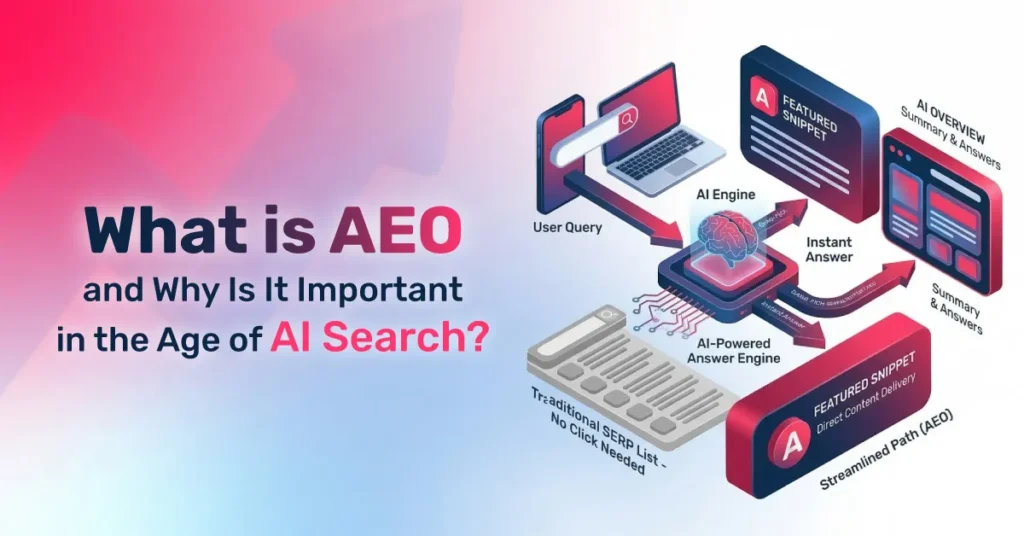
AEO stands for Answer Engine Optimization. It is the process of optimizing website content so that it is most suitable to be used as a direct “answer” by AI-powered or generative search engines. This includes platforms such as Google Search Generative Experience (SGE), ChatGPT, Microsoft Copilot (formerly known as Bing Copilot), and even voice search tools like Google Assistant and Siri.
The importance of AEO lies in moving beyond the competition for the #1 ranking. In today’s landscape, users often receive instant answers directly on the search results page (AI Overview) without ever clicking through to a website. AEO ensures that your brand becomes a trusted “source” for AI systems. In other words, it positions your business as a credible reference that AI relies on—ultimately building the highest level of authority in the eyes of consumers.
- AEO is the process of optimizing content so that AI selects it as a direct answer.
- The goal is not just traffic, but becoming an authority source for AI.
- It aligns with consumer behavior that demands concise, relevant, and immediate answers.
- It is critically important for brand survival in the era of Google SGE and voice search.
How SEO and AEO Differ: From “Search” to “Answering Questions
The main difference between these two strategies lies in their goals and how they operate. Although they are closely interconnected, AEO requires a more specific and refined approach to content optimization.
| Comparison factors | SEO (Search Engine Optimization) | AEO (Answer Engine Optimization) |
| Content format | Long, ambiguous articles focused on keyword density and internal/external links. | Content that answers specific questions clearly, using a structured Q&A format. |
| Structuring | Focuses on the hierarchy of H1–H6 headings and the use of keywords in the title and meta tags. | Focuses on Schema Markup (Structured Data), such as FAQ and How-To, as well as the use of bullet points and tables that are easy for AI to read and interpret. |
| Length / Conciseness | Long-form content designed to provide depth and build authority. | Content must be concise and able to deliver a clear answer within 50–100 words (optimized for snippets). |
| Results | Rank #1 on the SERP (driving traffic to the website through clicks). | Position Zero / Featured Snippet and inclusion in AI Overview (gaining brand visibility even without clicks). |
| Primary metrics | Organic Traffic, Time on Page | Number of Position Zero appearances and AI search citations. |
AEO does not replace SEO — it builds upon it. SEO serves as the foundation for establishing a website’s authority, while AEO ensures that AI systems can “understand” and effectively “utilize” that authoritative content.
Tips for Adjusting Your Mindset
- Stop thinking that users must always click on your website — instead, focus on how you can become the best possible answer.
- Shift from writing for keywords to writing for the actual questions users are searching for.
- Start implementing Schema Markup seriously to help AI understand your content structure.
- Ranking #1 in SEO gives you the opportunity to be selected for AEO — but it does not guarantee that AI will choose you.
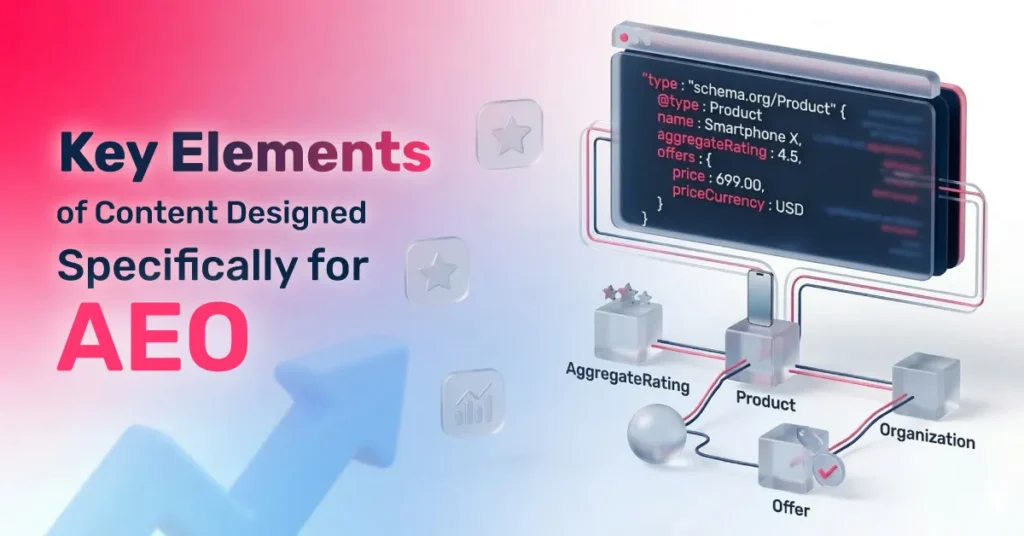
Key Elements of Content Designed Specifically for AEO
AEO content is not just about writing questions and answers. It must also have a clear structure and specific attributes that AI systems can easily “process” and “extract” for use.
Clarity and Specificity
The answer should be placed at the very beginning of the article or under the clearest, most prominent heading — not buried in lengthy introductions like traditional SEO writing. The content should address the question within the first paragraph, using concise and complete sentences.
Structured Data / Schema Markup
Schema Markup is code that helps search engines understand what the information on a page represents — for example, whether the content is an FAQ, How-To, Recipe, or Review. Implementing the correct schema increases the likelihood of your content being selected for a Featured Snippet or included in an AI Overview.
Q&A-Style Answers and Long-Tail Keywords
Since AEO focuses on answering questions, creating a Frequently Asked Questions (FAQ) section or using H2/H3 headings written as long-tail question phrases (e.g., “How do you fix a slow-loading website?”) helps AI systems more easily connect your content to users’ search queries.
Tips: On-Page Actions to Implement
- Paragraph Zero: Place the clearest and most direct answer to your H2/H3 question in the very first paragraph.
- Use Lists & Tables: Use bullet points, numbered lists, or tables to make it easier for AI to extract your content as a snippet.
- Implement Schema: Apply FAQ Schema and How to Schema to relevant content pages to enhance AI understanding and eligibility for rich results.
- Voice Search Friendly: Write content in a polite, natural conversational tone — as if you’re explaining the answer to a friend.
Measurable AEO Strategies That Deliver Real Results
AEO is not limited to content optimization alone — it also involves technical and marketing strategies.
Building Authority Through E-E-A-T
Even as AI takes on a larger role, Google still strictly adheres to the principles of E-E-A-T. In the evolving landscape of AEO vs SEO vs GEO, credibility remains the common foundation across all three strategies.
If your website lacks authority and trustworthiness, your content will not be selected as an AI-generated answer — regardless of how well it is optimized for AEO or GEO. Therefore, strong SEO remains the most important foundation upon which AEO and GEO are built.
Optimizing for Voice Search
AEO is closely connected to voice search, as voice users tend to ask direct, conversational questions and expect one clear answer. Writing in short, concise, and natural spoken language increases the likelihood of your content being selected as the response on voice-enabled devices.
Analyzing Competitors’ Featured Snippets on Google
Use SEO tools to identify which questions in your industry competitors are being selected for Featured Snippets. Then analyze how their content is structured and determine how you can provide answers that are “better and clearer” in order to compete for Position Zero.
- AEO Requires E-E-A-T: Build brand and author credibility alongside your AEO efforts to increase trustworthiness.
- Prioritize Voice Search: Use question-based headings such as who, what, where, when, and how to align with natural search behavior.
- Answer Engine First: Design content with the primary goal of being extracted and used by AI systems from the start.
- Measure Position Zero: Track Featured Snippet performance specifically — not just organic rankings.
The Triple-A Content Strategy: Advanced Content Strategy for the AI Era
In an era where traditional SEO strategies are no longer sufficient, Minimice Group has developed a framework called the “Triple-A Content Strategy” to help businesses fully capture opportunities in the age of AI search. This strategy consists of three core components that must work together seamlessly.
| Strategy | Description | Objective |
| Authority (SEO) | Building a strong website foundation through technical SEO, high-quality backlinks, and a solid site structure to earn Google’s trust. | To have Google rank the website highly and recognize it as having strong authority. |
| Answer (AEO) | Creating content that answers specific questions (FAQ, How-To), supported by proper Schema Markup implementation and concise, well-structured sentences. | To have AI select the content as a direct answer in AI Overview or Featured Snippets. |
| Alignment (GEO) | Structuring content and clearly defining business information (such as company details, products, and services) so AI can understand the full business context and generate more complex answers based on your data. | To have your brand selected as part of the answer generated by AI (Generative AI). |
Case Study: Turning the Game Around for an SME in the Financial Sector
One SME client in the financial industry working with Minimice Group faced a major challenge. Despite ranking #1 for their primary keywords, their traffic continued to decline.
The reason? Users were increasingly turning to AI tools to ask for definitions and product comparisons related to financial services — instead of clicking through to websites.
How Minimice Group Solved the Problem
- Restructured the existing content by adding clearly separated “Q&A” and “Definition” sections, distinct from the main body content.
- Implemented Schema Markup by deploying FAQ Schema and HowTo Schema across all key pages.
- Results: Within three months, the client’s content was selected by Google as a Featured Snippet (Position Zero) and became a primary reference source in AI Overview under Google SGE for more than 40 queries. This significantly increased brand mentions and overall credibility. Although organic clicks did not rise, the leads generated from AI-influenced search journeys became noticeably higher in quality.
- The Triple-A Strategy is the integration of SEO, AEO, and GEO working together in synergy.
- Minimice Group applies this strategy to turn the disruption caused by AI search into a strategic opportunity.
- At its core, the approach transforms content into a structured data feed that AI systems can easily understand and effectively utilize.
Essential Glossary for Beginners
- Answer Engine Optimization (AEO): A strategy focused on optimizing content so AI systems select it as a direct answer for users.
- Search Engine Optimization (SEO): The practice of optimizing a website to achieve higher rankings in traditional organic search results.
- Generative AI (GAI): Artificial intelligence capable of creating new content such as text, images, videos, or code (e.g., ChatGPT and Google Gemini).
- Featured Snippet (Position Zero): A short answer box that Google extracts from a website and displays at the very top of the search results page.
- Schema Markup (Structured Data): Code added to a website to help search engines and AI better understand the type and meaning of the information on a page.
AEO Starter Checklist: What to Do Immediately
- Audit Featured Snippets: Search for your core business questions and identify who owns Position Zero. Analyze how their content is structured and why it’s being selected.
- Restructure Q&A Sections: Create clear, direct FAQ sections on all key pages (Service Pages, Product Pages).
- Implement Schema Markup: Properly validate and deploy FAQ Schema, HowTo Schema, or Organization Schema where appropriate.
- Write Paragraph Zero: Review your H2/H3 headings and place the strongest, most concise answer in the first paragraph.
- Prioritize Concise: Use tables and lists to break information into structured chunks that AI can easily extract.
- Strengthen E-E-A-T Signals: Clearly display author information, credentials, and credible references to enhance your website’s authority.
Beyond Rankings: From Position to Answers
In the world of digital marketing in 2026, being fixated on ranking #1 on Google may no longer be enough. Marketing must evolve from Search Engine Optimization (SEO), which focuses on search visibility, to Answer Engine Optimization (AEO), which focuses on becoming the most trusted answer source for AI.
AEO is not a competitor to SEO — it is its evolution. It represents an investment in brand credibility, which is the most valuable asset in an era where consumer attention spans grow shorter every day. Preparing with the right AEO strategy starting today is therefore a way to build a sustainable competitive advantage.
If your business is ready to move beyond the limitations of traditional SEO and become the answer provider that AI chooses — in order to build true brand authority — now is the time to take action.
Call to Action starts restructuring your content for AEO today. Consult with experienced digital marketing professionals to analyze your website and develop a tailored Triple-A Content Strategy. Partner with Minimice Group to position your brand as the AI-selected answer — and accelerate your growth in 2026.
Would you like us to help analyze the key questions or keywords in your business to begin structuring a more effective AEO strategy?
Frequently Asked Questions
Q1: Will AEO Completely Replace SEO?
Not one replaces the other — they work together. SEO remains the strongest foundation. If a website lacks authority based on solid SEO principles, its content will not even be considered for use as a direct answer (AEO). Strong SEO execution ultimately maximizes the effectiveness of AEO.
Q2: If AI Uses Our Content to Answer Directly and Users Don’t Click Through, What’s the Benefit?
The key benefit is building brand visibility and achieving the highest level of authority. When AI selects your content as a source, it signals that your brand is trustworthy and credible. Users are more likely to remember your brand — and more likely to search for it directly later when they are ready to make a purchase or use your services.
Q3: How Long Should AEO Content Be?
There is no fixed rule. However, the core answer section (snippets) should be concise and able to address the question within 50-100 words. At the same time, the overall article should remain comprehensive in length, following SEO best practices to build sufficient authority for AI selection.
Q4: Does AEO Need to Be Applied to Every Page of a Website?
Not necessarily. You should prioritize pages that are more likely to be question-driven, such as definition articles, how-to guides, and FAQ pages.
Q5: What Is Google SGE and How Is It Related to AEO?
Google SGE (Search Generative Experience) is a new search system that uses generative AI to create summarized answers (AI Overview) that users can see instantly. AEO is the strategy that increases the likelihood of your content being selected as a reference source within SGE’s AI Overview.
Q6: How Closely Are Voice Search and AEO Connected?
They are closely related. Most voice searches are direct, question-based queries that require a single, concise answer. Well-optimized AEO content is therefore highly suitable for being selected as the response in voice search results.
Q7: If You’re Already Doing SEO Well, When Should You Start AEO?
You should start immediately, as AEO builds upon your existing SEO foundation. It mainly requires enhancing your structured data (Schema) implementation and placing a stronger emphasis on delivering clear, direct answers to user questions.
Q8: Will Implementing AEO Reduce Organic Traffic?
There may be a decline in traffic for certain queries where users receive instant answers (zero-click searches). However, the remaining traffic tends to be higher in quality, as those who click through are typically seeking in-depth information or are genuinely interested in making a purchase or using your services.
Q9: What Tools Can Help with AEO?
Common SEO tools can help analyze Featured Snippet opportunities, while structured data validation tools such as Google Structured Data Testing Tool assist in checking proper Schema Markup implementation.
Q10: How Is GEO Different from AEO?
AEO focuses on enabling AI to use your content to provide short, direct answers to specific questions. GEO (Generative Engine Optimization), on the other hand, focuses on optimizing content so AI can use it as a data source to generate more complex responses or entirely new summaries (generative content). It is considered a more advanced strategy built upon AEO.