


Key Takeaway
- Semantic Search is a search approach that focuses on meaning, context, and search intent rather than exact keyword matching. It uses AI and NLP to understand relationships between concepts and deliver more relevant results.
- Semantic SEO requires intent-driven content creation using a Topic Cluster structure, natural language, related subtopics, and Structured Data (Schema Markup) to improve AI understanding of context.
- Semantic Search improves visibility in AI-powered search, builds topical authority, and helps capture long-tail, intent-based queries—not just primary keywords.
- Use of actual search language (English + Filipino), inclusion of local context and city names, and a conversational writing style to support question-based and voice searches.
Search engines today don’t just look for matching keywords anymore. In 2026, they are smart enough to understand the meaning behind a search, the context of the question, and what users actually want to know. This is what is known as semantic search—a way for search engines to understand the intent and overall meaning of a query, not just the exact words used.
Because of this, the way we create and optimize content has changed. It’s no longer about repeating keywords many times. Instead, content needs to clearly answer questions, provide useful information, and truly match the user’s intent to rank well.
Defining Semantic Search: The Evolution of Meaning
Semantic Search is a search approach that focuses on understanding the meaning, intent, and context behind a query rather than simply matching exact keywords.
Traditional search engines relied on keyword matching. In contrast, Semantic Search analyzes user intent, relationships between words, and contextual signals to deliver more accurate and relevant results.This evolution is driven by advancements in Artificial Intelligence (AI), Natural Language Processing (NLP), and Machine Learning. For example, Google introduced Hummingbird in 2013 to better interpret conversational queries, followed by RankBrain, an AI system designed to understand unfamiliar or complex searches.
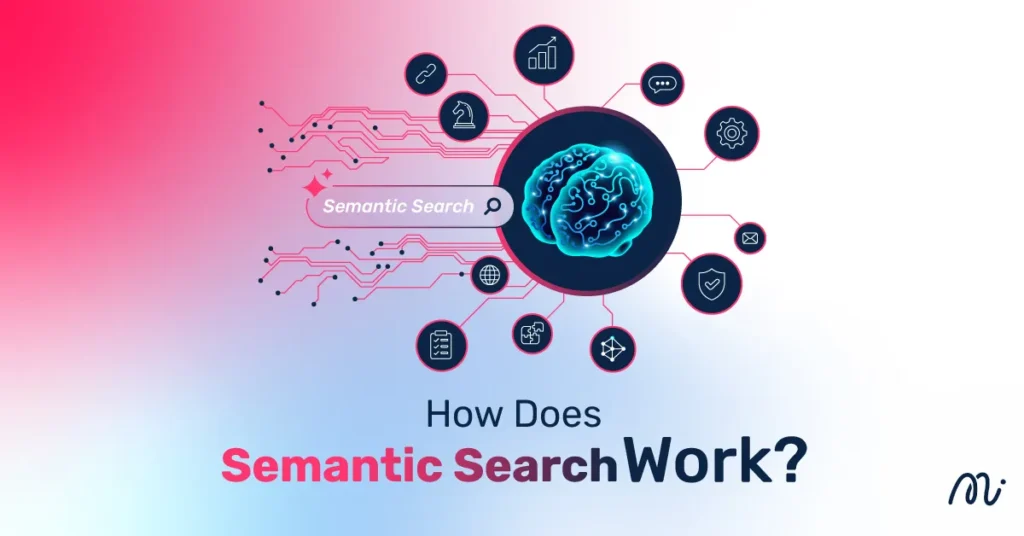
How Does Semantic Search Work?
Semantic Search works by understanding user intent and contextual meaning, rather than simply matching exact keywords. It leverages Natural Language Processing (NLP) to analyze search queries, identify key entities and their relationships, and interpret what users truly want.
Instead of indexing content based solely on keywords, it organizes information around topics and concepts, creating a deeper understanding of meaning. With the support of Machine Learning, the system then evaluates contextual signals—such as user behavior or location—to deliver highly relevant, intent-driven results.
Topic Clusters: The Structural Backbone of Semantics
Topic Clusters are a content strategy that organizes a website around a central pillar topic, supported by multiple related cluster articles that are all connected through internal links. The Pillar Page provides a comprehensive overview of a broad subject, while Cluster Content dives deeper into specific subtopics.By strategically linking these pages together, the structure clearly signals topical relevance and authority to search engines. As a result, it enhances SEO performance, strengthens topical authority, and delivers a more organized and user-friendly content experience.
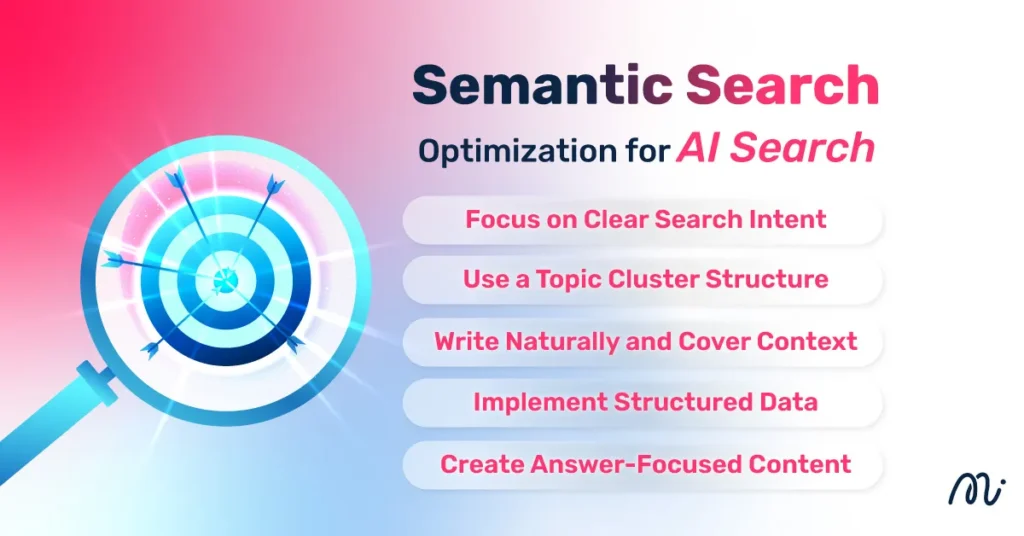
Semantic Search Optimization for AI Search
Optimizing Semantic Search for AI Search means creating content that is clear in meaning, context-rich, and intent-focused, rather than relying on repeated keywords.
- Focus on Clear Search Intent
Understand what users truly want—information, comparison, or purchase—and deliver direct, comprehensive answers.
- Use a Topic Cluster Structure
Organize content into a Pillar Page and supporting Cluster Content, connected through internal links to demonstrate topical depth and authority. - Write Naturally and Cover Context
Use natural language, related terms, and contextual variations to help AI fully understand the topic. - Implement Structured Data
Apply schema markup to clarify content types (e.g., articles, FAQs, products), making it easier for AI systems to interpret. - Create Answer-Focused Content
Structure content with clear headings, concise summaries, and scannable formatting so AI can easily extract and display key information.
Guiding Search Engines with Structured Data
Structured Data (Schema Markup) is code added to a webpage to clearly define the type and meaning of its content, helping search engines and AI systems understand information beyond plain text.
- Choose the Right Schema Type
Select a schema that matches your content, such as Article, FAQ, Product, Review, or Organization. - Use JSON-LD Format (Recommended)
Add structured data in JSON-LD format within the <head> or <body> of your page, specifying key details like title, author, publish date, price, or ratings. - Ensure Accuracy and Consistency
The structured data must match the visible content on the page and reflect truthful information. - Test and Validate
Use search engine testing tools to confirm the markup is error-free and properly interpreted.
Analyzing Competitors through a Semantic Lens
Semantic competitor analysis evaluates content based on meaning, search intent, and topical depth, rather than focusing solely on keywords. It begins by examining how comprehensively competitors cover a topic, including relevant subtopics and supporting concepts.
From there, assess whether their content clearly satisfies user intent—whether informational, commercial, or transactional—and how effectively it answers real user questions. Review their content structure, such as headings, internal linking, topic clusters, and contextual signals, to understand how they build topical authority.
Finally, identify content gaps and weak areas where you can create more complete, intent-driven, and semantically rich content to outperform them.
Measuring Semantic SEO Success
To determine whether your Semantic Search strategy is working, evaluate performance beyond simple keyword rankings and focus on intent alignment, topical authority, and user engagement. Start by monitoring organic traffic growth, especially across related keyword variations and long-tail queries, as success often appears through broader visibility rather than a single primary term.Next, track ranking improvements across entire topic clusters, since strong semantic structure typically lifts a whole content group—not just individual pages. Measure engagement signals like time on page, bounce rate, and pages per session to see whether your content truly satisfies user intent. Finally, review search visibility features such as featured snippets, rich results, and AI-generated summaries, which indicate that search engines clearly understand your content.
Why Do Philippine Businesses Need to Understand Semantic Search?
- Improves visibility in AI-driven search results as search engines prioritize meaning and user intent over exact keywords.
- Helps businesses capture diverse and long-tail search queries, especially in a multilingual market like the Philippines (English and Filipino).
- Strengthens local SEO performance, making it easier to appear in geographically relevant and intent-based searches.
- Builds topical authority and brand credibility by creating structured, in-depth content rather than scattered keyword pages.
- Increases conversion opportunities by aligning content with real customer intent—whether informational, commercial, or transactional.
- Prepares businesses for the future of search, where AI-powered systems and conversational queries continue to grow.
How to Optimize Content to Align with Filipino Users’ Search Intent
Analyzing Filipino Customers’ Search Intent
- Informational (seeking information) – e.g., How to register a business in the Philippines → Provide detailed, educational content that clearly explains the process and answers common questions.
- Navigational (searching for a brand or website) – e.g., Globe Telecom official website → Optimize your brand presence and website SEO so users can easily find your official pages.
- Transactional (ready to purchase a product or service) – e.g., Buy condo in Cebu City → Create optimized product or service pages and high-converting landing pages that directly match purchase intent.
Create In-Depth Content That Provides Comprehensive Answers
- Focus on comprehensive long-form content, not short 300-word articles. Fully explain the problem, solutions, and relevant examples to satisfy user intent.
- Use a Content Cluster strategy that connects a main topic with related subtopics (e.g., SEO → Semantic Search → Search Intent) to build topical authority and contextual relevance.
Use the Actual Language Filipino People Search For
- Research and use the real search terms and phrases that local users type into search engines, not just formal or industry jargon.
- Consider language variations and code-switching, as many users in the Philippines mix English and Filipino, while Thai users may use informal or shortened Thai phrases.
- Optimize for conversational and question-based queries, since users increasingly search in natural language.
- Include local context and geographic modifiers (e.g., city names, “near me” searches) to align with regional intent.
- Analyze search suggestions and related queries to identify how people naturally phrase their problems and needs.
Beginner’s Glossary
- Search Intent : The purpose behind a query, such as informational, navigational, or transactional.
- Entity : A clearly defined concept such as a person, place, brand, or topic that search engines can recognize and connect.
- Natural Language Processing (NLP) : AI technology that enables systems to understand and interpret human language.
- Machine Learning : Algorithms that help search engines improve results over time based on data and user behavior.
- Topic Clusters : A content structure built around a main pillar topic supported by related subtopics linked together.
- Topical Authority : The level of expertise and depth a website demonstrates on a specific subject.
- Structured Data (Schema Markup) : Code added to a webpage to help search engines clearly understand content types and context.
- Long-tail Keywords : More specific and detailed search phrases that often reflect clear user intent.
- Contextual Relevance : How well content aligns with the overall meaning and surrounding concepts of a search query.
Frequently Asked Questions
Q1: How Is Semantic Search Different from Traditional Keyword-Based Search?
Semantic Search focuses on understanding meaning, context, and user intent, while traditional keyword-based search primarily matches exact words or phrases in a query.
In traditional search, results depend heavily on keyword repetition and exact matches. In contrast, Semantic Search uses AI, NLP, and entity recognition to interpret relationships between concepts and deliver more relevant, intent-driven results.
Q2: Do We Need to Stop Using Keywords in SEO Altogether?
No, we do not need to stop using keywords in SEO. Keywords are still important, but they should be used within a meaning-driven and intent-focused strategy.Instead of stuffing exact-match phrases, focus on topic relevance, search intent, and related terms. Modern SEO combines keywords + context + semantic relationships to help search engines fully understand your content.
Q3: Why Should Small Businesses Pay Attention to Semantic Search?
Small businesses should pay attention to Semantic Search because it improves visibility based on user intent—not just big-budget keywords. By focusing on meaning, local context, and specific customer needs, small businesses can rank for long-tail and intent-driven searches that larger competitors may overlook.
Q4: Can We Use AI to Write Articles for Semantic SEO?
Yes, we can use AI to write articles for Semantic SEO—but it must be guided strategically. AI can help generate structured, topic-rich, and intent-aligned content, making it easier to cover related subtopics and semantic variations. However, human input is still essential to ensure accuracy, expertise, originality, and real value.
Q5: How Does Semantic Search Impact Local SEO?
Semantic Search significantly strengthens Local SEO by prioritizing user intent and contextual relevance. Instead of matching only location-based keywords, search engines analyze intent signals, proximity, entities, and local context to deliver more accurate results. This means businesses that provide clear location details, structured data, and locally relevant content are more likely to appear in local searches.
Q6: Which Google Algorithm Marked the Beginning of Semantic Search?
The beginning of Semantic Search is widely associated with Hummingbird, launched by Google in 2013. This update marked a major shift from simple keyword matching to understanding search intent, context, and the meaning behind entire queries.
Q7: Is Link Building Still Important in the Era of Semantic Search?
Yes, link building is still important in the era of Semantic Search. While search engines now prioritize meaning, intent, and topical relevance, backlinks remain a strong signal of authority and trustworthiness. However, the focus has shifted from quantity to quality, relevance, and contextual alignment.
Q8: How Is Voice Search Related to Semantic Search?
Voice Search is closely connected to Semantic Search because it relies on understanding natural language and user intent. When people use voice search, they speak in conversational, question-based phrases rather than short keywords. This requires search engines to interpret context, entities, and meaning, which is exactly how Semantic Search works.
Q9: Which Types of Schema Markup Contribute Most to Semantic SEO?
The types of Schema Markup that contribute most to Semantic SEO are those that clarify content meaning and intent. The most impactful include Article Schema, FAQ Schema, Product Schema, Review Schema, and Organization/LocalBusiness Schema, as they help search engines understand content type, entities, and contextual relationships.
Q10: How Should You Update Old Content to Support Semantic Search?
To support Semantic Search, old content should be updated to improve meaning, depth, and intent alignment. Start by expanding thin articles into comprehensive, topic-rich content that fully answers user questions. Add related subtopics, semantic keywords, and contextual explanations to strengthen topical relevance. Improve structure with clear headings, internal links, and updated examples, and implement structured data (Schema Markup) where appropriate.
The Path to Semantic Excellence
Semantic Search is a search approach that prioritizes meaning, context, and user intent over exact keyword matching. Instead of simply detecting words, search engines analyze intent, entity relationships, and topical relevance using technologies like Natural Language Processing (NLP) and Machine Learning to deliver more accurate results.
To align with Semantic Search, content must be comprehensive, well-structured, and intent-focused. Implementing Topic Clusters, contextual terms, and Structured Data (Schema Markup) strengthens topical authority and improves AI understanding. This is where working with experts like Minimice Group can help businesses design structured, semantic-driven content strategies that align with modern AI search systems. Success is measured through broader keyword visibility, stronger engagement, improved cluster performance, and presence in AI-driven search features.