

Key Takeaway
- GEO measures how visible, cited, and accurately represented a brand is across generative AI search experiences—not just where a webpage ranks.
- Core GEO metrics include AI mention rate, citation rate, share of voice, source visibility, referral traffic, sentiment, and conversions influenced by AI search.
- Effective GEO measurement requires combining first-party analytics, AI visibility tools, and repeated prompt testing across platforms such as ChatGPT, Gemini, Perplexity, and Google AI Search.
Tracking Keyword Ranking, Organic Clicks, CTR, and Conversions used to be enough to prove SEO growth. Today, when users query ChatGPT, Gemini, Perplexity, or Google AI Mode, the result is rarely a traditional ranking list.
If your brand appears inside an AI-generated answer but receives no click, did your GEO strategy work?
This dilemma shows why measuring visibility requires multiple dimensions. Foundational research defines Generative Engine Optimization as a framework to boost content presence within generative answers, completely distinct from legacy search engines. Navigating GEO AI means rethinking success.
We will explore practical Generative Engine Optimization Strategies to help your brand adapt. Read on to uncover GEO strategies for 2026, compare GEO vs SEO metrics, explore AI visibility tools, and learn how to measure brand mentions, citations, traffic, and conversions.
What Is Generative Engine Optimization (GEO)?
Generative Engine Optimization (GEO) is the practice of optimizing content to be featured within AI-generated responses. To understand GEO, look at how it shifts the user journey compared to traditional search.
- Traditional SEO: Search Query | Search Results | Ranking | Click | Website
- GEO Flow: Prompt | AI Retrieval | AI-generated Answer | Mention/Citation | Click or Brand Influence
Success in this new landscape is about establishing brand authority inside the AI’s response, even if the user never clicks through to your website.
However, GEO does not replace SEO. Google’s 2026 guidelines state that optimizing for AI Overviews and AI Mode remains rooted in SEO Fundamentals. There are no special techniques or hacks required to appear in Google’s AI Search.
To navigate this space, marketers use several distinct terms:
- SEO (Search Engine Optimization): Ranking on traditional search result pages.
- AEO (Answer Engine Optimization): Optimizing content for direct answer engines.
- GEO (Generative Engine Optimization): Boosting visibility in generative AI models.
- AI SEO: An umbrella term encompassing all these strategies.
Understanding these distinctions sets the stage for how we track and measure AI visibility effectively.
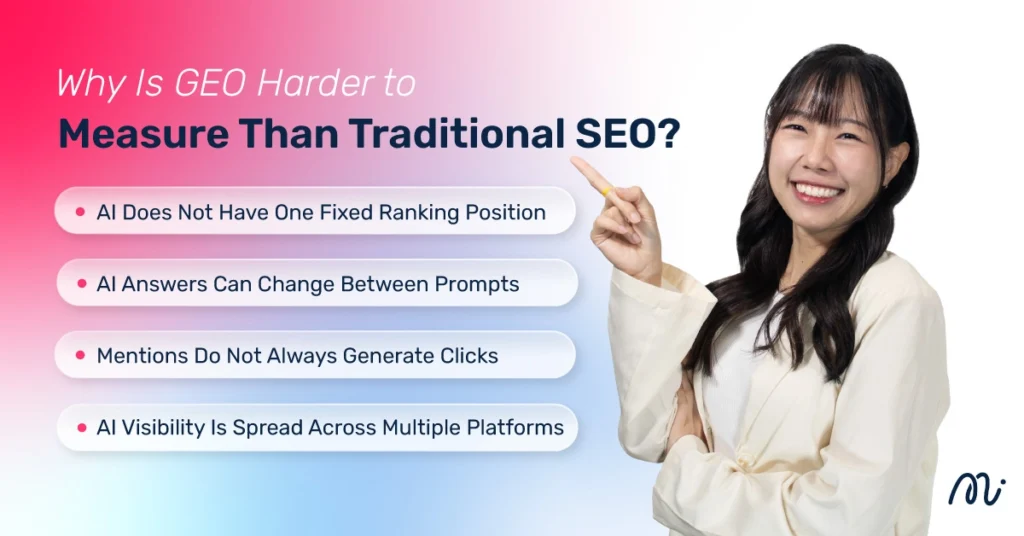
Why Is GEO Harder to Measure Than Traditional SEO?
AI Does Not Have One Fixed Ranking Position
Traditional SEO offers clear position metrics, such as “Keyword A ranks at position 3.” In GEO, there is no universal position 1 through 10 on a static search results page. Instead, performance is probabilistic. Measurement often shifts from fixed positions to visibility percentages, such as “The brand appeared in 42% of tested AI responses.”
AI Answers Can Change Between Prompts
AI outputs are highly dynamic. Asking the same core question can yield entirely different sources and brand mentions based on subtle factors:
- Slight changes in phrasing or word order
- Differences in user context or testing time
- Variations across platforms and AI models
Google notes that AI Overviews and AI Mode utilize different underlying models and techniques. Display links update dynamically, often leveraging query fan-out—a process where the system searches multiple related sub-queries behind the scenes before generating a consolidated response.
Mentions Do Not Always Generate Clicks
In traditional search, high visibility typically correlates with web traffic. Generative engines, however, aim to answer prompts directly within the interface. An AI model may mention your brand, attribute your research, cite your URL, or recommend your product without the user ever clicking through to your website.
AI Visibility Is Spread Across Multiple Platforms
Evaluating GEO performance requires expanding beyond a single search engine. Brand visibility is now distributed across multiple independent ecosystems:
Relying on data from a single platform provides an incomplete view of your true AI footprint.
GEO Metrics vs SEO Metrics: What Should You Measure?
To effectively measure Generative Engine Optimization, you must understand how its KPIs differ from traditional search marketing. The table below compares the metrics used in both approaches:
| Focus Area | Traditional SEO Metrics | Generative Engine Optimization (GEO) Metrics |
| Visibility | Keyword Ranking (Positions 1-10) | Appearance Rate (% of prompts where your brand appears) |
| Brand Authority | Domain Rating & Backlink Profile | Unlinked Brand Mentions & AI Output Sentiment |
| User Acquisition | Organic Clicks & Click-Through Rate (CTR) | Citation Clicks & AI Referral Traffic |
| Search Demand | Search Volume & SERP Impressions | Prompt Context & Query Variations |
| Success Marker | Organic Conversions | AI-driven Conversions & Brand Search Uplift |
When adapting your measurement strategy, do not look for a single “GEO metric” to replace Organic Traffic. AI search introduces a completely different user journey, which operates through a multi-step funnel:
- Exposure: Is the AI model aware of your data and entities?
- Mention: Does the AI explicitly name your brand in its generated text?
- Citation: Does the AI provide a clickable reference link to your website?
- Referral: Does the user actually click that link to visit your site?
- Conversion: Does the AI-referred visitor complete a desired business goal?
Each step of this funnel answers a different business question. For instance, high mentions without citations indicate strong brand awareness but low direct traffic potential. Conversely, a high citation rate requires tracking referral quality to see if those clicks turn into actual conversions. Measuring GEO effectively means evaluating the entire AI interaction cycle, not just the final click.
Best Tools for Tracking GEO and AI Search Visibility
There is no single “best” tool for tracking Generative Engine Optimization. The right choice depends entirely on your specific use case, budget, and the platforms you need to monitor. Here is a breakdown of the leading solutions based on what they do best.
1. Google Search Console
Best for: Google AI Overviews and AI Mode visibility
As Google’s first-party data source, Google Search Console remains essential for understanding how your site performs within Google’s ecosystem. It is ideal for tracking:
- Generative AI impressions: How often your content triggers an AI response.
- URL visibility: Which specific pages are being cited.
- Country trends: Geographic variations in AI search triggers.
- Device trends: How AI visibility differs across mobile and desktop.
2. Google Analytics 4
Best for: AI referral traffic and conversion measurement
While Search Console tracks impressions, Google Analytics 4 (GA4) measures what happens after the click. When AI platforms pass identifiable referrer data, GA4 helps you analyze:
- Sessions and Engagement: How long AI-referred users stay on your site.
- Leads and Revenue: The financial impact of generative search traffic.
- Conversion tracking: Measuring whether AI traffic actually completes your business goals.
3. Ahrefs Brand Radar
Best for: AI visibility and competitor benchmarking
Ahrefs has introduced Brand Radar specifically to monitor generative engines. It tracks performance across multiple AI search platforms, allowing marketers to measure:
- Brand visibility and Citations: How often your brand is mentioned and linked.
- AI Share of Voice: Your presence compared to the total market conversation.
- Competitor visibility: How often rivals are recommended instead of you.
- Custom Prompts: Tracking specific user queries relevant to your niche.
4. Semrush AI Visibility Toolkit
Best for: Brand and competitor AI visibility
Semrush offers a dedicated toolkit designed to analyze how often and in what context your brand appears within AI-generated answers. It is particularly useful for side-by-side competitor comparisons, helping you understand which brands the AI favors for specific industry queries.
5. Peec AI
Best for: Dedicated GEO monitoring
Peec AI is a specialized platform built explicitly for tracking brand performance across major generative engines like ChatGPT, Gemini, and Perplexity. It provides deep insights into competitive visibility and sentiment analysis specifically tailored for AI chatbot outputs.
Do You Need a Paid GEO Tool?
If your company is just starting to explore GEO, a combination of Google Search Console, GA4, and manual prompt tracking is often enough to gauge initial performance.
However, you should consider investing in a dedicated paid AI visibility platform if you need to manage:
- A large volume of target prompts
- Campaigns across multiple markets and languages
- Fierce competition with several key rivals
- Automated monthly client reporting at scale
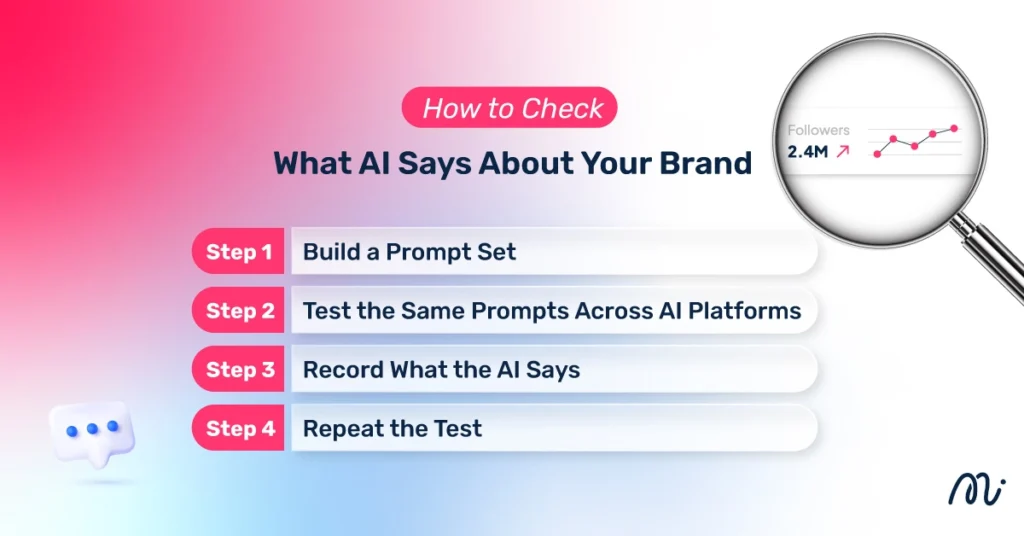
How to Check What AI Says About Your Brand
Step 1 — Build a Prompt Set
Develop a structured list of queries that your target audience is likely to ask generative engines. Categorize these prompts to cover different stages of the user journey:
- Informational Prompts: “Which companies offer [service]?”
- Recommendation Prompts: “What are the best [product/service] options for [audience]?”
- Comparison Prompts: “Compare [category A] and [category B].”
- Problem-Solution Prompts: “What is the best way to solve [customer problems]?”
Step 2 — Test the Same Prompts Across AI Platforms
Run your prompt set across the major generative engines to see how your brand is positioned.
- ChatGPT Search: Capable of browsing the web and displaying direct links to web sources within its answers.
- Perplexity: Built around a research-first model, providing explicit citations and inline links to original sources.
- Gemini: Displays related sources and links within its responses when it pulls information directly from web sources.
Step 3 — Record What the AI Says
Set up a tracking spreadsheet to systematically analyze the outputs. Include the following columns to ensure comprehensive data collection:
- Prompt: The exact query used.
- Platform: The engine tested (e.g., Gemini, Perplexity).
- Brand Mentioned: Was your brand explicitly named?
- Competitors: Which rival brands were recommended?
- Citation: Was there a clickable link to your website?
- Sentiment: Was the brand framed positively, negatively, or neutrally?
- Accuracy: Was the AI’s information about your brand factually correct?
- Date: The exact date of the test.
Step 4 — Repeat the Test
Do not rely on a single test to draw conclusions. According to 2026 GEO research, generative systems exhibit significant run-to-run variability. To accurately measure AI visibility, you must conduct repeated measurements.
Track and record the following variations over time:
- The original prompt
- Paraphrased versions of the prompt
- Multiple runs of the exact same query
- The date and time of the test
- The specific platform and the exact model or search mode used (if known)
How to Set GEO Goals You Can Actually Report to Clients
Avoid Goals Like “Rank #1 on ChatGPT”
Promising a client that they will “rank #1” on an AI platform sets everyone up for failure. Unlike Google Classic Search, generative engines do not have a stable SERP (Search Engine Results Page) position. Because AI outputs are probabilistic and change based on user context, phrasing, and the model’s current dataset, a static top ranking simply does not exist.
Set GEO Goals in Three Levels
Level 1 — Visibility
This level measures whether the AI knows who you are and considers your brand relevant to the conversation.
- Example Goal: Increase AI Mention Rate from 15% to 25% across 100 priority prompts within 6 months.
- Key Metrics: Mention Rate, AI Share of Voice, Prompt Coverage.
Level 2 — Authority
Visibility is great, but authority proves the AI trusts your content enough to use it as a reference point for users.
- Example Goal: Increase the percentage of tracked prompts citing [Brand Name] sources from 8% to 15%.
- Key Metrics: Citation Rate, Citation Share, Cited URLs.
Level 3 — Business Impact
Ultimately, GEO must drive tangible business outcomes, measuring what happens when users transition from the AI chat interface to your website.
- Example Goal: Increase qualified sessions and conversions from identifiable AI referral sources quarter over quarter.
- Key Metrics: Referral Sessions, Engagement, Lead Generation, Conversion Rate, Revenue.
Summary
Traditional SEO hasn’t vanished, but the measurement layer has evolved. The legacy funnel of Ranking | Click | Conversion has expanded into Visibility | Mention | Citation | Referral | Conversion. A comprehensive 2026 GEO report goes far beyond asking “Are we appearing in ChatGPT?” Instead, executing proven GEO strategies means answering where your brand is visible, what AI says about you, which sources influence those answers, and how that visibility drives actual business growth.
Ready to elevate your brand for the age of AI search? As a leading generative engine optimization agency, Minimice Group provides specialized SEO and AI SEO services, combining technical optimization, high-impact content, and authority building to maximize your presence across traditional search engines and generative AI platforms.
Contact Minimice Group to build a future-proof search strategy today.
FAQ
Is AEO different from GEO?
AEO (Answer Engine Optimization) focuses on optimizing content for direct answer engines like voice search. In contrast, GEO (Generative Engine Optimization) targets visibility within dynamic, AI-generated responses from large language models like ChatGPT, Gemini, and Google AI Overviews.
What is the difference between an AI mention and an AI citation?
An AI mention occurs when a generative model simply includes your brand name within its generated text. An AI citation goes a step further by providing a clickable hyperlink to your website, allowing users to visit your page directly.
What are the top 5 SEO strategies?
The top 5 strategies include optimizing Technical SEO for crawlability, producing high-quality helpful content, aligning with user Search Intent, building authoritative backlinks, and structuring data with schema markup to help search engines deeply understand your website’s context.
What is AI visibility?
AI visibility measures how often and how prominently your brand, products, or content appear within the responses generated by AI search engines. It indicates your brand’s overall presence across platforms like Google AI Mode, ChatGPT, and Perplexity.
What is AI Share of Voice?
AI Share of Voice (SOV) calculates your brand’s visibility in AI-generated answers compared to your competitors. It reveals how much of the relevant industry conversation your brand controls when users prompt AI engines about specific market categories.