


Key Takeaway
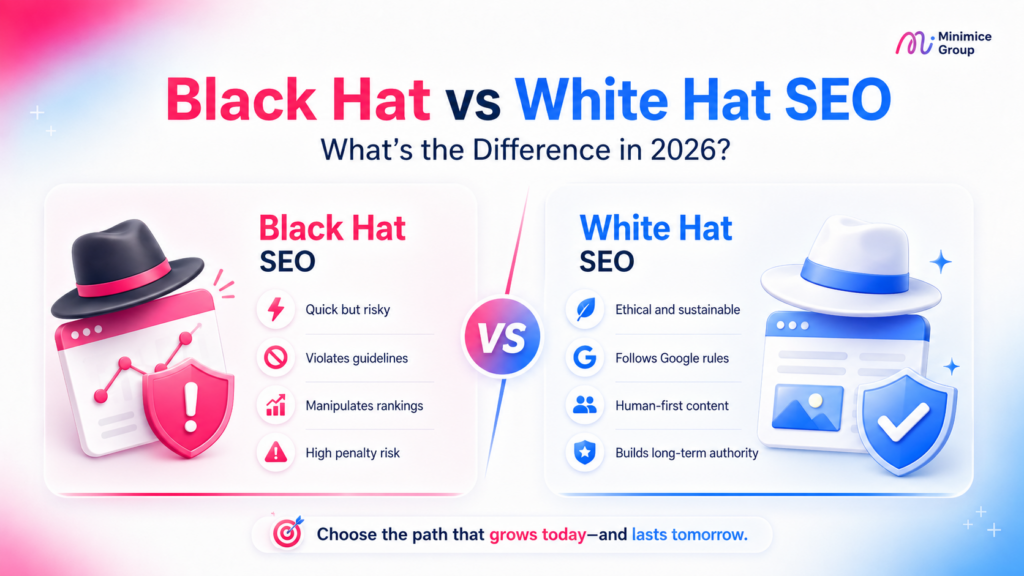
- Black Hat SEO uses risky shortcuts and violates guidelines for quick rankings. This approach relies on manipulating algorithms but often leads to severe penalties or permanent de-indexing in today’s advanced search environment.
- White Hat SEO focuses on ethical, human-centric strategies like high-quality content and technical health. It follows Google’s rules to build sustainable authority and trust, ensuring long-term growth and algorithm resilience.
- Black Hat provides immediate visibility but is volatile and unsustainable. White Hat offers brand security and evergreen traffic, though it demands a greater investment of time, effort, and resources to succeed.
- White Hat is the superior choice for any serious business. The best strategy for 2026 integrates these ethical foundations with AI-driven AEO (Answer Engine Optimization) to capture both traditional and AI-driven search results.
The search landscape in 2026 has become a high-stakes arena where the choice between speed and stability defines your brand’s future. Marketers often find themselves at a crossroads, questioning which path leads to the summit of the SERPs.
Black Hat vs White Hat SEO: Black Hat uses risky shortcuts, while White Hat focuses on ethical, sustainable strategies for long-term results. In an era where algorithms are more perceptive than ever, selecting the right approach is no longer just a tactical move—it is a survival necessity. Let’s dive into the core differences to determine which strategy will power your growth this year.
What Is Black Hat SEO?
Black Hat SEO is the “outlaw” side of search engine marketing, where the focus shifts from serving users to exploiting the system.
- Definition of Black Hat SEO: These are aggressive tactics that violate search engine guidelines and terms of service. The primary goal is to manipulate algorithm vulnerabilities to achieve rapid, unearned rankings rather than providing actual value to a human audience.
- Common Black Hat Techniques: According to Google’s spam policies, several methods are strictly forbidden:
- Keyword Stuffing: Forcing irrelevant keywords into content until it becomes unreadable for the sake of “relevance.”
- Cloaking: Showing one version of a page to search engine bots while delivering a completely different experience to users.
- Spam Backlinks: Using automated tools or link farms to inflate your backlink profile with thousands of low-quality, toxic links.
- Hidden Text: Placing keywords in the same color as the background to hide them from users while hoping search bots still count them.
- Risks of Using Black Hat SEO:
- Google Penalties: In 2026, AI-driven filters are incredibly precise; once detected, your site will face a manual action or algorithmic penalty.
- Ranking Wipeout: You could lose your visibility overnight, with your pages plummeting to the deep ends of the SERPs where no one will find them.
- Domain De-indexing: The ultimate risk is being permanently banned from Google’s index, rendering your website—and your brand—invisible to the world.
What Is White Hat SEO?
White Hat SEO is the practice of optimizing your website according to search engine guidelines. It prioritizes the human audience over algorithms, ensuring that every click provides real value.
- Definition of White Hat SEO: This approach focuses on ethical tactics that align with Google’s Search Essentials. By putting the user experience first and following the rules, you build a site that earns its rank through merit rather than trickery.
- Key White Hat Strategies:
- Content Quality: Developing deep, original, and helpful content that satisfies user intent and demonstrates E-E-A-T (Experience, Expertise, Authoritativeness, and Trustworthiness).
- On-page SEO: Crafting descriptive meta tags, clear heading structures, and intuitive internal linking to help users find what they need.
- Technical SEO: Ensuring fast loading speeds, mobile responsiveness, and secure connections (HTTPS) to provide a smooth browsing experience.
- Natural Backlinks: Earning mentions from high-authority sites because your content is genuinely link-worthy, rather than participating in link schemes.
- Benefits of White Hat SEO:
- Total Safety: You can sleep soundly knowing your site is immune to manual penalties and major algorithm shifts.
- Sustainability: Unlike “quick wins,” White Hat results are long-lasting, providing a stable foundation for your organic traffic to grow year after year.
- Brand Authority: Following ethical practices builds genuine trust with your audience, positioning your brand as a reliable leader in your niche.
Black Hat vs White Hat SEO | Key Differences
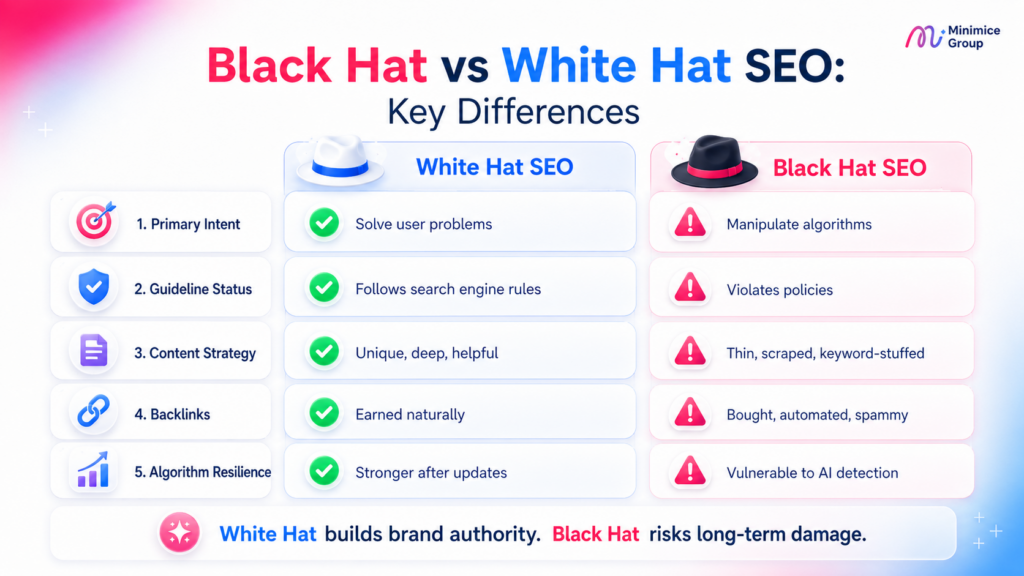
To help you decide which path aligns with your business goals, here is a direct comparison of how these two strategies operate in the 2026 landscape:
| Feature | White Hat SEO | Black Hat SEO |
|---|---|---|
| Primary Intent | Solve problems for the human user | Manipulate the search algorithm |
| Guideline Status | Strictly follows search engine rules | Intentionally violates policies |
| Content Strategy | Unique, deep, and helpful | Scraped, thin, or keyword-stuffed |
| Backlink Profile | Earned through quality and PR | Purchased or generated via bots |
| Algorithm Resilience | Gains strength with updates | Highly vulnerable to AI detection |
| Brand Reputation | Builds long-term authority & trust | Risks permanent damage to name |
Short-Term vs. Long-Term Results
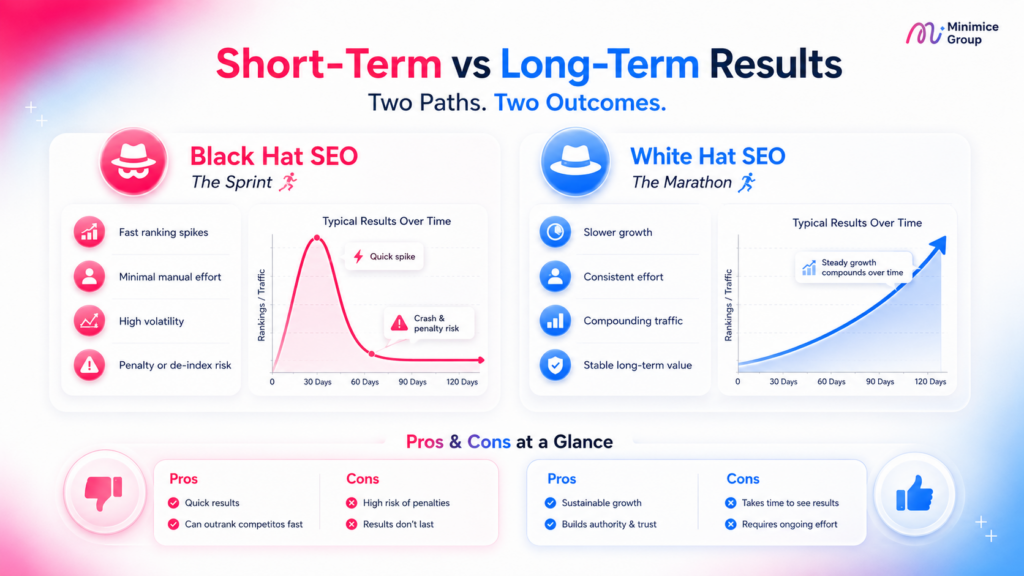
The real divide between these two methods lies in the timeline of success.
- Black Hat SEO (The Sprint): This approach often delivers fast, dramatic spikes in rankings. It is designed for instant gratification, but these gains are almost always temporary. In the 2026 era of hyper-perceptive AI, the window between “winning” and “getting banned” has narrowed to almost zero.
- White Hat SEO (The Marathon): This is a slow-burn strategy that requires patience and consistent effort. While you won’t see an overnight explosion in traffic, the results are compounded and sustainable. It creates a legacy for your website, ensuring that as you grow, your foundation remains unshakeable regardless of how many algorithm updates Google rolls out.
Pros and Cons of Black Hat and White Hat SEO
Understanding the strengths and weaknesses of each approach allows you to make an informed decision that aligns with your brand’s risk tolerance and growth goals.
Black Hat SEO
- Advantages of Black Hat SEO
- Rapid Results: These tactics can propel a site to the top of the SERPs in a matter of days, offering immediate visibility for short-term campaigns.
- Minimal Time Investment: Since it relies on automation and loopholes, it requires less manual effort in content creation and genuine networking.
- Disadvantages of Black Hat SEO
- Extreme Risk of Banning: Search engines are now highly efficient at detecting manipulation; once caught, your entire domain faces a permanent ban.
- Lack of Sustainability: The gains are fragile and typically disappear the moment an algorithm update occurs, leading to volatile and unpredictable traffic.
White Hat SEO
- Advantages of White Hat SEO
- Building Real Authority: Consistent quality signals tell search engines your brand is a leader, resulting in high trust scores and a stronger competitive edge.
- Long-Term Sustainability: Because it follows the rules, the traffic you earn is evergreen and cumulative, providing a reliable foundation for years to come.
- Disadvantages of White Hat SEO
- Significant Time Requirement: Achieving a top rank through ethical means is a slow-burn process that often takes months of consistent effort before seeing a return.
- Substantial Investment: Producing top-tier content and managing technical health requires heavy resource allocation, including skilled creators and SEO specialists.
Which SEO Strategy Is Best?
In the sophisticated search landscape of 2026, the choice is no longer just about “cheating vs. following rules”—it is about building a resilient brand.
- When Should You Use White Hat SEO?
White Hat SEO should be your default strategy if you intend for your business to exist beyond the next month. For established brands and startups alike, this approach builds a stable stream of organic traffic. Because search engines now prioritize Brand Authority, playing by the rules ensures your site remains a trusted destination that survives every major algorithm shake-up.
- Is Black Hat SEO Ever Worth It?
In very specific, disposable scenarios—such as a “burner” site for a flash event or a high-risk experimental project—some might find Black Hat tactics useful for a quick burst of visibility. However, for any serious business, it is never worth the trade-off. The cost of losing your entire digital footprint overnight far outweighs the temporary thrill of a fast ranking.
- Best Approach for 2026: The Hybrid Mindset
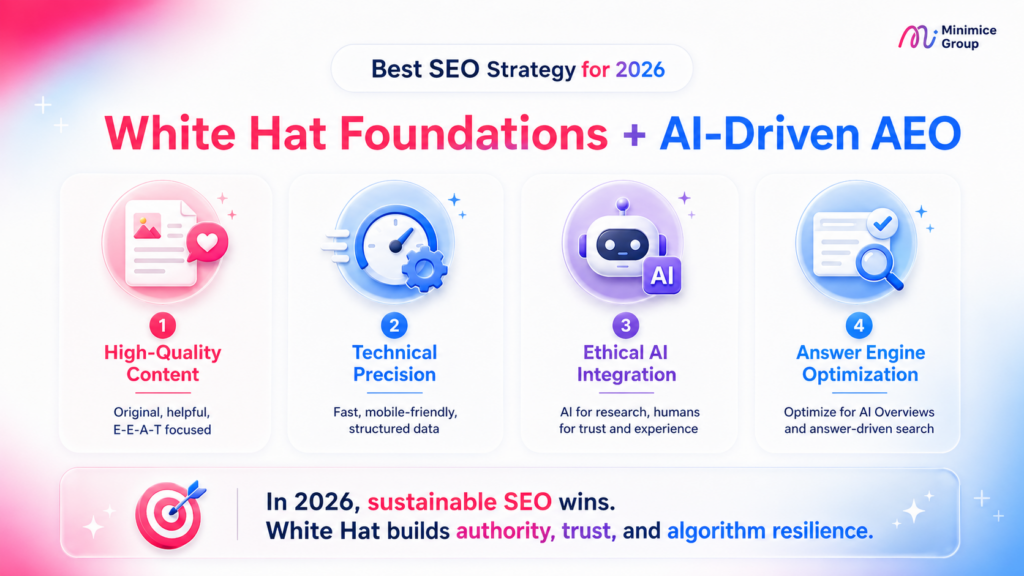
The winners in the current landscape don’t just follow the old rules; they innovate within them. The Best Approach for 2026 is a combination of White Hat foundations and AI-driven efficiency:
- Strategic AEO (Answer Engine Optimization): Beyond just ranking for keywords, you must optimize for AI Overviews to become the “featured answer” in AI-driven search results.
- Ethical AI Integration: Use AI for deep research and data analysis, but maintain strict human editorial oversight to ensure the “Experience” and “Trust” that AI cannot replicate on its own.
- Technical Precision: Focus on Structured Data and ultra-fast loading times to make your site perfectly readable for both human users and AI crawlers.
SEO Trends in 2026: Why White Hat Matters More
In the current landscape, the “cat and mouse” game between spammers and search engines has effectively ended, with AI-driven algorithms holding the clear advantage.
Google Algorithm Updates
Google’s core algorithms in 2026 have reached a level of near-perfect detection for manipulative tactics. Relying on Black Hat methods is no longer a “hack”; it is a fast track to digital invisibility.
- Neural Pattern Recognition: Google now utilizes advanced Spam Policies powered by deep learning to identify unnatural link footprints and automated content patterns with 99% accuracy.
- Dynamic Ranking Adjustments: The era of waiting for “big updates” is over. Rankings are now adjusted in real-time based on continuous quality signals, meaning a Black Hat shortcut can lead to a site-wide penalty within hours.
- The E-E-A-T Threshold: Search engines have raised the bar for Experience, Expertise, Authoritativeness, and Trustworthiness. Only White Hat strategies can cultivate the genuine digital reputation needed to pass these rigorous AI checks.
AI and Search Evolution
The transition from traditional Search Engines to Answer Engines has completely redefined how value is measured. As users increasingly rely on AI Overviews, the integrity of your content determines whether you are the “source” or “excluded.”
- The Dominance of AEO: To be featured in AI-driven Answer Engine Optimization (AEO) results, your content must be structured and factual. AI models are trained to ignore “thin” or manipulative content, making White Hat clarity your greatest asset.
- Citing Verified Sources: Modern AI search tools like Gemini and SearchGPT prioritize verified, ethical sources. If your domain has a history of Black Hat violations, you will be filtered out of the “Answer Box,” losing access to the most valuable real estate on the web.
- Predictive Search Intent: 2026 search engines focus on User Satisfaction metrics. Because White Hat SEO focuses on the human experience, it naturally aligns with the AI’s goal of providing the most helpful and safe answer possible.
Conclusion
In the high-stakes search environment of 2026, the divide between temporary tricks and enduring authority is absolute. White Hat SEO stands as the only safe and viable choice for businesses that aim for genuine, sustainable growth rather than a fleeting spike followed by a permanent ban.
By prioritizing ethical content, technical integrity, and user-centric value, you build a digital asset that actually gains strength with every AI algorithm update. In a world where shortcuts lead to digital extinction, investing in quality is the most strategic move you can make for your brand’s future.
Looking to secure your brand’s future at the top of the search results? Minimice Group specializes in data-driven White Hat SEO and AEO strategies designed to build long-term authority and drive high-quality traffic. Let our experts craft a sustainable growth roadmap that keeps your business thriving and safe from the risks of ever-changing algorithms.
FAQ
What does a Grey Hat mean?
Grey Hat SEO is the middle ground, using tactics that technically don’t violate guidelines but push the boundaries of what is considered ethical. It carries a moderate risk, as techniques like purchasing “high-quality” niche links may work today but could be flagged by AI-driven algorithms tomorrow.
Does White Hat SEO actually work for high-competition niches?
Yes, and it is arguably the only way to win in the long run. While high-competition niches are crowded, White Hat builds genuine authority and E-E-A-T that AI search engines prioritize over the temporary and volatile ranking spikes common with Black Hat shortcuts.
Can a website be successful using only 100% White Hat techniques?
Absolutely. In 2026, 100% White Hat is the safest and most profitable strategy because it ensures your site is “algorithm-proof.” While the initial growth is slower, the traffic is more loyal, higher-converting, and immune to the sudden wipeouts that affect manipulative sites.
Will Google permanently ban my domain if I get caught using Black Hat SEO?
It is a very real possibility. For severe or repeated violations, Google can de-index your domain, making your website invisible to searchers. Once a domain is permanently banned, recovering your brand’s digital presence often requires starting over entirely with a new domain.
Is AI-generated content considered White Hat or Black Hat now?
It depends on the quality and intent. It is considered White Hat if the content is helpful, accurate, and adds unique value for the user. However, it shifts into Black Hat territory if used to mass-produce “thin” or misleading content solely to manipulate search rankings.