


In the fast-paced digital landscape of Manila, business owners often fall into a common trap: The “Boost Post” Button.
It is designed to be addictive. You see a post performing well, Facebook suggests reaching 10,000 more people for just 500 PHP, and you click “Boost.” You get likes, hearts, and a few comments. It feels like success.
But here is the hard truth: If those likes aren’t turning into cash in the bank, you aren’t investing; you are donating to Mark Zuckerberg.
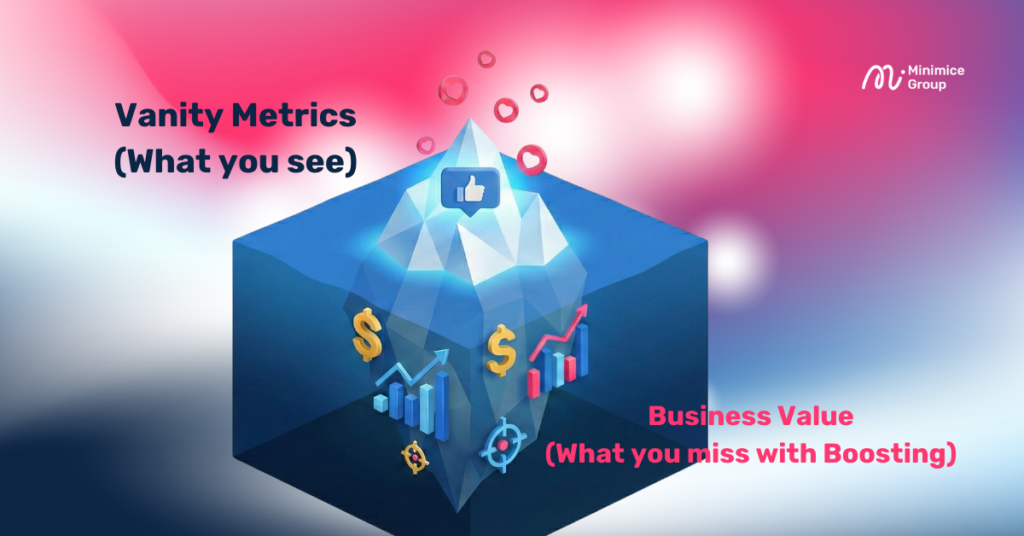
As a Strategic Digital Consultant, I analyze data from hundreds of Philippine businesses. The pattern is clear: Companies relying on “Boosting” see high engagement but low revenue. Companies using Meta Ads Manager see lower vanity metrics but significantly higher Return on Ad Spend (ROAS).
The Strategic Comparison Matrix
Why is there such a huge performance gap? It comes down to Control and Intent.
| Feature | Boost Post Button (The Trap) | Meta Ads Manager (The Pro Tool) |
| Primary Goal | Engagement (Likes, Shares, Comments) | Business Results (Leads, Sales, Installs) |
| Targeting | Basic (Age, Gender, Interest) | Advanced (Lookalikes, Custom Audiences, Retargeting) |
| Ad Placements | Limited (Newsfeed & Instagram Feed) | Full Ecosystem (Stories, Reels, Audience Network, Messenger) |
| Creative Strategy | Single Post (One Image/Video) | Dynamic Creative (A/B Testing 10+ variations automatically) |
| Tracking | Basic Clicks | Deep Data (Server-Side API, Offline Conversions, ROAS) |
| Objective | “Get people to see this” | “Get people to buy this” |
Deep Dive: 3 Ways “Boosting” Burns Your Budget
A. The “Vanity Metric” Illusion
The algorithm behind the Boost button has one job: fulfill your request cheaply. If you ask for “Engagement,” it shows your ad to users who are habitual likers—people who double-tap everything but rarely buy anything.
- The Loss: You pay for eyeballs that have zero purchase intent.
- The Ads Manager Fix: We use “Sales” or “Leads” objectives. The algorithm ignores the “likers” and hunts for the “buyers”—users with a history of online purchasing.
B. The Lack of Retargeting (The Leaky Bucket)
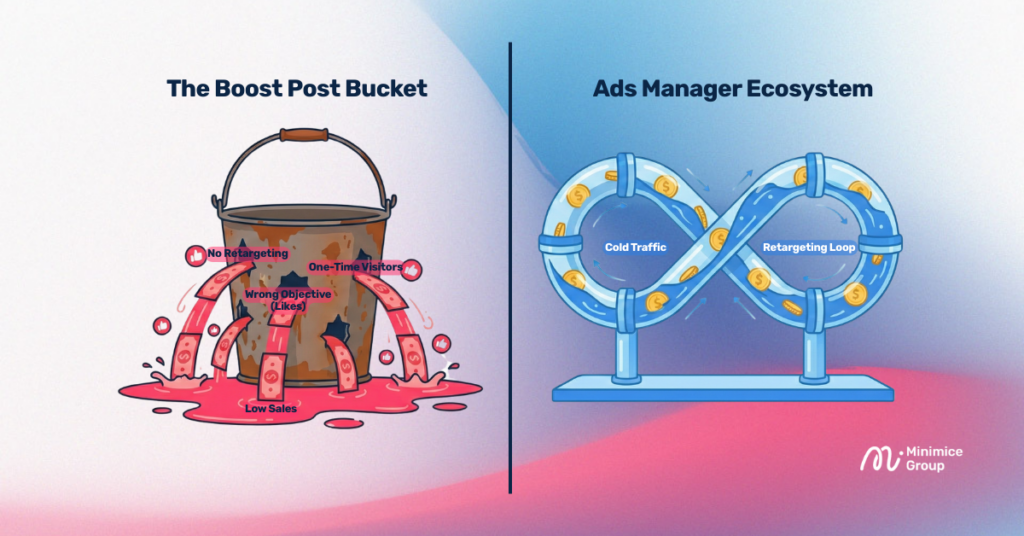
97% of people don’t buy on their first visit. Boosting a post targets cold audiences over and over again. You are constantly paying to introduce yourself to strangers.
- The Loss: You lose everyone who clicked but didn’t buy immediately.
- The Ads Manager Fix: With Ads Manager, Minimice creates Retargeting Layers. We show specific “Follow-up” ads (e.g., testimonials or discount codes) only to people who visited your website or added to cart but didn’t checkout. This is where the profit is made.
C. Creative Limitations
When you boost a post, you are betting your budget on one image and one headline. If that creativity doesn’t resonate, your money is gone.
- The Loss: You have no way of knowing if a different headline would have doubled your sales.
- The Ads Manager Fix: We use Dynamic Creative Testing (DCT). We upload 5 images, 3 headlines, and 2 primary texts. Meta’s AI mixes and matches them to find the perfect winning combination for each user, lowering your Cost Per Acquisition (CPA).
Strategic Recommendation: Pivot to Professional Management
If your marketing strategy relies on the “Boost” button, you are operating with a SME mindset in a corporate battlefield.
Why Partner with Minimice Group?
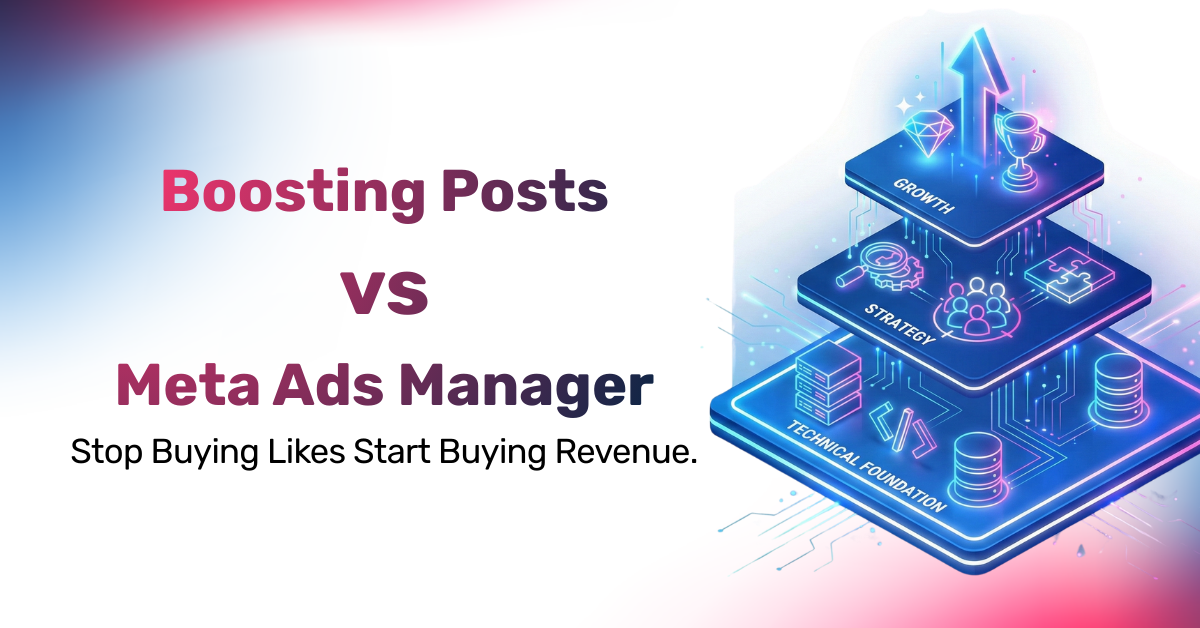
Transitioning to Meta Ads Manager is complex. It requires technical setup (Pixel, CAPI), creative variety, and daily optimization.
Minimice Group acts as your Performance Architect:
- Technical Foundation: We don’t just run ads; we set up the tracking infrastructure so you know exactly which Peso generated which Sale.
- Adaptive Strategy: We don’t “set and forget.” If a creative fatigues (stops working), we kill it and launch a new one instantly.
- Audience Engineering: We build “Lookalike Audiences” based on your best customers (High LTV), not just random interests.
The Trade-off: Hiring an agency costs more than a 500 PHP boost. But the cost of wasted ad spend on the Boost button over a year is far higher than the fee of a professional partner who actually drives revenue.
FAQs
Does social media activity really impact Google rankings?
Social media is not a direct ranking factor, but it creates a positive feedback loop. High engagement on social platforms drives traffic and brand mentions, which signals to Google that your content is valuable and increases the likelihood of earning natural backlinks.
How long does it take for Google to index a new page in 2026?
The minimum daily spend can be similar, but the Cost Per Result is usually lower with Ads Manager. You might pay more per 1,000 impressions (CPM), but because you are targeting high-intent buyers, your Cost Per Sale (CPS) drops.
3. Can Minimice help if I don’t have a website?
Yes. In the Philippines, “Messenger Marketing” is huge. We use Ads Manager to run “Click-to-Messenger” campaigns with automated chat flows that qualify leads before you even speak to them—something a basic Boost cannot do effectively.
4. Can I target my competitors’ followers with Ads Manager?
Directly? No. Strategically? Yes. We can target “Interests” related to your competitors and use “intersect” layering to find people who are in the market for your specific product category, effectively capturing their audience.
5. What is the “Learning Phase” in Ads Manager?
Unlike Boosting which just spends money immediately, Ads Manager has a “Learning Phase” (usually 50 conversions/week). It needs data to optimize. Minimice manages this delicate phase to ensure your campaign exits learning and becomes a stable revenue generator.
Would you like me to audit your last 3 “Boosted Posts” to calculate how much budget was potentially wasted on non-converting traffic?
FAQ: Expert Insights on Meta Ads in Manila
1. Why is localized targeting in Metro Manila critical for Meta Ads?
Manila is a fragmented market. A user in BGC (Bonifacio Global City) has a significantly different purchasing power and lifestyle than a user in a provincial area. By using geo-fencing and localized ad copy (Taglish vs. English), agencies like Minimice Group can increase relevance scores and reduce CPA.
- Better ROI through district-specific targeting.
- Reduced ad waste on non-serviceable areas.
- Higher conversion rates through cultural alignment.