
Key Takeaway
- Paid media strategy is more than just running ads—it connects business goals, audience targeting, channels, budgets, creatives, and measurement. Success comes from aligning these elements to turn ad spend into real business results and revenue.
- In 2026, Paid Media is more AI-driven, data-focused, and privacy-conscious than ever. Success depends on leveraging first-party data and optimizing the entire customer journey—not just driving quick sales.
- A strong Paid media strategy starts with clear business goals, , the right channels, and compelling creatives—supported by continuous testing and optimization to drive better results.
The digital landscape doesn’t hit pause, and by 2026, standard ad tactics just won’t cut through the noise. Navigating fragmented audiences and privacy-first algorithms requires more than a healthy budget—it demands tactical agility.
Whether scaling a startup or optimizing enterprise spend, mastering the modern advertising ecosystem is non-negotiable. Learn what Paid media strategy is, key ad types, 2026 trends, beginner terms, and how to start building a smarter paid media plan. Let’s dive into the blueprint that will redefine your ROI this year.
What Is Paid Media?
Think of Paid Media as renting a megaphone to get your brand noticed instantly through social ads or search results. While Owned Media is stuff you fully control (like your website) and Earned Media is free buzz (like word-of-mouth), paid media gives you immediate visibility.
In 2026, relying purely on organic traffic is a tough game, making paid ads your shortcut to bypass tight algorithm shifts and hyper-target your ideal audience. It remains your fastest ticket to scale your reach and drive predictable growth without waiting around for people to magically discover you.
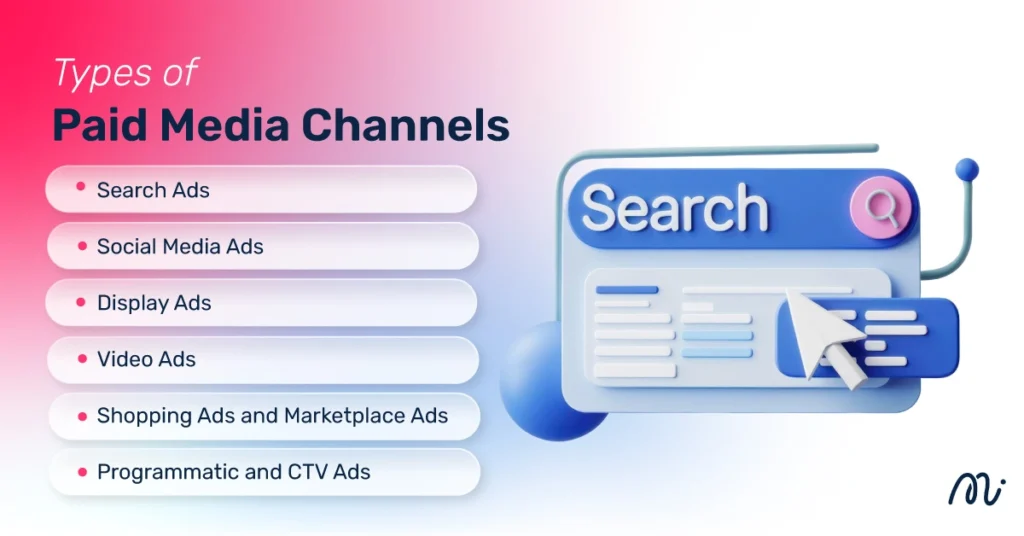
Types of Paid Media Channels
Think of paid media channels as different neighborhoods in a massive digital city. You don’t need to live in all of them, but you do need to know where your crowd hangs out. Let’s look at the coolest spots to drop your ads and grab some serious attention.
1. Search Ads
When people want answers, they head straight to Google or Bing. Search ads grab users at the exact moment they are looking for a solution, whether they are comparing prices, reading reviews, or hunting for a specific service. Because these users already have high buying intent, it is a highly effective tool for lead generation, service-based businesses, and e-commerce brands. If you want to intercept hot prospects typing in high-intent keywords, this channel is your best friend.
2. Social Media Ads
This is where your brand gets to show off its personality. Running ads on Meta, TikTok, or LinkedIn lets you use scroll-stopping visuals and video to catch people while they hang out online. Social ads work incredibly well for building brand awareness, boosting engagement, and driving quick conversions. It is a goldmine for lifestyle brands, beauty, fashion, and apps, but with the right targeting, even B2B campaigns can land huge wins here.
3. Display Ads
Ever noticed a visual banner ad following you around while reading your favorite blog or using an app? That is a display ad doing its job. While they might not always get immediate clicks, display ads are fantastic for keeping your brand top-of-mind. They work best for building broad brand awareness and launching retargeting campaigns to gently remind past visitors to come back and finish their purchase before they forget about you.
4. Video Ads
People love watching videos, making YouTube, TikTok, and Instagram Reels absolute powerhouses for advertisers. Video ads allow you to tell a compelling story, build trust instantly, and explain complex products in just a few seconds. Instead of reading a long page of text, your audience gets to see your product in action. It is highly engaging and one of the best formats to connect emotionally with your target audience.
5. Shopping Ads and Marketplace Ads
If you run an e-commerce store, this channel is a game-changer. Whether it is Google Shopping or marketplace platforms like Shopee and Lazada, these ads put your product image, price, and promos right in front of active shoppers. Because users see exactly what they are getting before they even click, it cuts out the guesswork. It is the most direct way to drive sales and boost retail media performance today.
6. Programmatic and CTV Ads
Think of programmatic ads as your automated smart-buyer, using AI to bid on the best ad spaces across the web instantly. Pair that with Connected TV (CTV) ads on streaming platforms, and you are now reaching people right on their big living room screens. This combo is perfect for brands wanting to expand their reach fast and build lasting brand recognition without manually negotiating with hundreds of individual websites or TV networks.
Who Is Paid Media Best For?
- Businesses That Want Faster Visibility:
If you just launched a new brand, dropped a fresh product, or introduced a new service, waiting for organic SEO takes too long. Paid media gets you in front of your audience instantly, making it perfect for building rapid brand awareness and securing a top spot on the digital map.
- Brands That Need Leads or Sales:
Whether you are hunting for form sign-ups, consultation bookings, app installs, or straight-up online store purchases, paid ads act as a direct pipeline. It helps you target users who are ready to take action, making it ideal for driving consistent leads and direct revenue.
- Companies That Want to Test New Markets:
Thinking about launching in a new region or trying a different marketing angle? Paid media lets you test the waters without a massive upfront commitment. You can quickly run small budget tests to see which audiences, product features, or ad messages get the best response.
- Teams That Already Have a Website or Landing Page:
Driving traffic is only half the battle; you need a solid place for people to land. Paid media works wonders when paired with a fast-loading webpage and a frictionless conversion path. A clean destination ensures your ad budget actually turns clicks into customers.
What Is Paid Media Strategy?
A paid media strategy is your ultimate game plan for spending your ad budget without any guesswork. It connects the dots between your business goals, target audience, ad creatives, and performance tracking so you aren’t just burning cash. Instead of hoping for the best, you map out exactly which channels to use and how to measure your success.
Look at this paid media strategy example: a fitness brand runs short TikTok video ads targeted at busy professionals to drive sign-ups for a free app trial. It is all about putting the right message in front of the right eyes at the perfect time.
What Will Paid Media Strategy Look Like in 2026?
- AI and Automation Will Become Core to Campaign Management:
AI handles the heavy lifting like audience expansion, bidding, and campaign optimization. However, human marketers remain the brains of the operation. Your job shifts to steering the overarching strategy, creative direction, and brand messaging that algorithms just can’t replicate.
- First-Party Data Will Be More Important:
With privacy rules tightening, your owned data is pure gold. Leveraging your CRM, email lists, and website behavior is essential for accurate targeting. Collecting this data directly ensures you can still reach the right audience without relying on third-party cookies.
- Creative Testing Will Drive Performance:
Since ad platforms rely on automation, your ad creative is your ultimate weapon. The algorithm needs a constant variety of assets to learn what works. Success means constantly testing different hooks, visuals, and video formats to let the system find the winning combos.
- Full-Funnel Strategy Will Be More Practical:
Chasing the final sale right away is a quick way to run out of audiences. A smart approach maps out the entire customer journey. You need a balanced mix of ads that handle awareness, consideration, conversion, and customer retention to keep your pipeline full.
- Measurement Will Move Beyond Last Click:
Judging success based solely on the final click gives you a flawed picture. Instead, look at the big picture by tracking assisted conversions and the full customer journey. Focus on holistic metrics like ROAS, CPA, and Lifetime Value (LTV) to see the true impact of your spend.
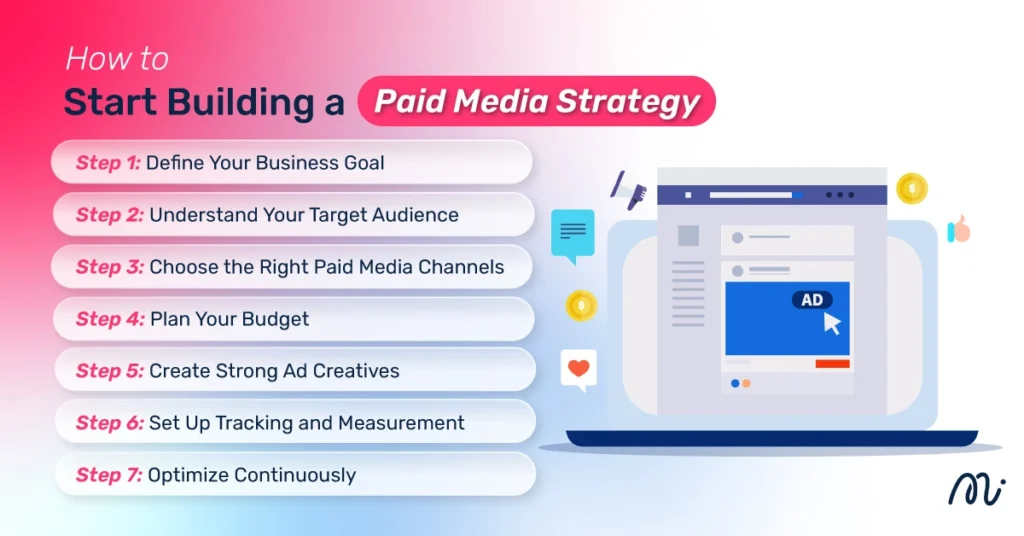
How to Start Building a Paid Media Strategy
Ready to launch your own campaigns? Building a paid media strategy doesn’t have to be overwhelming. Think of it as mapping out a road trip—you just need to know where you’re going and how to get there. Let’s break down the step-by-step blueprint to get your ads up, running, and winning.
Step 1: Define Your Business Goal
You can’t hit a target you can’t see. Start by locking in your main objective, whether it’s increasing brand awareness, generating fresh leads, driving online sales, boosting app installs, promoting a new product, or growing website traffic. Your goal dictates your entire setup, so pick one clear focus to guide your campaign.
Step 2: Understand Your Target Audience
To make your ads click, you need to know exactly who is on the other side of the screen. Figure out who your ideal customers are, what pain points keep them up at night, which platforms they hang out on, and how they make buying decisions. Speaking their native language makes your budget go much further.
Step 3: Choose the Right Paid Media Channels
You don’t need to be everywhere; just be where it matters. Pick channels that align with your goals: Google Search for capturing active demand, Meta Ads for awareness and conversions, TikTok Ads for video-first content, LinkedIn Ads for B2B networking, YouTube Ads for storytelling, and Marketplace Ads for direct e-commerce sales.
Step 4: Plan Your Budget
Avoid throwing all your cash into one bucket. Smart advertisers divide their budget across the funnel, allocating specific amounts for awareness, consideration, conversion, and retargeting. Crucially, always leave a flexible buffer for continuous testing so you can double down on what actually works without running out of funds.
Step 5: Create Strong Ad Creatives
Your creativity is what stops the scroll. Don’t rely on just one image; mix it up with diverse formats. Build an asset library featuring static graphics, short-form videos, authentic UGC-style content, customer testimonials, product demos, and side-by-side comparison creatives to give the platform algorithms plenty of variations to test.
Step 6: Set Up Tracking and Measurement
Flying blind is the easiest way to waste money. Before launching anything, ensure your tracking toolkit is locked down. Set up tools like GA4, ad pixels, Conversion APIs, UTM tags, CRM integration, and event tracking to know exactly which ad, keyword, or creative is generating actual revenue for your business.
Step 7: Optimize Continuously
Paid media is never a “set it and forget it” project. Once your ads are live, the real work begins. Review your dashboard regularly to tweak your targeting, refresh your ad copy, swap out tired creatives, shift budgets toward winning campaigns, and test new ideas to keep your performance climbing.
Basic Paid Media Terms for Beginners
- Conversion: This is the ultimate action you want users to take, like buying a product, filling out a form, adding your brand on Line, or downloading an app.
- CPC (Cost Per Click): The specific amount of money you pay every time a user clicks on your ad. It tells you exactly how much it costs to drive traffic to your page.
- PPC (Pay Per Click): An advertising model where you only pay when someone actually clicks your ad, rather than paying just to display it on a screen.
- CPM (Cost Per Mille): The cost you pay for every 1,000 times your ad is shown. This is the standard metric used when your main focus is building broad brand awareness.
- CPA (Cost Per Acquisition): The total ad spend required to secure a single conversion, such as one new lead, a booking, or a completed customer order.
- ROAS (Return on Ad Spend): A metric measuring the revenue generated for every dollar spent on ads. It is a must-use metric for e-commerce brands to track profitability.
- CTR (Click-Through Rate): The percentage of people who saw your ad and chose to click it. A higher rate means your creativity is successfully capturing attention.
- UGC (User-Generated Content): Authentic content created by real users instead of the brand, like unboxing videos, product reviews, or customer photos. It helps build instant trust.
- Retargeting: The process of serving ads to people who previously interacted with you, like visiting your website or abandoning a shopping cart, to bring them back to finish the purchase.
- Lookalike Audience: A clever targeting feature that finds new users who share similar characteristics and behaviors with your existing customers, making your audience expansion much smarter.
- Impression: The total number of times your ad appears on a user’s screen, giving you a clear view of how many times your content was potentially seen.
- Frequency: The average number of times a single person sees your ad. Keeping an eye on this prevents annoying your audience with the same content over and over.
- Ad Fatigue: This happens when your audience sees your ad too many times, causing performance to drop and costs to rise because people simply get bored of your creativity.
- A/B Testing (Split Testing): Running two slightly different versions of an ad at the same time to see which headline, visual, or call-to-action performs better based on real data.
- Landing Page: The specific web page a user lands on after clicking your ad, optimized solely to get them to take one specific action.
- Tracking Pixel: A tiny piece of code placed on your website that monitors visitor behavior and reports it back to ad platforms for sharper targeting.
- CAC (Customer Acquisition Cost): The total business cost required to win a single new customer, combining your ad spend with all marketing resources used to close the deal.
- Quality Score: A rating given by search engines to measure the relevance and usefulness of your ad and landing page, directly affecting how much you pay per click.
- Conversion Rate (CR): The percentage of people who click your ad and actually complete your desired action. It shows how good your landing page is at turning visitors into customers.
- Hook: The first 3 seconds of your video or text designed to grab attention and stop users from scrolling past. A killer hook can completely change your campaign’s success rate.
Conclusion
Mastering your Paid Media Strategy 2026 is all about blending smart AI automation with killer creative testing and solid first-party data. Relying on organic reach isn’t enough anymore; you need a well-planned funnel across search, social, and video channels to capture attention fast. By understanding your audience, defining clear goals, and setting up bulletproof tracking, you easily turn clicks into customers. Don’t let your ad budget go to waste by guessing. Stay flexible, optimize your assets constantly, and let real-time data guide every dollar to scale your business growth.
If building all of this sounds like a lot to handle, Minimice Group has your back. They specialize in turning complex ad setups into profitable engines. From crafting data-driven paid media plans and managing high-converting paid ads to handling SEO and creative production, their team takes the guesswork out of digital growth. Ready to scale without the headache? Let them optimize your campaigns while you focus on running your business.
FAQ
What are common mistakes to avoid in paid media strategy?
The biggest traps are flying blind without proper conversion tracking and trying to target everyone instead of a specific niche. Burning your entire budget on a single, unoptimized creative without running active A/B tests will also drain your wallet with zero returns.
What is the difference between PPC and paid media?
Think of paid media as the big umbrella covering every single type of advertising you pay for, including display banners, sponsorships, and video spots. PPC (Pay-Per-Click) is just one specific pricing model under that umbrella where you only pay when a user actually clicks your ad.
What is the difference between CPC and CPA?
CPC (Cost Per Click) measures the price of curiosity, showing exactly what you pay when a user clicks on your ad. On the flip side, CPA (Cost Per Acquisition) measures the price of commitment, calculating the total ad spend needed to get someone to complete a final action, like a purchase or sign-up.
Is paid media suitable for small businesses?
Absolutely, because you don’t need a massive budget to get in the game. Paid media allows small brands to compete with industry giants instantly by targeting highly specific local audiences and scaling up your spend only when you see profitable returns.
Is paid media better than organic marketing?
Neither is superior; they are actually teammates. Paid media buys you immediate speed, traffic, and scale, while organic marketing builds long-term brand equity, trust, and free recurring visitors. Combining both gives you the ultimate growth engine.
What is the role of AI in paid media strategy 2026?
In 2026, AI serves as your ultimate data-crunching co-pilot, automating real-time bidding, audience expansion, and creative asset mixing. This shifts the human marketer’s role away from manual tweaks and entirely into high-level strategy, emotional messaging, and brand direction.