




Key Takeaway
- An SEM agency provides specialized support for paid search campaigns, helping businesses with strategy, campaign setup, conversion tracking, reporting, and continuous improvement.
- Key evaluation factors include the agency’s Google Ads experience, process for understanding your business, reporting practices, fee structure, and communication style.
- A suitable SEM partner should prioritize your business goals, offer transparent recommendations, and rely on campaign data to drive optimization decisions.
Choosing the right SEM agency in Manila requires a careful review of their strategy, Google Ads expertise, reporting, pricing, and transparency. While launching paid search campaigns seems straightforward, generating sustainable returns involves complex elements like audience targeting, bidding, and conversion tracking.
For businesses lacking a dedicated media team, an experienced agency provides technical support to navigate these search engine marketing complexities. Rather than judging partners purely on low fees or unrealistic performance guarantees, you must evaluate their actual optimization processes. Let’s explore why hiring an agency is the right move and the 15 critical factors to consider before deciding.
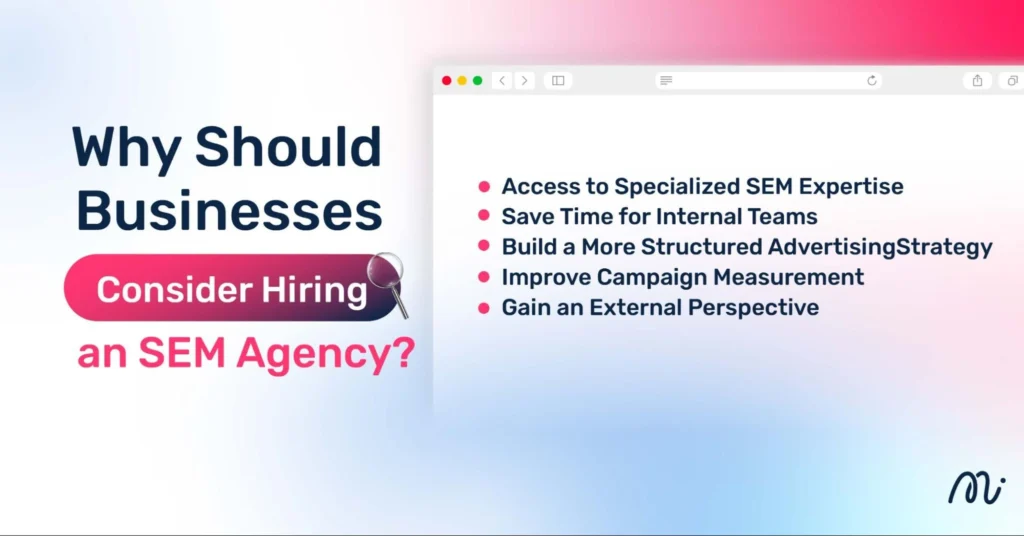
Why Should Businesses Consider Hiring an SEM Agency?
Choosing to work with an agency doesn’t necessarily mean an in-house team is less capable. Instead, it’s about recognizing when a business needs additional expertise, resources, or strategic support to maximize the potential of its advertising budget.
Access to Specialized SEM Expertise
- Cross-Industry Knowledge: Agencies managing SEM google campaigns handle multiple accounts, giving them unique insights into shifting consumer behaviors and successful industry benchmarks.
- Platform Updates: They stay updated on the latest Google Ads features, automation tools, and advertising policies updates, ensuring your account utilizes the most efficient tech stack.
- Problem Solving: An experienced team quickly diagnoses and fixes common ad issues, such as ad disapprovals, sudden drop-offs in traffic, or spiking costs per click (CPC).
Save Time for Internal Teams
- Eliminate Daily Maintenance: Paid ads require constant monitoring. An agency absorbs daily tasks like bid adjustments, negative keyword updates, and budget checks.
- Focus on Strategy: Outsourcing execution allows your internal marketing team to focus on high-level brand strategy, product development, and overall business growth.
- Consistent Momentum: Campaigns receive undivided attention, preventing performance degradation caused by internal team members juggling too many responsibilities.
Build a More Structured Advertising Strategy
- Funnel Alignment: A specialized ads agency maps your ad structures to the customer journey, balancing high-intent search ads with mid-funnel remarketing efforts.
- Strategic Resource Allocation: They ensure your budget is distributed logically between brand protection campaigns, generic product terms, and high-margin services.
- Scalable Frameworks: Professional setups allow your account to handle seasonal budget increases or expansion into new geographic regions without breaking existing data models.
Improve Campaign Measurement
- Advanced Tracking Architectures: Agencies possess the technical skills to build solid tracking infrastructures using Google Tag Manager (GTM) and Google Analytics 4 (GA4).
- Attribution Clarity: They help clarify which touchpoints actually drive value, ensuring you don’t overspend on keywords that only drive superficial clicks.
- Data Cleanliness: Regular audits of your data layers ensure that spam conversions, duplicate transactions, or broken pixels do not corrupt your bidding algorithms.
Gain an External Perspective
- Unbiased Audits: An outside team looks at your historical data without internal political bias, identifying wasted ad spend and overlooked growth opportunities.
- Competitor Intelligence: Agencies utilize premium paid tools to analyze competitor ad copy, keyword targeting strategies, and estimated monthly spends.
- Fresh Creative Concepts: They bring creative insights from other verticals, adapting successful strategies to give your brand a unique competitive edge.
15 Things to Know Before Hiring an SEM Agency in Manila
Choosing the right agency should go beyond reviewing a portfolio or comparing prices. It is crucial to evaluate whether the agency’s working process aligns with your goals, business model, and organizational expectations. Here are 15 factors to consider:
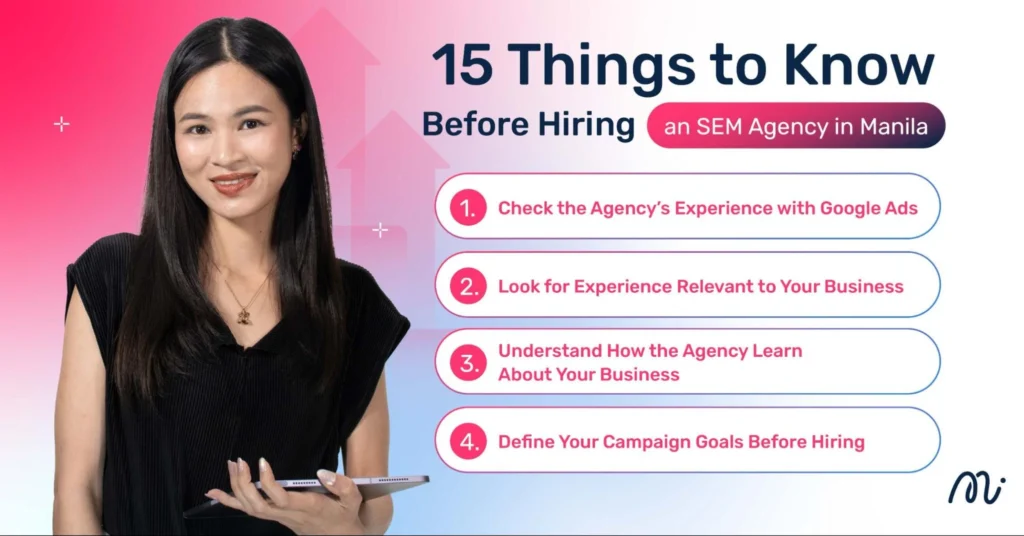
1. Check the Agency’s Experience with Google Ads
- Campaign Type Mastery: Ensure the team has hands-on experience running the specific ad formats your business needs, such as Search, Performance Max (PMax), Display, Shopping, or YouTube Ads.
- Strategic Allocation: Ask how they balance automated asset groups with manual controls to ensure machine learning tools don’t waste your budget.
- Platform Certifications: Confirm that the actual account managers handling your budget hold active Google Ads Certifications across relevant disciplines.
2. Look for Experience Relevant to Your Business
- Target Audience Familiarity: An agency with relevant industry experience understands your target customer’s search habits, pain points, and buying cycles.
- Adaptability Over History: While industry familiarity is a plus, a robust onboarding and research framework is often more valuable than niche experience alone.
- Competitive Awareness: Experienced agencies already know the major players in your space, saving time during the initial onboarding and market analysis phases.
3. Understand How the Agency Learns About Your Business
- Comprehensive Onboarding: Reliable partners conduct discovery workshops to understand your unique selling propositions (USPs), margins, and customer lifetime value (LTV).
- Sales Pipeline Integration: They map their ad strategy to your actual sales process, recognizing how leads move from a click to a closed deal.
- Red Flag Identification: Avoid agencies that present a generic, pre-packaged campaign plan before asking detailed questions about your business operations.
4. Define Your Campaign Goals Before Hiring
- Clear Business Objectives: Define exactly what success looks like—whether it is qualified B2B lead generation, e-commerce sales, or high-volume phone inquiries.
- Metric Alignment: Different objectives dictate different campaign setups; for instance, lead generation prioritizes Cost Per Acquisition (CPA), while e-commerce focuses on Return on Ad Spend (ROAS).
- Strategic Translation: The agency must be able to convert your broad commercial goals into specific, trackable Key Performance Indicators (KPIs) within the ad platform.
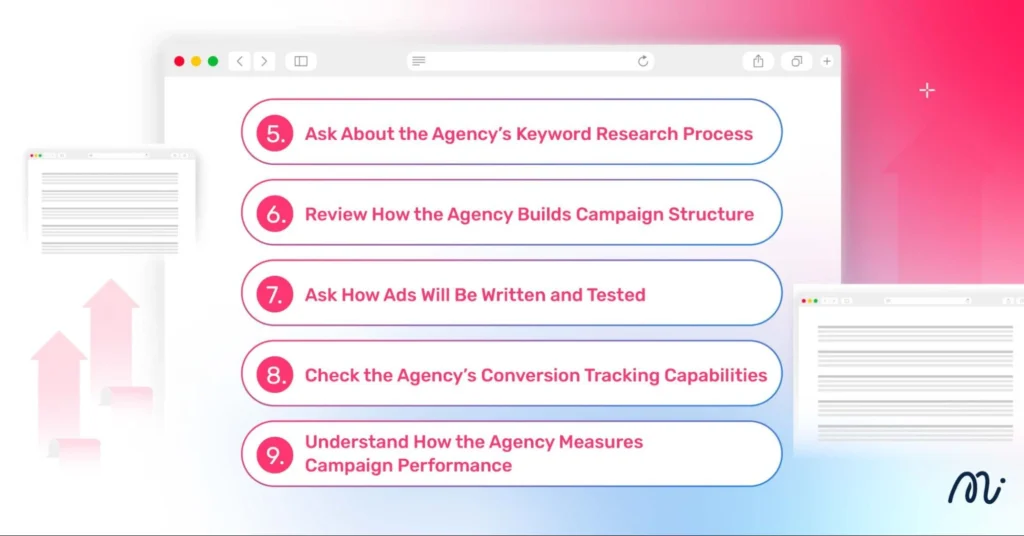
5. Ask About the Agency’s Keyword Research Process
- Intent Prioritization: For effective SEM google campaigns, they should focus heavily on commercial and transactional intent rather than chasing high-volume, generic keywords that drain budgets.
- Proactive Negative Management: Ask how they build and maintain negative keyword lists to prevent your ads from appearing on irrelevant queries.
- Cost-Per-Click Forecasting: The agency must provide realistic estimates of keyword costs in Manila’s landscape to ensure your budget is sufficient to compete.
6. Review How the Agency Builds Campaign Structure
- Logical Account Architecture: A clean layout (e.g., separating campaigns by product category, intent level, or geography) makes data analysis much easier.
- Algorithm-Friendly Setup: They should structure accounts to feed Google’s Smart Bidding algorithms sufficient data conversion volume to function properly.
- Customization vs. Templates: Ensure their structural approach is customized to your budget limits and product variations rather than copied from a standard template.
7. Ask How Ads Will Be Written and Tested
- Ad Copy Relevance: Ad messaging must align perfectly with the user’s search query while highlighting your brand’s specific benefits and clear Calls to Action (CTAs).
- Landing Page Cohesion: The agency should ensure the ad copy matches the destination landing page layout and messaging to maintain high Google Quality Scores.
- A/B Testing Frameworks: Inquire about their system for testing headlines and descriptions to continuously improve your Click-Through Rates (CTR).
8. Check the Agency’s Conversion Tracking Capabilities
- End-to-End Tracking: Confirm they can implement tracking for all critical user actions, including form completions, e-commerce checkouts, and click-to-call buttons.
- Advanced Integrations: Ensure they understand how to configure Enhanced Conversions and server-side tracking to combat modern data privacy limitations.
- Data Integrity Checks: The agency must regularly validate that conversion actions match your actual internal CRM data or backend sales logs.
9. Understand How the Agency Measures Campaign Performance
- Business Metric Focus: Look for a partner that focuses on bottom-line business metrics like Conversion Value and Cost Per Lead (CPL) rather than vanity metrics like impressions.
- Contextual Data Analysis: They should explain why metrics fluctuate based on market changes, seasonal trends, or competitor bidding movements.
- Attribution Modeling Strategy: Ensure they know how to utilize data-driven attribution to evaluate how different keyword categories assist in the final conversion.
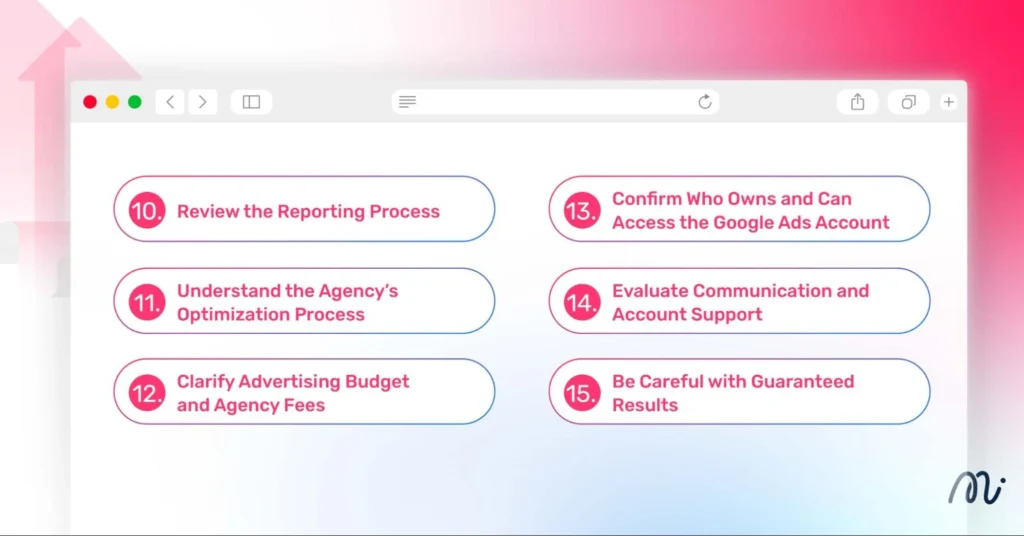
10. Review the Reporting Process
- Actionable Insights: Reports must go beyond standard data exports, providing a written analysis of what the data means and what optimizations will be made next.
- Transparent Data Access: You should receive access to a live, real-time dashboard (such as Google Data Studio) so you can monitor key metrics at any time.
- Strategic Review Meetings: Confirm the frequency of live syncs to review monthly performance, discuss budget adjustments, and realign on business changes.
11. Understand the Agency’s Optimization Process
- Data-Driven Cadence: Optimizations should occur based on data thresholds rather than random changes that push campaigns back into the algorithmic learning phase.
- Holistic Routine Tasks: Their routine process must include search term audits, device performance adjustments, ad scheduling updates, and audience refinements.
- Landing Page Optimization: A good partner reviews and provides recommendations on your landing page’s conversion rate optimization (CRO) and mobile speed.
12. Clarify Advertising Budget and Agency Fees
- Cost Separation: Maintain total transparency by separating your direct ad spend (paid directly to Google) from the agency’s management fee.
- Fee Structure Clarity: Understand exactly how they charge—whether it is a flat monthly retainer, a percentage of ad spend, or a performance-based fee model.
- Scope of Deliverables: Confirm precisely what is included in the fee, checking for hidden charges regarding landing page creation, asset design, or initial tracking setups.
13. Confirm Who Owns and Can Access the Google Ads Account
- Full Administrative Ownership: The Google Ads account and all historical data must remain under your business’s ultimate ownership from day one.
- Transparent Access Levels: Your internal team must retain read/write or administrative access to verify optimization changes and changes in the Change History log.
- Clean Exit Clauses: Ensure that if the contract ends, the account, tracking codes, and asset groups remain with your company without deletion or restrictions.
14. Evaluate Communication and Account Support
- Dedicated Contact Points: Identify exactly who will manage your account daily and who will handle strategic escalations when performance issues arise.
- Clear Service Level Agreements (SLAs): Confirm response times for normal campaign adjustments as well as protocols for urgent emergency situations.
- Jargon-Free Reporting: The team must be able to explain technical account problems in simple, business-oriented terms that your stakeholders understand.
15. Be Careful with Guaranteed Results
- Unrealistic Promises: Avoid agencies guaranteeing a permanent number-one ranking or fixed sales volumes, as ad auctions shift constantly based on external forces.
- Multi-Variable Dependencies: Performance relies heavily on external variables like competitor bidding surges, product pricing strategies, and macroeconomic demand.
- Risk Transparency: A professional agency outlines potential risks, budget limitations, and historical market baselines instead of offering empty guarantees.
Conclusion
Work with an SEM Agency That Understands Your Business Goals
Before choosing an SEM agency in Manila, take time to compare its experience, processes, tracking capabilities, communication style, and approach to campaign optimization. The right partner should provide clear recommendations and help your team understand how paid search supports broader business goals.
Choosing an SEM agency in Manila should involve more than comparing advertising fees. A suitable agency should take time to understand your goals, target customers, available data, and overall digital marketing strategy.
Minimice Group Manila provides Google Ads services designed around measurable business objectives. Our team supports businesses with campaign planning, keyword research, campaign setup, conversion measurement, ongoing optimization, and performance reporting. By connecting paid advertising with broader digital marketing, online marketing SEM, and SEO strategies, businesses can build a more coordinated approach to reaching customers across the entire search journey.
FAQ
Can SEM and SEO be used together?
Yes, they often work best together. SEM (paid search) can provide immediate visibility and traffic for targeted keywords, while SEO (organic search) builds long-term authority and sustainable traffic over time. Using both allows a business to dominate search engine results pages and capture customers at different stages of their journey.
What questions should I ask an SEM agency?
Focus on process, transparency, and experience. Important questions include asking about their experience with businesses similar to yours, how they structure their reporting, who owns the ad account, how they handle conversion tracking, and what their specific optimization process looks like after a campaign launches.
How much does an SEM agency in Manila charge?
Fees vary based on the service model. Agencies typically charge either a flat monthly management fee, a percentage of the total advertising spend or a hybrid model. The cost depends on the complexity of the campaigns, the amount of ad spend managed, and the level of strategic support required.
Should you hire an SEM agency or build an in-house team?
It depends on your business needs and resources. Building an in-house team gives you dedicated focus but requires time for hiring, training, and managing software costs. Hiring an agency provides immediate access to a team of specialized experts, diverse industry experience, and established tools, often at a lower cost than a full-time senior hire.
Can an SEM agency guarantee sales?
No professional agency can guarantee exact sales numbers. While a good agency can drive highly targeted traffic and optimize for conversions, actual sales depend on many factors outside their control, such as product pricing, market demand, website user experience, and the effectiveness of your internal sales team.