


Key Takeaway
- Automated Bidding is a broad Google Ads bidding approach where Google adjusts bids based on campaign goals.
- Smart Bidding is a type of Automated Bidding focused on conversions or conversion value using Google AI.
- The best bidding strategy depends on your goal, conversion data, budget, and how much control your team needs.
Running Google Ads successfully involves more than just choosing the right keywords or writing compelling ad copy. One of the most important factors behind campaign performance is your bidding strategy—the method Google uses to determine how much to bid in each auction.
Many businesses often confuse Smart Bidding with Automated Bidding because both rely on Google’s automation. However, while they may sound similar, they differ in how they work, what goals they optimize for, and when they should be used.
In this guide, we’ll break down Smart Bidding vs Automated Bidding, explain their key differences, compare their pros and cons, and help you determine which strategy best fits your marketing objectives.
Smart Bidding And Automated Bidding: Why It Matters
Choosing the right b idding strategy does not only affect your advertising costs. It also has a direct impact on lead quality, conversion volume, and your ability to scale campaign performance over time.
If your bidding strategy does not match your business goals, your campaign may not use its budget efficiently. For example, you may receive a high volume of traffic but generate very few conversions. In another case, you may get conversions, but the cost per conversion may be higher than necessary.
Many businesses use the terms Smart Bidding and Automated Bidding interchangeably because both use Google’s AI and automation to adjust bids automatically. However, these two concepts are not exactly the same. They have different purposes, mechanisms, and best-use cases.
Before choosing a bidding strategy for Google Ads, it is important to understand the difference between Smart Bidding and Automated Bidding. This will help you select the right strategy based on your marketing goals, available data, and desired business outcomes.
What Is Automated Bidding?
If you are wondering what automated bidding is, the simple answer is this: Automated Bidding is a Google Ads feature that automatically adjusts your bids based on the campaign goal you set.
Instead of manually changing bids for keywords, devices, locations, or audiences, Google uses automation to help determine the best bid for each situation. This reduces the time spent on manual bid adjustments and allows campaigns to respond faster to changes in search behavior, competition, and auction conditions.
Automated Bidding is the broader category of bidding strategies in Google Ads. It includes several strategies designed for different objectives, such as increasing website visits, improving visibility, generating conversions, or maximizing conversion value.
Some marketers also call this auto bidding, especially when referring to automatic bid adjustments in a general way. However, in Google Ads, the more accurate term is automated bidding.
Common Types of Automated Bidding
Common types of Automated Bidding include:
- Maximize Clicks: Helps drive as many website visits as possible within your budget. It is commonly used when the main goal is to increase traffic to a website or landing page.
- Target Impression Share: Helps your ads appear in specific positions on the search results page. This strategy is useful when visibility, brand awareness, or search presence is the main objective.
- Maximize Conversions: Helps your campaign generate as many conversions as possible within your budget. It is often used for lead generation, sign-ups, calls, bookings, or purchase-focused campaigns.
- Maximize Conversion Value: Focuses on generating the highest total conversion value within your budget. This is especially useful for ecommerce businesses or companies where different conversions have different values.
- Target CPA: Helps advertisers get conversions at or near a target cost per action. This strategy is useful when your business has a clear target cost for each lead, sale, or valuable customer action.
- Target ROAS: Helps optimize bids based on revenue or conversion value. It is commonly used by ecommerce brands and revenue-focused businesses that want to achieve a specific return from their advertising budget.
What Is Smart Bidding?
If you are asking What is Smart Bidding, the answer is that Smart Bidding is a subset of Automated Bidding that uses Google’s machine learning and AI to optimize for conversions or conversion value.
While Automated Bidding can support several goals, Smart Bidding is specifically focused on performance outcomes. It helps advertisers improve lead volume, sales, revenue, or return on ad spend by adjusting bids based on real-time signals.
Smart Bidding uses Google’s AI to evaluate many factors before deciding how much to bid. These factors are called signals. They help Google understand how likely a user is to complete a valuable action, such as submitting a form, calling a business, or making a purchase.
Smart Bidding may use signals such as:
- User context: Device, location, browser, and time of day
- Audience behavior: User intent, remarketing signals, and past interactions
- Search context: Search query, competition level, and auction environment
- Conversion likelihood: The probability that a user will complete a valuable action
One important feature of Smart Bidding is auction-time bidding. In simple terms, auction-time bidding means Google evaluates each ad auction individually before setting the bid.
Instead of using one fixed bid for every situation, Google looks at the user’s context in that specific moment. For example, a user searching from a mobile device in Metro Manila during business hours may have a different likelihood of converting than someone searching from another location late at night.
Smart Bidding uses these real-time signals to make more informed bid decisions. This is why it can be powerful for businesses that already have reliable conversion tracking and enough data for Google’s system to learn from.
Common Types of Smart Bidding
Common Smart Bidding strategies include:
- Target CPA: Best for campaigns that want to control the average cost per lead or conversion. It is commonly used in lead generation campaigns where cost efficiency matters.
- Target ROAS: Best for ecommerce or revenue-focused campaigns that track conversion value. It helps advertisers aim for a specific return on ad spend.
- Maximize Conversions: Best for increasing lead volume, bookings, sign-ups, or purchases within the available campaign budget.
- Maximize Conversion Value: Best for businesses that want to prioritize high-value conversions instead of focusing only on the total number of conversions.
Smart Bidding vs. Automated Bidding in Google Ads: What’s the Difference?
Before choosing between Smart Bidding and Automated Bidding, it is helpful to compare them side by side. The main difference is that Automated Bidding is the broader system, while Smart Bidding is a more advanced category within Automated Bidding that focuses on conversion-based results.
Here is a simple comparison of Smart Bidding vs. Automated Bidding in Google Ads:
| Factor | Automated Bidding | Smart Bidding |
| Meaning | A broad group of bidding strategies that automatically adjust bids based on campaign goals. | A subset of Automated Bidding that uses Google’s AI and machine learning to optimize for conversions or conversion value. |
| Main Goal | Supports different goals, including clicks, visibility, conversions, and conversion value. | Focuses mainly on conversions, conversion value, CPA, or ROAS. |
| AI Usage | Uses automation to adjust bids, but not every strategy is focused on conversion-based machine learning. | Uses machine learning, real-time signals, and auction-time bidding to make more advanced bid decisions. |
| Best For | Businesses that want to save time, increase traffic, improve visibility, or simplify campaign management. | Businesses that want to improve lead quality, increase sales, optimize CPA, or scale revenue-focused campaigns. |
| Data Requirement | data, depending on the strategy used. | Works best when conversion tracking is accurate and the campaign has enough quality conversion data. |
Pros and Cons of Automated Bidding
Automated Bidding can be useful for many businesses, especially those that want to reduce manual work and allow Google Ads to adjust bids based on selected goals. However, like any strategy, it has both strengths and limitations.
Pros
Automated Bidding can help businesses because it:
- Saves time from manual bid adjustments
It reduces the need to manually adjust bids across keywords, devices, locations, and audiences. This is especially helpful for small marketing teams or business owners who do not have time to monitor campaigns every day. - Supports traffic and visibility goals
Automated Bidding works well when the goal is to increase website traffic or improve search visibility. For example, Maximize Clicks can help drive more visitors to your website, while Target Impression Share can support brand awareness. - Makes campaign management easier for small teams
For businesses with limited marketing resources, Automated Bidding can make Google Ads easier to manage. It simplifies bid management and helps campaigns react without requiring constant manual changes. - Helps campaigns react faster than manual bidding
Market conditions can change quickly. Automated Bidding allows campaigns to respond faster because the system can adjust bids based on campaign goals and available signals.
Cons
However, Automated Bidding also has limitations:
- Advertisers have less manual control
One of the biggest trade-offs of Automated Bidding is reduced manual control. Advertisers cannot always control every bid decision at a detailed level. - Campaigns may spend budget quickly if goals are unclear
If your campaign goals are not clearly defined, Automated Bidding may spend your budget without delivering meaningful results. For example, a campaign focused only on clicks may bring traffic that does not convert. - Performance still depends on proper campaign setup
Automated Bidding is not a magic solution. It still depends on the quality of your campaign structure, targeting, keywords, creative assets, and landing page experience. - It may not work well if tracking is incomplete
For conversion-focused strategies, incomplete tracking can lead to poor optimization. If Google Ads cannot properly measure leads, purchases, or other valuable actions, the system may not have enough reliable data to make strong bidding decisions.
Pros and Cons of Smart Bidding
Smart Bidding can be very powerful when used correctly. It is designed for advertisers who want to optimize for leads, sales, revenue, or return on ad spend. However, it also requires stronger data quality and a more strategic setup.
Pros
Smart Bidding can help businesses by:
- Optimizing toward conversions or revenue
Smart Bidding focuses on business outcomes, not just clicks or impressions. It can help campaigns optimize toward leads, purchases, revenue, or other valuable actions. - Using real-time auction signals
Smart Bidding evaluates real-time signals during each auction, such as device, location, time, browser, audience behavior, and other contextual factors. - Scaling campaigns with strong data
When your account has accurate conversion tracking and enough quality data, Smart Bidding can help scale performance more efficiently. - Supporting lead generation, ecommerce, and performance campaigns
Smart Bidding works well for campaigns where conversions matter most. It is often used by lead generation businesses, ecommerce brands, B2B companies, service providers, and performance-focused advertisers.
Cons
However, Smart Bidding may not be ideal if:
- Conversion tracking is inaccurate
Smart Bidding depends heavily on accurate conversion tracking. If your tracking setup is wrong, duplicated, missing, or measuring low-quality actions, Google may optimize toward the wrong signals. - The campaign does not have enough data
Smart Bidding works best with reliable conversion data. If a campaign has very few conversions or poor-quality leads, the system may struggle to optimize effectively. - The system is still in the learning period
Smart Bidding often needs time to learn. During the learning period, performance may fluctuate as Google’s system gathers data and adjusts to the campaign goal. - The business needs full manual control over bids
Smart Bidding can feel less transparent because Google’s system makes many bid decisions automatically. Advertisers may not see every individual factor behind each bid.
Who Should Use Automated Bidding?
Automated Bidding is a good option for businesses that want to simplify campaign management and support goals such as traffic, visibility, or early-stage campaign learning.
Automated Bidding may be a good fit for businesses that:
- Want to increase website traffic
- Want to improve brand awareness
- Are new to Google Ads
- Have limited conversion data
- Have a small marketing team
- Need a simpler way to manage bids
From a practical agency perspective, we often see businesses start with Automated Bidding when they are still building their campaign foundation. For example, a local service provider in the Philippines may first need to understand which keywords, locations, and audiences bring the most engaged users before shifting to a more conversion-focused strategy.
Automated Bidding can help at this stage because it allows the campaign to gather data while reducing the workload of manual bid management. However, it should still be monitored closely to ensure the budget is being used efficiently.
Who Should Use Smart Bidding?
Smart Bidding is better suited for businesses that are ready to focus on conversions, lead quality, sales, or revenue growth.
Smart Bidding may be a good fit for businesses that:
- Have accurate conversion tracking
- Generate consistent conversion data
- Want to increase leads or sales
- Want to optimize CPA or ROAS
- Need to scale performance campaigns
- Have clear and measurable conversion goals
For example, a B2B company that receives regular form submissions may use Target CPA to control lead costs. An ecommerce brand may use Target ROAS or Maximize Conversion Value to increase revenue from paid search.
Smart Bidding can be powerful, but it works best when the campaign has a strong foundation. This includes clean tracking, clear conversion goals, relevant keywords, strong ad copy, and landing pages that encourage users to take action.
Smart Bidding vs. Automated Bidding: Which One Should You Choose?
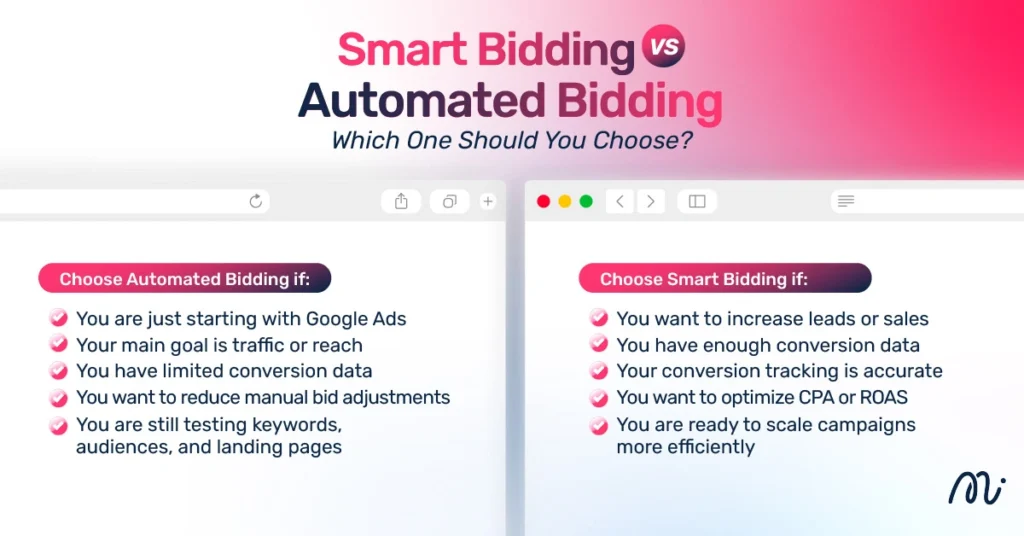
When comparing Smart Bidding vs. Automated Bidding, the right choice depends on where your business is in its Google Ads journey.
Choose Automated Bidding if:
- You are just starting with Google Ads
- Your main goal is traffic or reach
- You have limited conversion data
- You want to reduce manual bid adjustments
- You are still testing keywords, audiences, and landing pages
Choose Smart Bidding if:
- You want to increase leads or sales
- You have enough conversion data
- Your conversion tracking is accurate
- You want to optimize CPA or ROAS
- You are ready to scale campaigns more efficiently
There is no single best bidding strategy for every business. A strategy that works well for an ecommerce store may not be the best choice for a B2B service provider. A campaign built for brand awareness may need a different bidding strategy from a campaign built for lead generation.
The best approach is to match your bidding strategy with your business goal, campaign maturity, data quality, and available budget.
Real-World Examples of Using Bidding Strategies
To better understand how these strategies work in practice, let’s look at a few real-world examples.
Example 1: Automated Bidding for Brand Awareness
Imagine a premium lifestyle brand in the Philippines launching a new website. The goal is to introduce the brand to more potential customers and increase website visits.
At this stage, the business may not have enough conversion data yet. The main objective is visibility and traffic, not immediate sales. In this case, Automated Bidding strategies such as Maximize Clicks or Target Impression Share may be useful.
Maximize Clicks can help bring more users to the website, while Target Impression Share can help the brand appear more prominently for selected search terms. This approach can support early-stage awareness while the business gathers more data.
Example 2: Smart Bidding for Lead Generation
Now imagine a B2B company offering professional services in Metro Manila. The business wants to generate qualified leads through form submissions and phone calls.
If the campaign already has accurate conversion tracking and receives consistent leads, Smart Bidding may be a better option. A strategy like Target CPA can help the campaign aim for leads at a target cost.
This is useful when the business wants to control the cost per lead while increasing lead volume. However, the quality of conversion tracking matters. If the campaign tracks low-quality actions, Smart Bidding may optimize toward the wrong leads.
Example 3: Smart Bidding for Ecommerce
For an ecommerce business, not every conversion has the same value. A customer buying a high-value product is more valuable than someone buying a low-cost item.
In this case, Smart Bidding strategies such as Target ROAS or Maximize Conversion Value can help optimize toward revenue. Instead of only increasing the number of purchases, the campaign can focus on generating higher total conversion value.
This approach is useful for ecommerce brands that want to improve return on ad spend and scale revenue from Google Ads.

How Minimice Group Manila Helps Businesses Choose the Right Bidding Strategy
Choosing between smart bidding, automated bidding, and other Google Ads strategies can be challenging, especially when your business needs to balance traffic, lead quality, cost, and revenue.
This is where Minimice Group Manila can help.
As a full-service digital marketing agency with a strong focus on SEO, Minimice Group Manila helps businesses build strategies that go beyond short-term traffic. We look at your business goals, campaign structure, conversion data, website performance, and customer journey to recommend a bidding strategy that fits your market.
For businesses in the Philippines, local context matters. A strategy that works in one market may not always work the same way for Filipino audiences. That is why we focus on practical, data-informed strategies that help your business reach the right people, not just more people.
Our team can support your business with:
- SEO strategy
- Google Ads strategy
- Campaign optimization
- Keyword research
- Conversion tracking recommendations
- Landing page direction
- Performance analysis
Ready to see your business grow with smarter digital marketing? Let’s help you reach the right Filipino audience with SEO and Google Ads strategies that actually work. No fluff, just results.
Conclusion
Smart Bidding and Automated Bidding are both useful in Google Ads, but they are not the same. Automated Bidding is the broader category that includes several strategies for traffic, visibility, conversions, and conversion value. Smart Bidding is a more advanced part of Automated Bidding that uses Google’s AI and machine learning to optimize for conversions or revenue.
If your business is still building traffic and collecting data, Automated Bidding may be a practical starting point. If your goal is to increase leads, sales, CPA efficiency, or ROAS, Smart Bidding may be the better choice.
The right strategy depends on your goals, conversion tracking, data quality, and budget. Minimice Group helps businesses in the Philippines choose the right SEO and Google Ads strategy to reach the right audience and turn marketing activity into real business results.
FAQs
Does Smart Bidding need conversion tracking?
Yes. Smart Bidding works best when conversion tracking is properly set up and the campaign has reliable data.
Which bidding strategy is best for a new Google Ads campaign?
For new campaigns with limited data, Maximize Clicks or Maximize Conversions may be a practical starting point, depending on the campaign goal.
Can I switch from Automated Bidding to Smart Bidding later?
Yes. Many businesses start with broader Automated Bidding and move to Smart Bidding once they have enough conversion data.
Which is better for lead generation?
Smart Bidding is usually more suitable for lead generation because it focuses on conversions, not just clicks.