

Key Takeaway
- Reasons Why High Website Traffic Does Not Always Translate Into Property Leads: High traffic can come from people who are still researching rather than buyers who are ready to inquire. Effective real estate SEO should focus on qualified search intent, relevant landing pages, and a clear path toward inquiries and site viewings.
- Key Factors to Look for in the Best SEO Companies for Real Estate: Look beyond rankings and traffic. Strong SEO partners should understand buyer intent, location-based demand, Technical SEO, CRO, and how organic search contributes to qualified leads throughout the property funnel.
- How Minimice Group Manila Helps Improve Real Estate SEO Performance: The team takes a data-driven approach to SEO, connecting keyword opportunities, Local SEO, Technical SEO, AI SEO, and conversion performance to identify where search visibility can create stronger business opportunities.
For property developers, brokerage firms, and property managers in the Philippines, growing website traffic can look like a sign that SEO is working, but high traffic means little if it does not lead to qualified inquiries or site viewings. The real challenge is attracting high-intent buyers, connecting them with the right property or location pages, and guiding them toward conversion.
This is why choosing among the best SEO companies for real estate requires looking beyond rankings and traffic alone, and focusing instead on buyer intent, Local SEO, Technical SEO, conversion performance, and a strategy that supports the full property lead funnel.
The Problem: High Traffic, Zero Property Viewings
Imagine opening an SEO report and seeing positive numbers across the board. Organic sessions are up, impressions are growing, and several keywords have moved closer to the first page. Yet when the sales team checks property inquiries and scheduled site viewings, little has changed.
This is where traffic-focused reporting can become misleading.
Traffic is only the beginning of the acquisition funnel. Before deciding that an SEO strategy for real estate is working, property businesses need to understand who is arriving, what those visitors searched for, which pages they entered, and what they did after landing on the website.
A visitor reading an article about “property investment trends in the Philippines” may be valuable for awareness. However, that person is not necessarily as close to conversion as someone searching for a specific condominium type in BGC or looking for a property viewing in Makati.
The goal, therefore, should not simply be More Traffic = Better SEO. A more commercially useful framework is Qualified Traffic + Relevant Landing Page + Clear Conversion Path = More Valuable SEO.
More Traffic Does Not Always Mean More Qualified Buyers
Traffic volume and traffic quality are different metrics.
A real estate website can attract thousands of organic visitors through broad informational topics, such as neighborhood guides, investment advice, financing explainers, or market updates. These visitors can support brand visibility, but many may still be in the research stage.
High-intent searches behave differently. Queries related to a specific property type, project, location, price range, availability, or viewing request can indicate that the user is moving closer to a commercial decision.
For example, compare these searches:
- “best places to live in Metro Manila”
- “condos for sale in BGC”
- “2 bedroom condo for sale in BGC”
- “book condo viewing BGC”
All four can bring relevant users to a property website, but they represent very different levels of purchase readiness.
The Search Intent Gap Behind Dry Property Leads
Search intent helps explain why websites with healthy traffic sometimes struggle to generate sales opportunities.
At the awareness stage, a user may search for general information about a neighborhood. During consideration, that user may narrow the search to condominiums in a particular city. Later, the search may become specific enough to include property size, project name, pricing, or a request for a viewing.
A strong SEO strategy for real estate needs content for different stages without allowing informational traffic to dominate the entire strategy.
Research-oriented articles can introduce potential buyers to a brand. Internal links should then guide those visitors naturally toward relevant location pages, project pages, comparison pages, or property listings. High-intent searches should lead as directly as possible to pages capable of satisfying that intent.
Google’s people-first content guidance emphasizes creating content to help users, rather than producing pages solely to attract search engine visits. Useful content should leave visitors feeling that they have learned enough to move closer to their goal.
For real estate businesses, that principle means answering the question behind the search, then giving qualified prospects an obvious next step.
Generic Marketing vs. Specialized Real Estate SEO Strategy
Generic digital marketing and specialized real estate SEO can use many of the same channels and tools. The difference is not that one approach is inherently wrong. The difference is strategic focus.
Property marketing involves location-sensitive demand, longer consideration cycles, high-value transactions, and multiple interactions before conversion. SEO planning should account for those realities.
| Strategic Area | Generic Marketing Approach | Specialized Real Estate SEO Strategy |
| Primary Goal | Increase traffic and visibility | Generate qualified property demand |
| Keyword Strategy | Prioritize broad, high-volume keywords | Map keywords to buyer intent, property type, location, and funnel stage |
| Content Strategy | Publish broad informational content | Build project, location, comparison, and decision-stage content |
| Local Search | Basic location optimization | Build relevance around projects, offices, and target markets |
| Website Structure | Organize around general categories | Connect project, location, property-type, and buyer-journey pages |
| Conversion Strategy | Measure visits and engagement | Track inquiries, calls, site-viewing requests, and qualified lead actions |
| Technical SEO | Fix general website issues | Prioritize technical issues that affect property discovery, usability, and conversion |
| Reporting | Focus on rankings, impressions, and traffic | Measure visibility, qualified leads, conversion rate, and business outcomes |
| AI Search Readiness | Treat AI Search as a separate tactic | Build on strong SEO foundations, useful content, and clear website structure |
| Optimization | Treat SEO as a standalone channel | Align SEO with UX, CRO, content, Local SEO, and performance marketing |
Why Real Estate Requires a Different Search Strategy
Buying, renting, or investing in property rarely happens after a single search.
A potential buyer might first research neighborhoods, compare locations, explore property types, review individual developments, study financing options, and only then contact a developer or brokerage.
Location also plays a particularly important role. A search for “condo for sale” is broad, while “condo for sale in Makati near BGC” reveals considerably more about what the user wants.
A specialized strategy should therefore create connections between informational content, location pages, property categories, individual developments, and conversion pages.
Project pages should capture project-specific demand. Location pages should provide genuinely useful information instead of repeating the same copy with a different city name. Blog content should support discovery while internal links help visitors progress toward commercially relevant pages.
The objective is not simply to rank more URLs, but to create a search journey that simplifies property discovery and guides the right visitors toward the next action.
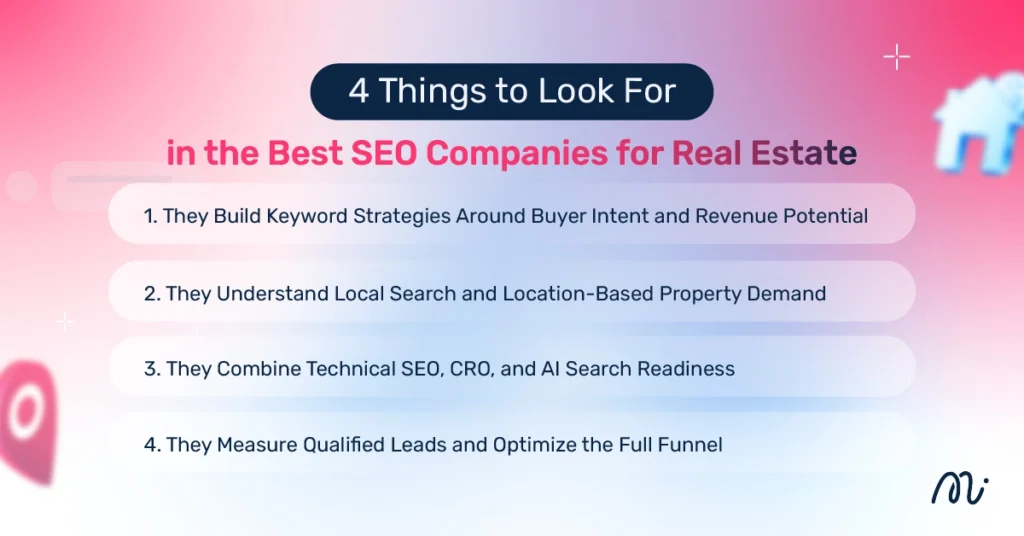
4 Things to Look For in the Best SEO Companies for Real Estate
Choosing a real estate SEO company should involve more than comparing packages or asking which provider promises the biggest traffic increase.
Property executives should evaluate how an agency approaches the business problem. Can it explain why particular keywords matter? Does it understand geographic demand? Can it identify technical and conversion barriers? Can it measure what happens after organic users reach the website?
Google’s guidance for hiring an SEO recommends evaluating how an SEO measures success and whether the provider understands the business, its customers, its competitors, and the markets it serves.
The following four areas are particularly important for property businesses.
1. They Build Keyword Strategies Around Buyer Intent and Revenue Potential
A keyword with high search volume is not automatically a high-priority business opportunity.
An effective keyword strategy should consider buyer intent, commercial relevance, and conversion potential, not just how many times a phrase is searched.
A capable real estate SEO company should separate informational, commercial, and transactional search intent, while mapping keywords to property types, project names, locations, and different stages of the buyer journey.
Instead of asking only how many searches a keyword receives, property teams should also ask:
- What search intent does this keyword represent?
- Which page should satisfy that intent?
- Does the query relate to a location or property the business actually serves?
- What should the visitor do after reaching the page?
- Can performance eventually be connected to inquiries or viewing requests?
A strong keyword portfolio balances demand-generation with demand-capture opportunities. Informational pages can create awareness, while commercial and transactional pages compete for users who are closer to making a property decision.
At Minimice Group Manila, SEO planning is approached through a broader performance lens. Keyword opportunities are considered alongside website structure, technical health, content, Local SEO, and conversion, rather than treating traffic as the final objective.
For property businesses, the takeaway is clear: an SEO strategy for real estate should balance search demand, business relevance, and conversion opportunity.
2. They Understand Local Search and Location-Based Property Demand
Real estate is inherently location-driven.
Prospective customers rarely search only for a generic property type. Search behavior often includes a city, district, neighborhood, nearby landmark, transportation hub, school, workplace, or specific development.
This makes local SEO for real estate agents, brokerages, property managers, and developers an important part of organic search planning.
A capable SEO partner should identify location-specific demand and translate it into useful website architecture and content. This may include optimizing appropriate project pages, improving location pages, strengthening Google Business Profile visibility where applicable, and developing neighborhood content that genuinely helps potential customers understand an area.
Local SEO should not become an exercise in producing dozens of nearly identical city pages. Replacing only the city name while keeping the rest of the content unchanged provides little value to prospective buyers.
Google explains in its local ranking guidance that local results are mainly influenced by relevance, distance, and prominence. Complete and accurate business information can also help Google better understand and match a business with relevant searches.
For Philippine property businesses, this means understanding real location demand rather than simply adding Manila, Makati, BGC, Cebu, or other geographic modifiers across every page.
Minimice Group Manila treats Local SEO as part of the wider search journey, connecting geographic visibility with keyword strategy, commercial pages, and conversion opportunities.
3. They Combine Technical SEO, CRO, and AI Search Readiness
Property websites can become technically complex.
A developer website may contain project pages, unit categories, floor plans, location pages, galleries, articles, and several layers of navigation. Brokerage websites may manage hundreds or thousands of listings.
If important pages are difficult for search engines to crawl or index, strong content alone may not be enough.
A capable provider of real estate SEO services should examine crawlability, indexability, website architecture, internal links, duplicate pages, canonicalization, mobile usability, page performance, and structured data where appropriate.
Google’s SEO Starter Guide reinforces the importance of helping search engines discover and understand website content through clear structure and relevant links.
However, technical health is only part of the equation.
Once prospective buyers reach a property page, the website still needs to help them move forward. Is the inquiry form easy to find? Can someone using a mobile device contact the sales team quickly? Are the most important project details clear? Does the page remove enough uncertainty for the visitor to consider a site viewing?
That is where CRO becomes important.
The same principle applies to AI Search. Preparing for AI-assisted discovery should not mean replacing foundational SEO with unsupported shortcuts. Google’s guidance for generative AI features in Search states that existing SEO best practices continue to apply to AI features and emphasizes useful content, technical accessibility, and a strong experience for visitors.
Minimice Group Manila connects Technical SEO and AI Search considerations with the broader conversion journey. For property businesses, search visibility becomes more valuable when technically accessible pages also make it easier for prospective buyers to take meaningful action.
4. They Measure Qualified Leads and Optimize the Full Funnel
Rankings, impressions, and traffic remain useful indicators. They can reveal changes in organic visibility and help diagnose where opportunities exist.
But they should not be the final KPI for a lead-driven property business.
A more useful funnel looks like this:
Search → Property Page → Inquiry → Qualified Lead → Site Viewing
Strong SEO measurement should track organic inquiries, form submissions, calls, viewing requests, and other meaningful actions. Where the data allows, performance can also be analyzed by landing page, project, location, or intent.
This helps identify an important distinction: the page generating the most organic traffic may not be the page generating the strongest business results.
Google Search Console’s Performance report provides data such as clicks, impressions, queries, pages, and CTR that can help teams understand how users are finding a website through Google Search.
For on-site measurement, Google Analytics also allows important user actions to be tracked as key events and conversions. This creates a stronger measurement framework than relying on visits alone.
This full-funnel perspective is particularly important for property businesses because a single qualified lead can carry significantly more value than a large volume of low-intent traffic.
The best SEO companies for real estate should do more than increase rankings and organic traffic. They should understand buyer intent, location-based demand, technical barriers, conversion paths, and lead quality. For developers, brokerage firms, and property managers in the Philippines, the right real estate SEO company should connect every stage of the journey, from the first search to the property inquiry and site viewing.
Minimice Group Manila approaches SEO as part of a broader performance-driven growth strategy. By combining data-backed SEO, Technical SEO, Local SEO, AI Search, and full-funnel performance thinking, the objective is to turn search visibility into stronger opportunities for sustainable business growth.
Warning Signs Your Current Real Estate SEO Services Are Failing
A single disappointing metric does not necessarily mean an SEO strategy has failed. Search demand changes, property inventory changes, markets fluctuate, and website performance can vary between periods.
However, when several of the following warning signs appear together, the strategy and measurement framework deserve a closer review.
Organic Traffic Is Growing, but Property Inquiries Are Flat
If sessions continue to rise while inquiries and site viewings remain unchanged, examine which pages are driving the increase.
The website may be growing primarily through informational content. Organic conversion rates may also be declining because new visitors have weaker commercial intent.
Compare high-traffic pages with inquiry-producing pages. If the two groups barely overlap, the content and keyword strategy may need stronger connections to commercial demand.
Your Rankings Are Dominated by Low-Intent Keywords
A ranking report can look impressive when dozens of keywords are moving upward, but those gains may contribute little to the sales pipeline if most queries are informational.
Review whether commercial property searches, location-specific searches, project terms, and high-intent queries are also improving.
A balanced real estate SEO strategy should build awareness while creating visibility where prospective customers are closer to making decisions.
Your Reports Focus on Rankings, Not Lead Quality
Monthly SEO reports should help management make decisions.
If reports show ranking changes, impressions, and clicks without explaining which landing pages generate inquiries, which pages convert, and where qualified leads originate, there is still a major piece of the performance picture missing.
A useful report should help answer: What should be optimized next, and why?
Local Search Visibility Is an Afterthought
For property businesses tied to particular developments, offices, or service areas, location relevance can become a major source of qualified demand.
Warning signs include missing or poorly maintained location pages, incomplete Business Profiles where relevant, weak neighborhood content, and keyword plans that barely account for geographic intent.
Local SEO for real estate agents and other property businesses should connect local discovery with actual commercial pages and conversion opportunities.
There Is No Clear Technical SEO Roadmap
A Technical SEO audit should not end with a spreadsheet containing hundreds of errors with no clear priorities.
Important problems need to be organized according to their impact on search visibility, user experience, and commercial value.
Persistent indexing issues, deeply buried project pages, weak internal linking, overlapping pages targeting the same intent, and poor site performance can all limit organic results.
A practical roadmap should explain what needs to be addressed first, why it matters, and how the impact will be measured.
Your SEO Strategy Has No Clear Plan for AI Search in 2026
AI Overviews and AI-assisted search experiences are changing how people discover information, but that does not make traditional SEO obsolete.
A warning sign is either extreme: ignoring AI Search completely or replacing proven SEO fundamentals with unsupported “GEO” or “AEO” hacks.
The better approach is to maintain strong technical foundations, publish original and useful content, improve page experience, make relationships between projects and locations clear, and monitor how search behavior evolves.
Search strategy should adapt to new discovery experiences without losing sight of what prospective property buyers actually need.
Stop Wasting Budget. Build a Real Estate SEO Strategy That Drives Qualified Leads.
If a property website is generating more visits without generating enough qualified demand, increasing traffic further may not solve the underlying problem.
The gap could begin with the keywords being targeted. It could appear in the site architecture, Local SEO strategy, project pages, technical setup, or conversion journey. In many cases, several of those factors interact.
This is where a Free Website Audit can provide a practical starting point.
A useful audit should go beyond identifying technical errors. It should examine search intent, keyword opportunities, high-value landing pages, Local SEO, internal linking, website structure, and conversion paths. The goal is to understand where high-intent prospects may be getting lost before deciding which part of the strategy deserves priority.
High organic traffic is only valuable when it reaches the right audience and moves prospective buyers closer to an inquiry or site viewing. If current real estate SEO services are generating clicks without enough qualified leads, a website audit can help reveal where that disconnect begins.
Minimice Group Manila combines data-driven SEO, Technical SEO, Local SEO, and full-funnel performance thinking to identify opportunities across the search and conversion journey. Starting with a Free Website Audit can help clarify where a property website may be losing high-intent demand and where an SEO strategy for real estate should focus next.
Turn Search Visibility Into a Qualified Property Pipeline
For a real estate business, the organic funnel can be viewed as:
Search → Landing Page → Property Discovery → Inquiry → Qualified Lead → Site Viewing
A Free Website Audit should examine each stage rather than looking at rankings in isolation.
At the search level, review whether traffic comes from informational, commercial, or transactional queries. At the landing-page level, identify whether high-intent searches reach relevant property, project, or location pages. From there, review internal links, technical barriers, mobile usability, forms, calls, WhatsApp actions, and other conversion points.
The analysis should help answer questions such as:
- Which pages attract significant traffic but produce few inquiries?
- Are high-intent property keywords adequately covered?
- Which project and location pages have unrealized search opportunities?
- Are technical issues limiting discovery of commercially important pages?
- Can visitors move easily from informational content to relevant properties?
- Where do prospective buyers appear to leave the conversion funnel?
- Which SEO opportunities have the strongest combination of demand, relevance, and conversion potential?
The objective is not to generate another list of SEO tasks. It is to build a prioritized roadmap around qualified demand.
That distinction is what turns a website audit from a technical checklist into a useful business tool.
Conclusion
Growing organic traffic is valuable, but it should never be the only definition of SEO success for a property business. Effective real estate SEO connects buyer intent, location-based demand, relevant content, Technical SEO, CRO, and measurable lead actions throughout the journey from search to site viewing. When comparing the best SEO companies for real estate, look for a partner that can explain how those pieces work together and how performance will be evaluated beyond rankings alone.
Minimice Group Manila brings a data-driven approach to SEO and full-funnel performance, helping lead-driven businesses identify where organic visibility can create stronger commercial opportunities.
Find out why your real estate website is generating traffic without enough qualified property leads. Get a Free Website Audit from Minimice Group Manila to uncover gaps in search intent, Technical SEO, Local SEO, and conversion paths, and identify the next opportunities for sustainable growth.
FAQ
What should I look for in the Best SEO Companies for Real Estate?
Look for an agency that understands buyer intent, location-based demand, Technical SEO, content strategy, CRO, and qualified lead measurement. A strong agency should explain how its recommendations connect organic visibility with actual business goals rather than evaluating success through rankings alone.
What is Real Estate SEO?
Real Estate SEO is the practice of optimizing property-related websites while aligning content and landing pages with the needs of prospective buyers, renters, investors, and property owners. It can include keyword research, Technical SEO, content, Local SEO, internal linking, and conversion-focused optimization.
How is Real Estate SEO different from general SEO?
Real estate SEO places additional emphasis on geographic intent, property types, project pages, neighborhood searches, long buyer journeys, and high-value conversion actions. An SEO strategy for real estate therefore needs to connect informational discovery with relevant property pages and inquiry opportunities.
Why does my real estate website get traffic but few property leads?
The website may be attracting visitors through broad informational keywords rather than searches associated with stronger buying intent. Other causes can include irrelevant landing pages, poor conversion paths, weak project visibility, technical problems, or limited coverage of high-intent and location-specific queries.
Can SEO help increase property viewing requests?
SEO can increase opportunities to reach people searching for relevant properties and locations. However, visibility needs to be combined with useful landing pages and clear conversion paths. The goal is to make it easier for qualified prospects to move from a search result to an inquiry or site-viewing request.