
Key Takeaway
- Local ads may waste budget when targeting is too broad, keywords are irrelevant, landing pages are weak, or conversion tracking is incomplete.
- High-intent clicks can be turned into actual customers through relevant keywords, aligned ad copy, and conversion-focused landing pages with clear CTAs and trust signals.
- Minimice Group helps improve Google Ads lead quality by analyzing campaign and sales data to identify qualified lead sources and optimize performance.
Getting Google Ads clicks but no leads can be frustrating, especially when your campaign continues to spend money without generating form submissions, calls, or inquiries. However, the problem may not be the number of clicks alone. It may be related to traffic quality, targeting, user intent, landing page experience, or conversion tracking.
To improve performance, businesses need to look beyond clicks and examine the entire conversion journey, from targeting, keywords, and ad copy to landing pages and conversion tracking. Google Ads conversion tracking is designed to help businesses understand whether ad interactions lead to valuable actions such as sales, leads, or phone calls.
The goal is not simply to generate more traffic. It is to attract the right people, give them the information they need, and make it easy for them to take the next step.

The Frustration of Paying for “Window Shoppers”
Before trying to solve the Google Ads clicks but no leads problem, it is important to understand the difference between traffic, clicks, and leads.
Traffic refers to people visiting your website. Clicks indicate that someone interacted with your advertisement and visited your destination page. A lead, however, represents a more meaningful action, such as submitting a form, calling your business, requesting a quote, or making an inquiry.
This means a campaign can generate thousands of clicks without necessarily producing valuable business opportunities.
For example, someone may search for “how much does dental treatment cost?” and click an ad to learn more. That person may be interested in the topic but may not be ready to book an appointment. Another user searching for “emergency dentist near me” may have a much stronger intention to purchase a service.
For this reason, a low CPC or high number of clicks does not automatically mean that a campaign is performing well. Businesses should evaluate metrics such as:
- Conversion Rate: How many visitors take a desired action?
- Cost per Lead (CPL): How much does it cost to generate each lead?
- Lead Quality: Are the leads relevant and qualified?
- Sales Conversion Rate: How many leads eventually become customers?
- Cost per Acquisition (CPA): How much does it cost to acquire an actual customer?
Looking at these metrics together gives businesses a much clearer picture of whether their Google Ads budget is generating meaningful results.
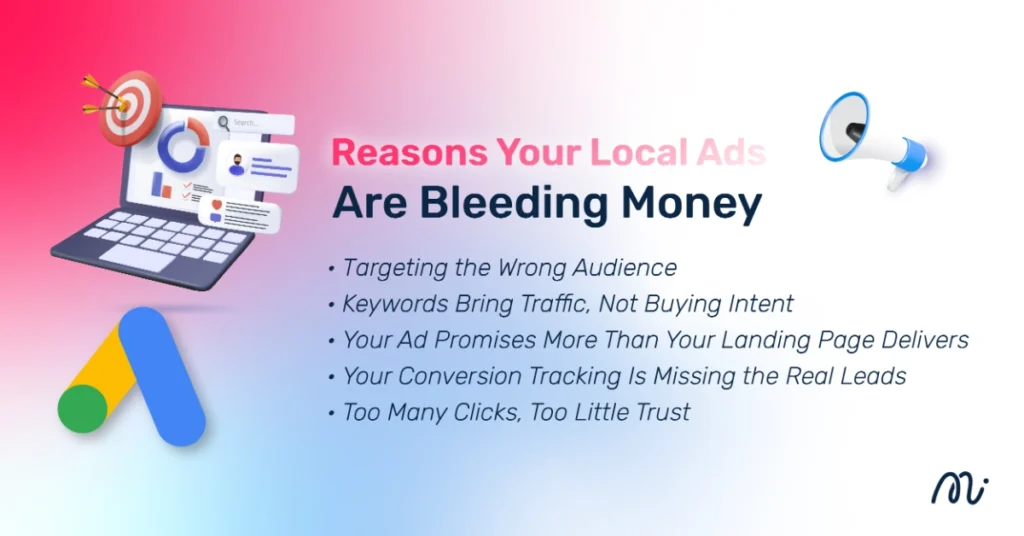
Reasons Your Local Ads Are Bleeding Money
Targeting the Wrong Audience
One of the most common reasons for poor Google Ads lead quality is targeting the wrong audience. If your audience is too broad, your ads may reach people who are interested in your general topic but are unlikely to become customers. This can happen when the campaign does not clearly reflect the business’s customer persona, service area, or purchasing needs.
Location targeting is especially important for local ads. A local service provider may only serve customers within specific cities, districts, or geographical areas. If ads reach people outside the service area, the campaign can generate clicks that have little commercial value.
Businesses should therefore review their location settings, service areas, audience signals, and customer profiles regularly to make sure advertising spend is concentrated on people who can realistically become customers.
Keywords Bring Traffic, Not Buying Intent
Not every keyword has the same commercial value. Some searches generate substantial traffic but have limited purchasing intent, which can contribute to Google Ads clicks but no leads.
For example, informational intent searches such as “what is dental implant treatment?” or “how does air conditioning repair work?” may generate traffic but not necessarily immediate inquiries. By contrast, commercial or transactional intent is often stronger when users search for terms such as “best dental clinic near me,” “air conditioner repair service,” or “buy office furniture online.”
The difference matters because high traffic does not always equal high-quality traffic. A keyword can have substantial search volume while generating few qualified leads. Businesses should therefore evaluate keywords based not only on search volume or CPC, but also on whether the search reflects a genuine intention to use the product or service.
Your Ad Promises More Than Your Landing Page Delivers
Another common reason for Google Ads clicks but no leads is a mismatch between the advertisement and the landing page. The ad may promote a specific service, price, or promotion, but users may not find the same information after clicking.
When the landing page does not deliver what users expect, such as the advertised offer, pricing, service details, or next steps, they may leave without converting. The ad copy and landing page should therefore provide consistent and relevant information, making it easier for users to understand the offer and take action.
Your Conversion Tracking Is Missing the Real Leads
Sometimes a business appears to have no leads simply because it is not tracking all meaningful conversion actions. A customer may not submit a traditional contact form. Instead, they might call the business, click a phone number, start a chat, request directions, or complete another important action.
Google Ads conversion tracking can help businesses measure actions such as sales, leads, phone calls, and other valuable interactions. It can also provide insight into which ads and keywords contribute to business outcomes.
Without comprehensive tracking, businesses may make decisions based on incomplete data. A campaign that appears to generate “no leads” may actually be producing conversions that simply are not being measured.
Too Many Clicks, Too Little Trust
Even when the targeting and keywords are relevant, users may hesitate to convert if the landing page does not build enough trust. A landing page for a high-consideration service should provide evidence that the business is legitimate, experienced, and capable of delivering the promised result.
Useful trust signals may include:
- Customer reviews and testimonials
- Case studies and previous work
- Credentials, certifications, or awards
- Company and team information
- Clear contact details
- Service information and pricing where appropriate
- Relevant policies and business information
Trust does not guarantee a conversion, but it can reduce uncertainty and help qualified visitors feel more comfortable taking the next step.
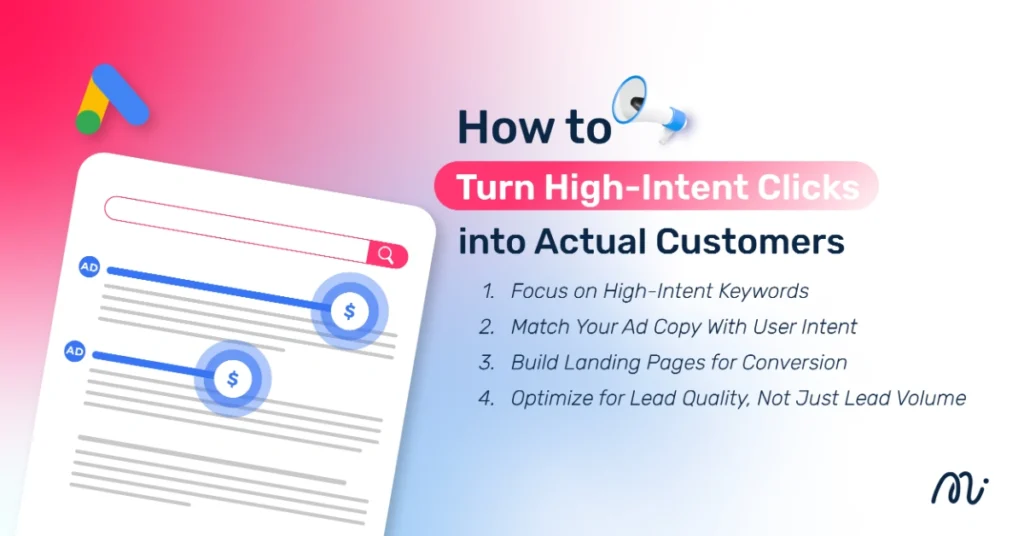
How to Turn High-Intent Clicks into Actual Customers
1. Focus on High-Intent Keywords
Start by identifying keywords that indicate a stronger intention to purchase, book, contact, or request a service. This can help businesses improve Google Ads lead quality while reducing irrelevant traffic.
For example, searches containing terms such as “buy,” “price,” “service,” “quote,” “book,” “near me,” or specific product and service names may indicate stronger commercial intent than broad informational searches.
However, intent depends on the industry and customer journey, so keyword selection should be based on actual business data rather than assumptions alone.
Businesses should also use negative keywords to prevent ads from appearing for irrelevant searches. This helps reduce wasted clicks and allows more of the budget to focus on users who are genuinely relevant to the business.
2. Match Your Ad Copy With User Intent
Your ad should clearly communicate what users can expect after clicking. A strong Google Ads message can include relevant elements such as:
- Unique Selling Proposition (USP)
- Specific services or products
- Pricing or promotional offers
- Key benefits
- Service locations
- Differentiating features
- Clear calls to action
This approach does more than encourage clicks. It can also help pre-qualify users before they reach the landing page. For example, if your service starts at a particular price, showing that information in the ad may discourage users looking for a much cheaper option while attracting people who are comfortable with your pricing.
The objective is not necessarily to achieve the highest possible Click-Through Rate. It is to attract the right clicks from people who are more likely to convert.
3. Build Landing Pages for Conversion
A high-intent click can still be lost if the landing page creates friction. A conversion-focused landing page should make the next action obvious. This can include a clear CTA such as “Request a Quote,” “Book a Consultation,” “Call Now,” or “Get Started.”
It should also minimize unnecessary steps between the user and the desired action.
Consider the following:
- Use a clear and relevant headline.
- Match the landing page message with the ad.
- Place the primary CTA where users can easily find it.
- Keep forms as simple as possible.
- Highlight important benefits and differentiators.
- Include reviews, case studies, credentials, or other trust signals.
- Make important contact information easy to access.
- Test different headlines, CTAs, layouts, and forms.
Google recommends evaluating landing-page performance and improving the relationship between ads and landing pages as part of campaign optimization.
4. Optimize for Lead Quality, Not Just Lead Volume
To improve Google Ads lead quality, businesses should look beyond the total number of leads and identify where qualified leads are coming from. Analyzing campaigns, keywords, search terms, locations, and conversion types can reveal which sources attract users with stronger purchasing intent.
The next step is to connect lead data with actual sales outcomes. For example, a keyword that generates fewer leads but consistently brings prospects who request a quote or become customers may be more valuable than one that generates a high volume of low-quality inquiries.
These insights can then be used to optimize campaigns, refine targeting, adjust keyword strategies, and allocate budget toward the sources that generate better-quality leads. This creates a continuous process of improving Google Ads performance based on actual business results rather than clicks or lead volume alone.
Why E-E-A-T is Crucial for B2C Conversions
E-E-A-T — Experience, Expertise, Authoritativeness, and Trustworthiness — is commonly discussed in the context of SEO, but the underlying principles of demonstrating credibility are also valuable when converting paid-search visitors.
Google’s guidance emphasizes creating helpful, reliable, people-first content. For businesses running Google Ads, this means the destination experience should give potential customers enough useful information to understand the service and evaluate whether the company is trustworthy.
A conversion-focused landing page can demonstrate E-E-A-T through:
- Customer Reviews: Show genuine experiences from previous customers.
- Case Studies / Portfolio: Demonstrate relevant experience and results.
- Credentials or Awards: Highlight qualifications, certifications, or recognized achievements where relevant.
- Company and Team Information: Help visitors understand who is behind the business.
- Verifiable Contact Information: Make it easy for customers to confirm and contact the company.
- Relevant Policies and Business Information: Provide important details that help reduce uncertainty.
People who click an ad are not necessarily ready to buy immediately. Some are comparing providers, checking prices, or evaluating whether a business is trustworthy. Strong credibility signals can reduce hesitation and give qualified visitors more reasons to take the next step.
Improve Google Ads Lead Quality with Minimice Group
Minimice Group is Google Premier Partner and performance-focused Google Ads agency that prioritizes campaign performance and conversions rather than simply increasing the number of clicks. With a data-driven approach, the team manages every stage of campaign execution, from campaign strategy, audience targeting, and keyword selection to ad optimization, landing page improvements, and lead quality analysis.
For businesses experiencing Google Ads clicks with no leads, the issue may go beyond the number of clicks a campaign generates. Minimice Group focuses on identifying gaps in campaign performance and improving conversion opportunities, with the goal of generating qualified leads that have stronger potential to become actual customers.
Talk to our Google Ads experts and find out what’s holding your campaigns back.
Conclusion
Google Ads campaigns that generate clicks but no leads may have problems beyond ad performance. Poor targeting, low-intent keywords, mismatched ad copy, weak landing pages, limited trust signals, and incomplete conversion tracking can all explain why Google Ads clicks don’t turn into leads. Businesses should look beyond CPC and Click-Through Rate and focus on lead quality, conversion rate, cost per lead, and ultimately sales outcomes.
By using high-intent keywords, negative keywords, relevant ad copy, conversion-focused landing pages, and accurate tracking, businesses can improve Google Ads lead quality and make their advertising budget more effective. For companies that need deeper campaign analysis, a Google Ads agency such as Minimice Group can help connect campaign performance with meaningful business outcomes.
FAQ
Why does my Google Ads get clicks but no leads?
If you are experiencing Google Ads clicks with no leads, common causes include targeting the wrong audience, weak keyword intent, poor landing-page relevance, insufficient trust signals, or incomplete conversion tracking.
How do I fix Google Ads clicks but no leads?
Start by reviewing your keywords, search terms, ad copy, landing page, and conversion tracking. Identify whether the traffic is relevant, whether users are showing commercial intent, and whether every meaningful conversion action is being properly measured.
How can I improve Google Ads lead quality?
Focus on high-intent keywords, use negative keywords, refine your audience and location targeting, align your ads with user intent, and optimize your landing pages for conversion. Most importantly, connect lead data with sales outcomes to determine which campaigns and keywords generate customers rather than simply leads.
Should I hire a Google Ads Agency if my ads get clicks but no leads?
A Google Ads agency may be useful when campaigns consistently generate traffic but fail to produce qualified leads. An experienced agency can review targeting, keywords, ad copy, landing pages, and conversion tracking to identify opportunities to improve Google Ads lead quality.
What is more important, Google Ads clicks or leads?
Leads and lead quality are generally more important than clicks. Clicks represent traffic and indicate that users interacted with an ad, while a lead represents a more meaningful action that may contribute to a business outcome. However, the ultimate goal is not simply to maximize leads, but to generate qualified leads that have a realistic chance of becoming customers.