

Key Takeaway
- Why B2B SEO Should Focus on Business Problems Instead of Search Volume: Search volume shows demand, but not whether searchers are potential buyers. Strong B2B SEO prioritizes commercial intent, business problems, and qualified opportunities.
- How Topic Clusters Help Attract Corporate Buyers: Topic clusters connect service pages with supporting content that answers questions throughout the buying journey, helping prospects move from research to vendor evaluation.
- How Minimice Group Manila Builds Topic Authority for B2B Brands: The team connects business objectives, search intent, Technical SEO, content architecture, and conversion measurement to build authority around topics that matter to corporate buyers.
For B2B companies, building topic authority is not about publishing more content or targeting every keyword with search volume. Working with a B2B SEO agency can help businesses create a connected content ecosystem around the real problems their ideal clients are trying to solve.
A strong B2B SEO content strategy helps search engines understand areas of expertise while guiding decision-makers from early research to commercial evaluation. Instead of chasing random keywords, the focus should be on topics that strengthen relevance, demonstrate expertise, and support the path toward a qualified business opportunity.
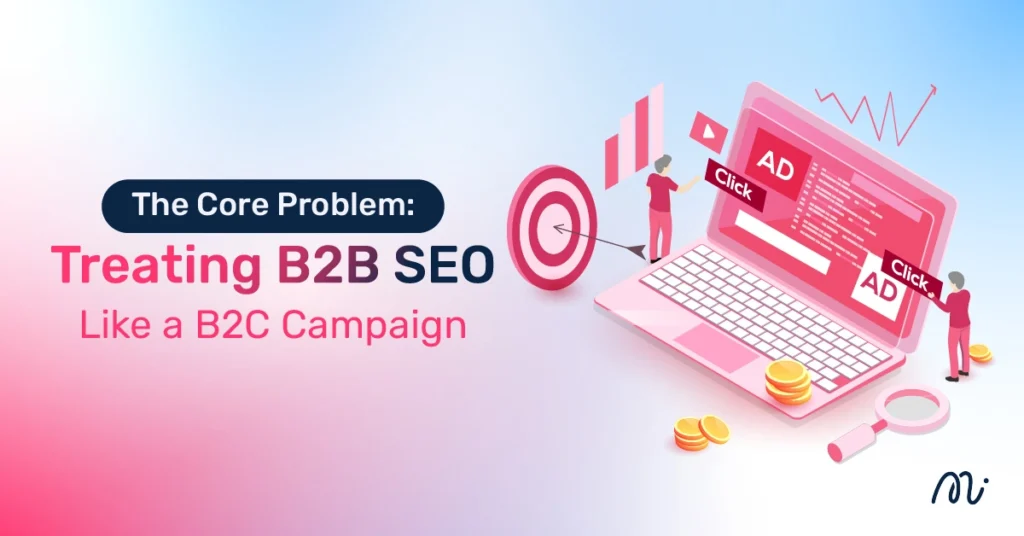
The Core Problem: Treating B2B SEO Like a B2C Campaign
A common B2B SEO problem occurs when traffic, impressions, and rankings increase, but qualified corporate inquiries do not.
The issue is often not SEO itself, but a strategy focused too heavily on traffic volume. Broad keywords can attract large audiences with little buying intent, while highly specific searches may come from decision-makers actively evaluating a solution.
This becomes particularly important for high-ticket services, where purchases may involve long evaluation cycles and several stakeholders. Modern B2B buying is increasingly fragmented across channels: McKinsey’s 2026 Global B2B Pulse found that buyers use an average of ten channels across the purchasing journey.
Therefore, effective B2B SEO needs to connect search visibility with the commercial buying journey rather than treating every organic visit as equally valuable.
The Traffic Trap: When SEO Metrics Look Good but Revenue Does Not
Traffic, impressions, CTR, and rankings are useful indicators, but they should not define B2B SEO success on their own.
The more important questions are:
- Is organic search generating qualified inquiries?
- Are decision-makers reaching commercial pages?
- Does content move visitors toward service evaluation?
- Which pages contribute to sales opportunities?
The Search Console Performance report helps identify clicks, impressions, CTR, queries, and page-level search performance, but these metrics become more useful for B2B businesses when combined with lead and sales data.
For search engine optimization for business, traffic should be treated as part of the journey—not the final result.
High-Ticket Buyers Do Not Make Decisions After One Search
B2B buyers rarely move directly from a search to a purchase.
A typical journey may look like:
Problem Search → Solution Research → Vendor Comparison → Case Study → Service Page → Consultation
Different stakeholders may also need different information:
- CEO: Will this support business growth?
- Marketing Director: Can this generate qualified demand?
- Finance: Is the investment commercially justified?
- Procurement: Is the vendor credible?
- Technical teams: Can the solution meet operational requirements?
A strong SEO content architecture should answer these questions throughout the decision process instead of focusing only on the keyword that generated the first visit.
B2C vs B2B SEO: What’s the Real Difference?
| Factor | B2C SEO | B2B SEO |
| Primary Audience | Individual consumers | Decision-makers, buying committees, and business stakeholders |
| Purchase Journey | Often shorter and more direct | Usually longer, multi-stage, and research-intensive |
| Transaction Value | Typically lower per transaction | Often higher-value contracts or recurring business relationships |
| Keyword Strategy | High-volume consumer keywords can be important | Lower-volume, high-intent, and problem-specific keywords can be more valuable |
| Search Intent | Product discovery, comparison, purchase, promotions | Business problems, solution research, vendor evaluation, and commercial investigation |
| Content Focus | Product benefits, reviews, comparisons, inspiration, promotions | ROI, implementation, expertise, risk reduction, case studies, and proof |
| Decision Process | Usually one primary buyer | Multiple stakeholders may influence the final decision |
| Content Depth | Often shorter and more transactional | Often deeper, more educational, and decision-support focused |
| Primary Conversion | Purchase, signup, app install | Consultation, demo, qualified inquiry, proposal request |
| Lead Quality | Often measured through direct conversions | Must consider fit, authority, business need, and sales potential |
| SEO Measurement | Traffic, transactions, conversion rate, revenue | Qualified leads, opportunity quality, pipeline influence, assisted conversions |
| Authority Signals | Product relevance, reviews, and consumer trust | Subject-matter expertise, credibility, case studies, industry knowledge |
| Sales Integration | Can be highly transactional | Often requires close alignment between SEO, marketing, CRM, and sales |
| Typical SEO Goal | Drive more purchases from organic search | Generate qualified demand and influence high-value business opportunities |
The fundamentals of SEO remain similar. What changes is the commercial journey the strategy needs to support.
B2B Keyword Volume Can Be Small While Business Value Is High
Low search volume does not mean low business value.
A keyword searched only a few times each month may be highly valuable if the searcher is a CFO, Marketing Director, Procurement Manager, or business owner actively evaluating a provider.
Instead of assessing keywords through search volume alone, consider:
- Business relevance
- Search intent
- Buying stage
- Potential account value
- Conversion potential
Long-tail queries are particularly useful because their specificity can reveal real business requirements.
The better question is not simply “How many people search for this?” but “Who is searching, and what are they trying to solve?”
B2B SEO Must Speak to a Buying Committee
B2B content needs to support more than one persona because one corporate purchase may involve several stakeholders.
A service page might answer commercial questions, while a technical guide addresses implementation concerns and a case study provides proof for management or procurement.
The aim is not to place every answer on a single page, but to build a website where each stakeholder can find the information needed to move the decision forward.
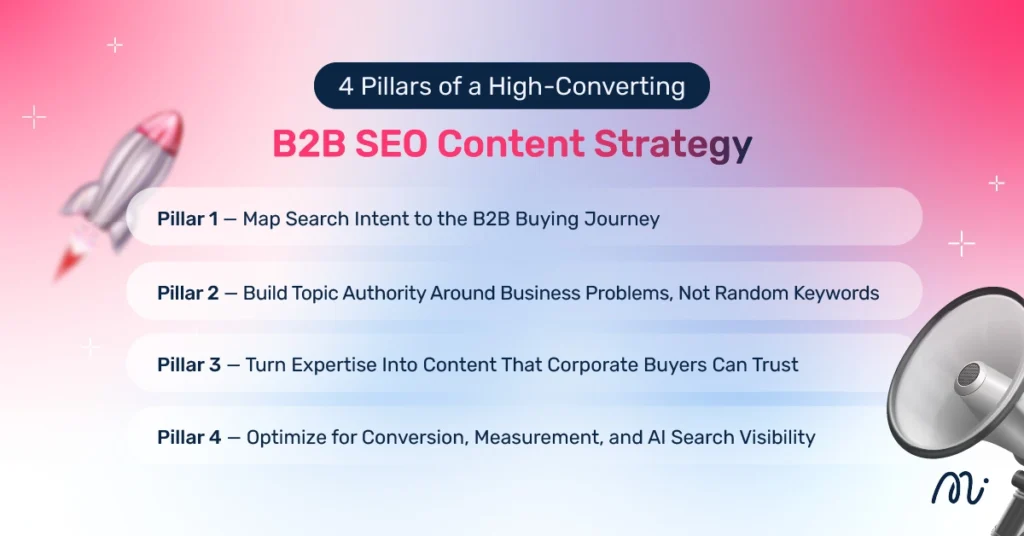
4 Pillars of a High-Converting B2B SEO Content Strategy
Pillar 1 — Map Search Intent to the B2B Buying Journey
B2B keyword research should start with the business problem and buying stage before focusing on search volume.
Problem Awareness
- “why enterprise leads are declining”
- “why SEO traffic is not converting”
Solution Research
- “B2B lead generation strategy”
- “SEO for B2B companies”
- “Search engine optimization for business”
Commercial Investigation
- “B2B SEO Agency”
- “Best B2B SEO agency”
- “SEO agency Philippines”
Vendor Evaluation
- Case studies
- Industry expertise
- Methodology
- Service scope
- Results and proof
At Minimice Group Manila, keyword planning starts with commercial objectives and customer intent before expanding into topic clusters. This keeps the strategy focused on searches that can contribute to qualified opportunities instead of traffic alone.
Pillar 2 — Build Topic Authority Around Business Problems, Not Random Keywords
Publishing disconnected articles because keywords have search volume can create a large content library without creating a clear area of authority.
A stronger approach is to connect supporting topics to a core commercial service.
Core Commercial Page:
B2B SEO Services
Supporting Content:
- How B2B SEO Generates Qualified Leads
- B2B SEO vs B2C SEO
- SEO KPIs Every Marketing Director Should Track
- How to Evaluate an SEO Agency
- B2B Keyword Research for High-Ticket Services
- SEO and AI Search Visibility for B2B Brands
Supporting articles should naturally direct readers toward relevant commercial pages through contextual internal links. Google’s SEO link best practices reinforce the importance of understandable anchor text and internal links that help users and Google make sense of relationships between pages.
The Minimice Group Manila approach is to build interconnected content ecosystems that help prospects move logically from education to service consideration.
Pillar 3 — Turn Expertise Into Content That Corporate Buyers Can Trust
Corporate buyers need more than generic articles that summarize information available everywhere else.
Useful B2B content can include:
- Expert insights
- Case studies
- Original research
- Practical frameworks
- Industry-specific observations
- Benchmarks
- Clear methodology
Google’s people-first content guidance emphasizes original information, useful analysis, clear sourcing, and content that demonstrates genuine knowledge or first-hand expertise. Google also clarifies that E-E-A-T itself is not a single ranking factor.
For corporate buyers, these principles have value beyond rankings. They provide evidence that the company understands the problem at a level deeper than a generic search summary.
Instead of publishing another “10 SEO Tips” article, a B2B brand could explain how technical SEO, commercial keyword targeting, and content architecture work together to generate qualified demand for a high-value service.
Pillar 4 — Optimize for Conversion, Measurement, and AI Search Visibility
SEO should not stop at ranking.
High-intent visitors need clear next steps, such as:
- Request a consultation
- Request an audit
- Explore a service
- Read a case study
- Contact the strategy team
Performance should then be connected across the journey:
Organic Search → Content Engagement → Service Page → Inquiry → Qualified Lead → Opportunity
AI-powered search adds another discovery layer, but it does not make foundational SEO obsolete. Google’s guidance for AI Overviews and AI Mode confirms that the same core SEO practices used for traditional Google Search remain relevant to AI features, without requiring a separate set of special technical requirements.
At Minimice Group Manila, SEO is treated as part of a broader revenue ecosystem rather than an isolated traffic channel.
What Should a B2B SEO Agency Measure Beyond Traffic?
A useful B2B SEO report should combine search indicators with commercial outcomes.
Search Visibility
- Qualified keyword rankings
- Non-branded commercial visibility
- Organic impressions
- Organic clicks
- Priority topic visibility
Engagement
- Service page visits
- Returning visitors
- Movement from educational to commercial pages
Lead Quality
- Organic inquiries
- Consultation requests
- Marketing-qualified leads
- Sales-qualified leads
Business Impact
- Opportunities influenced by organic search
- Pipeline value
- Lead-to-opportunity rate
- Revenue influenced by organic acquisition
Measurement is also expanding with search itself. In June 2026, Google introduced dedicated Generative AI performance reports in Search Console, including impressions, pages, countries, devices, and visibility associated with AI-powered Search experiences for websites included in the rollout.
For B2B marketing teams, this adds another layer to the measurement framework: search visibility now extends beyond traditional rankings.

How to Choose the Best B2B SEO Agency in the Philippines
Choosing the Best B2B SEO Agency in Manila should be based on business strategy rather than promises of rankings.
Ask potential partners:
- How will you identify searches used by our real buyers?
- How do you distinguish traffic potential from commercial intent?
- How will SEO support our B2B sales funnel?
- How do you evaluate content gaps across the buying journey?
- How will technical SEO support our content strategy?
- How do you measure qualified organic leads?
- How will SEO performance be reported to senior management?
- How do you adapt as search behavior changes?
- How do you approach AI-powered search visibility?
- Can you explain the business logic behind your SEO roadmap?
Red Flags to Avoid
Be cautious of strategies built primarily around:
- Guaranteed ranking promises
- Keyword volume without search intent
- Traffic reports without lead-quality context
- Large volumes of generic content
- The same SEO roadmap for every industry
- Little discussion of measurement or business outcomes
A strong agency should be able to explain why each SEO activity matters to the business, not simply whether it follows a standard checklist.
Why B2B SEO Best Practices Are Changing in 2026
The fundamentals of B2B SEO best practices remain important: technical accessibility, useful content, logical site architecture, internal linking, and alignment with search intent.
Google’s Search Essentials continue to emphasize helpful, reliable content and using language that reflects how people actually search.
What is changing is the environment around those fundamentals.
Search journeys now include conventional results, AI Overviews, AI Mode, and other research tools. This increases the strategic value of:
- Original expertise
- Specific answers to complex buyer questions
- Strong technical foundations
- Clear content architecture
- Commercially relevant content
- Useful internal connections between pages
- Visibility across multiple search experiences
The reality is not that SEO no longer works, but that it must create more value than simply ranking a page for a keyword.
Stop Losing Corporate Deals. Partner with the Best B2B SEO Agency in the Philippines
Your business does not need more irrelevant traffic. It needs visibility among the people who influence real corporate purchases.
Effective B2B SEO connects technical foundations, commercial keyword research, content architecture, authority, conversion, and measurement.
Minimice Group Manila approaches SEO from a business-first perspective: analyzing what the company sells, who influences the purchase, what those people search for, and which content can move them toward a qualified opportunity.
Sustainable organic growth requires a roadmap built around the business rather than a generic SEO package.
Conclusion
B2B SEO works best when traffic is treated as a means rather than the final goal. The strongest strategies map search intent to the corporate buying journey, build topic authority around real business problems, demonstrate expertise, maintain strong technical foundations, and connect organic visibility with qualified demand.
At Minimice Group Manila, SEO is approached as part of a broader business growth ecosystem. From technical foundations and search strategy to content development and evolving AI Search visibility, the focus is on building an organic presence that can support qualified demand over the long term.
Ready to find out whether your SEO is attracting traffic or actual business opportunities? Explore how a strategic B2B SEO agency can build a search roadmap around your business goals.
FAQ
What is B2B SEO?
B2B SEO is the process of improving organic search visibility to attract companies, decision-makers, and buying committees. It combines technical SEO, keyword strategy, content, authority, and conversion planning around business buying journeys.
What does a B2B SEO Agency do?
A B2B SEO agency develops an organic search strategy around business objectives. This can include technical SEO, keyword research, content architecture, service-page optimization, topic clusters, internal linking, analytics, and lead measurement.
How is B2B SEO different from B2C SEO?
B2C SEO often targets individual consumers and shorter purchase journeys. B2B SEO usually supports longer evaluation cycles involving multiple stakeholders, making commercial intent, lead quality, content depth, and sales alignment more important.
How do you choose the Best B2B SEO Agency in the Philippines?
Look for an agency that can connect SEO activities with business goals, qualified demand, and the B2B buying journey. The best B2B SEO agency for your organization should be able to explain its keyword strategy, technical roadmap, content methodology, measurement framework, and approach to changing search behavior.
How long does B2B SEO take to generate results?
There is no fixed timeline. Results depend on competition, website condition, existing authority, content quality, and keyword difficulty. Search visibility may begin improving before revenue because high-value B2B deals often involve longer sales cycles.