If you run a service business, like a clinic, school, real estate agency, B2B software company or home services provider, a sale rarely happens in one click. People want to ask questions, compare options and talk to someone first. Lead generation ads are built for that journey. Instead of pushing people straight to checkout, they collect a name, phone number or message so your team can follow up.
This guide covers lead generation for service based businesses on Google, Meta (Facebook, Instagram, Messenger and WhatsApp) and TikTok: how each platform’s forms work, when to use an in-ad form versus a landing page, and how to protect lead quality and follow-up so your pipeline turns into revenue.
What Are Lead Generation Ads?
Lead generation ads are ad formats and campaign objectives designed to capture contact details or start a conversation with a potential customer. The key difference from a regular traffic ad is the conversion point: the goal is a submitted form, a call or a chat, not just a website visit.
Each platform offers its own version:
- Google Ads lead form assets let people submit their information in a form directly in your ad, and can be added to Search and Performance Max campaigns (Google Ads Help).
- Meta lead ads collect contact details from people on Facebook and Instagram, either through a form or by starting a conversation in chat.
- TikTok lead generation opens an instant form when someone taps the call to action, or redirects people to your website, TikTok Direct Messages or instant messaging apps (TikTok Ads Manager Help).
Google Ads Lead Form Assets vs Meta Instant Forms vs TikTok Instant Forms
All three platforms let people send their details without leaving the app, but they reach people at different moments.
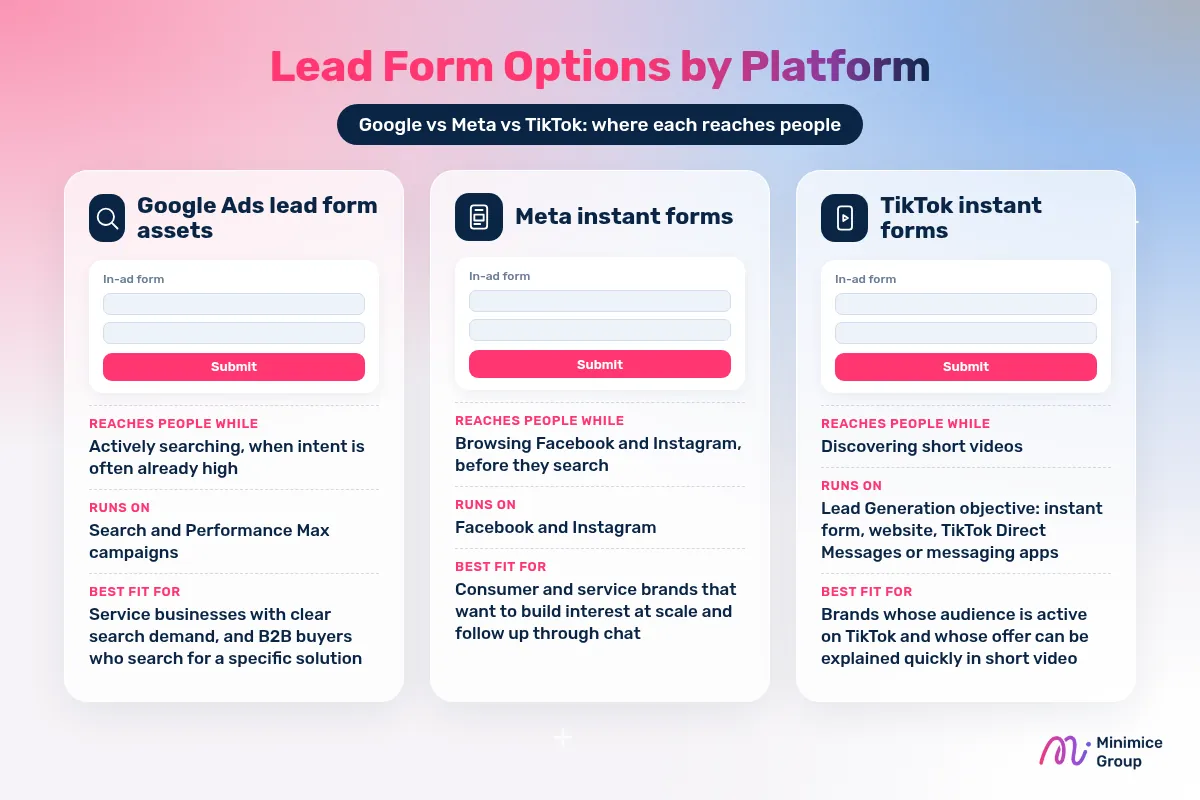
- Google Ads lead form assets: reach people while they are actively searching, so intent is often already high.
- Meta instant forms: reach people while they browse Facebook and Instagram, before they search, and can hand the conversation to chat.
- TikTok instant forms: reach people while they discover short videos, which suits offers that can be explained quickly.
Lead delivery also differs. Google lets you collect leads by CSV download, email notifications, the Google Ads API, a webhook or Zapier (Google Ads Help). TikTok says leads can be synced to a CRM through Zapier, LeadsBridge or custom APIs (TikTok Ads Manager Help). The sections below cover each platform in turn.
Lead Generation Ads on Google: Capturing High-Intent Searches
Lead generation ads on Google mostly start from search demand. With Google Ads lead form assets, you create a lead form in Google Ads and attach it to a Search or Performance Max campaign. If you are weighing campaign types, compare Search and Performance Max campaigns against your goals before you choose.
Google lists a few requirements: a good history of policy compliance, a privacy policy, and a campaign that uses a conversion-focused bid strategy optimized toward a lead form conversion goal (Google Ads Help). Some advertisers, depending on the campaign and lead form format, may also need to complete Advertiser verification (Google Ads Help). Google also notes that CSV downloads cover only the last 30 days and that leads are stored for 60 days, so download or sync them often (Google Ads Help).
Best fit for: service businesses with clear search demand, and B2B buyers who search for a specific solution.
Meta Lead Ads: Instant Forms, Messenger & WhatsApp
Meta shows your ad to people as they scroll their feeds, which can be before they have started looking for a provider. That makes lead generation ads on Meta useful for creating demand, not only capturing it.
For businesses in the Philippines, you can start with Messenger as your main chat channel and treat Facebook lead ads to WhatsApp as an option if your team already handles inquiries there.
Best fit for: consumer and service brands that want to build interest at scale and follow up through chat.
TikTok Lead Generation Ads: Reaching Discovery Audiences
TikTok lead generation ads use the Lead Generation objective. TikTok says instant forms load faster than a typical landing page and can pre-populate fields (TikTok Ads Manager Help). People can also be sent to your website, TikTok Direct Messages or instant messaging apps instead of a form.
Best fit for: brands whose audience is active on TikTok and whose offer can be explained quickly in short video.
In-Ad Form or Landing Page? Choosing for Lead Quality
An in-ad form and a landing page each have a place. The right choice depends on how much the person needs to know before they contact you.
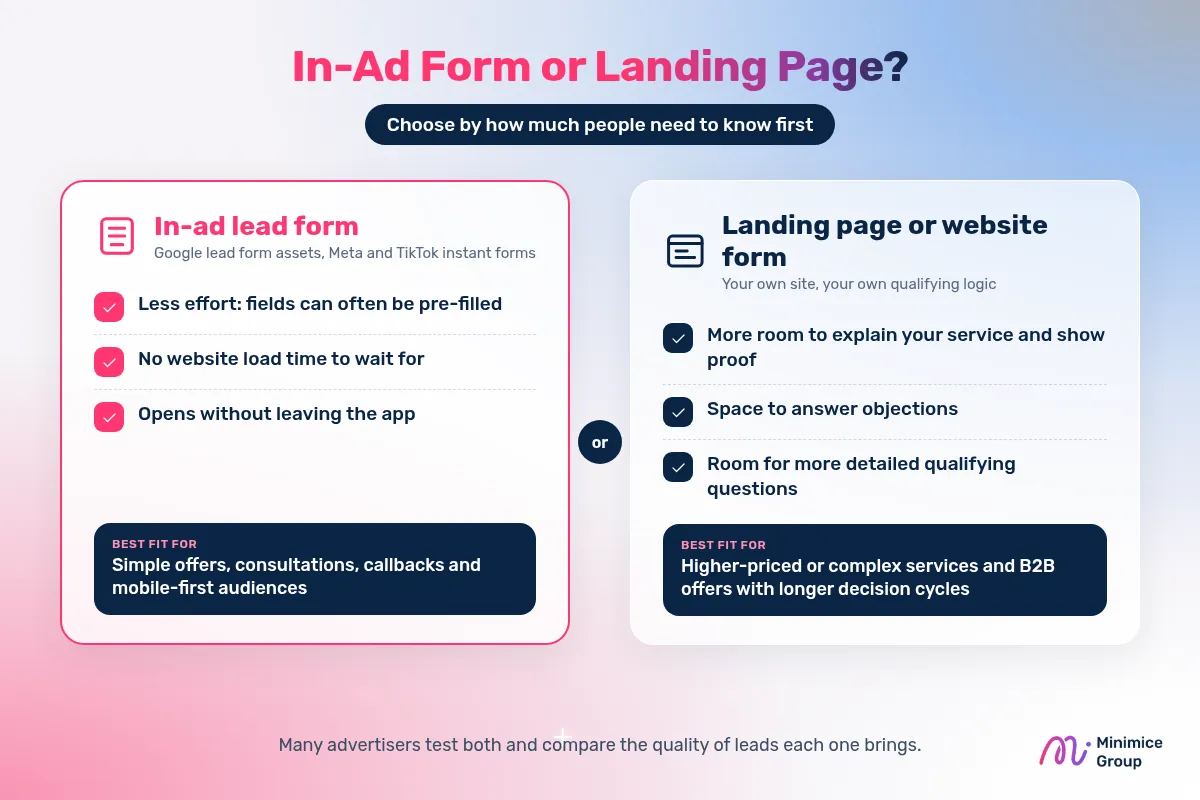
In-ad lead form (Google lead form assets, Meta instant forms, TikTok instant forms)
- Lower effort for the user, since fields can often be pre-filled.
- No website load time to wait for.
- Best fit for: simple offers, consultations, callbacks and mobile-first audiences.
Landing page or website form
- More room to explain your service, show proof and answer objections.
- Lets you use your own qualifying logic. TikTok, for example, notes that your own website form may be preferred when you want to ask more detailed qualifying questions than its instant form supports (TikTok Ads Manager Help).
- Best fit for: higher-priced or complex services, and B2B offers with longer decision cycles.
Many advertisers test both and compare the quality of leads each one brings.
How to Filter Low-Quality Leads
Easy forms can bring in more submissions, but some of them may be low intent. To track lead quality over time, see our guide to Meta ads metrics for lead quality. A few practical ways to protect quality:
- Add a qualifying question. Ask about budget range, location, timeline or service type, so your team can prioritize.
- Add more questions when quality matters. Where quality matters more than volume, a form with a few more questions can discourage casual sign-ups.
- Use verification tools. Google mentions features like OTP verification (Google Ads Help).
- Check the landing page too. If clicks arrive but good leads don’t, see our checklist on Google Ads not converting.
Follow-Up and CRM Sync: Turning Leads into Revenue
A lead that sits unseen in an ads dashboard rarely becomes a customer.
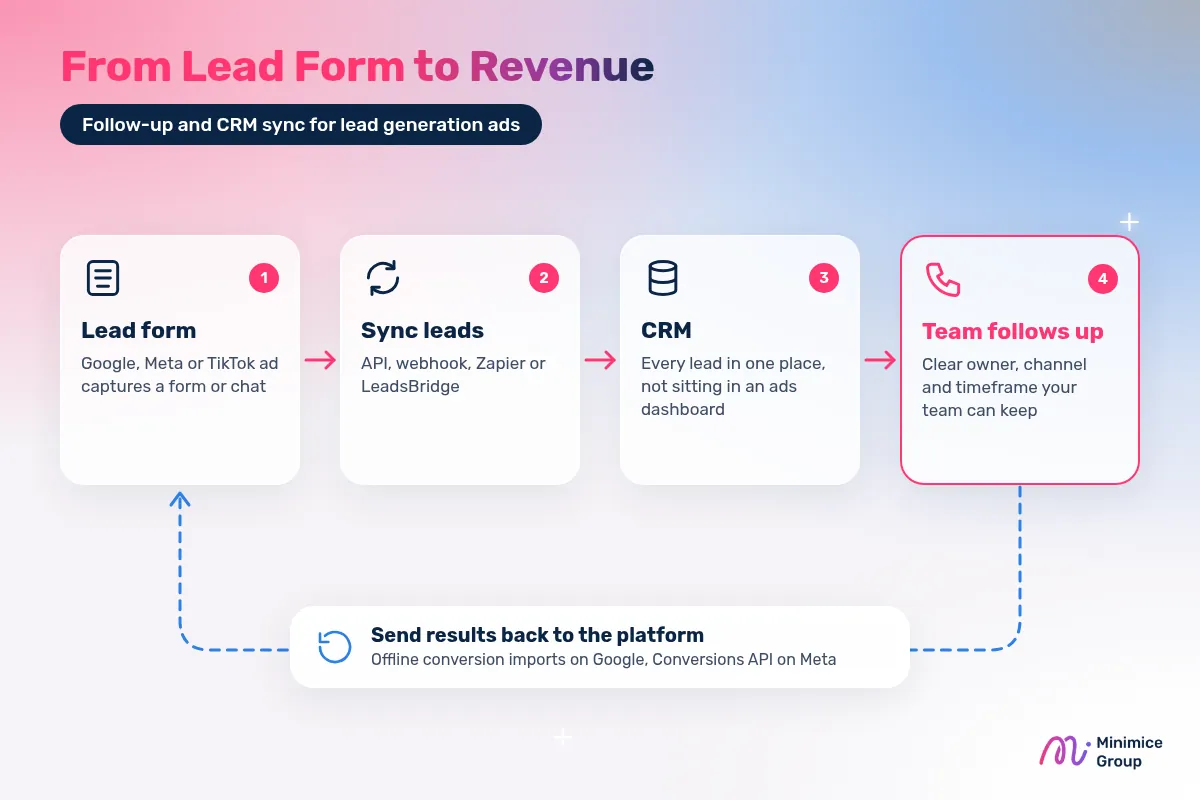
- Connect leads to your CRM. Google supports the Google Ads API, webhooks and Zapier (Google Ads Help). For TikTok lead generation CRM integration, TikTok lists Zapier, LeadsBridge and custom APIs (TikTok Ads Manager Help).
- Follow up consistently. Set a clear internal process for who calls or replies, through which channel, and within a timeframe your team can realistically keep.
- Send results back to the platform. Telling the ad platform which leads became customers helps you judge which campaigns bring real business, not just form fills. On Google, you can do this with offline conversion imports (Google Ads Help). On Meta, the Conversions API connects data such as offline conversions from your server or CRM to Meta (Meta for Developers).
A Lead Generation Strategy for Service-Based Businesses
A practical Google Ads lead generation strategy usually sits alongside social channels rather than replacing them:
- Map your sales cycle. If deals usually take several weeks to close, plan spend and reporting with that lag in mind.
- Split budget by intent. Use Google search campaigns to capture people already looking, and Meta or TikTok to build interest that turns into future demand.
- Prepare follow-up capacity. More leads only help if your team can respond. Check staffing and holiday schedules before you scale.
- Refresh creative and offers. Seasonal offers, consultations or reviews give people a reason to raise their hand now.
Want help planning lead gen campaigns? Minimice Group is a Google Premier Partner, and our team runs Google Ads, Facebook Ads, social media ads and TikTok ads campaigns for businesses in the Philippines. Talk to our team about your lead generation goals.
FAQ
Is an in-ad form or a website the right choice for lead generation ads?
Neither suits every case. In-ad forms are a good fit for simple offers and mobile users, while landing pages suit complex services that need more explanation.
Can Facebook lead ads send leads to WhatsApp?
Many businesses move Meta ad leads into chat apps such as WhatsApp or Messenger for follow-up. Check the options available in Meta Ads Manager when you set up your campaign.
Are lead generation ads worth it for small service businesses?
They can be, if your offer is clear enough to act on from an ad and your team can respond to leads consistently. Start with one platform where your customers already spend time, track which leads become customers, and expand from there.
How many questions should a lead form have?
Ask only what your team needs to prioritize the first call, such as service type, location or timeline. Then test whether adding a question improves lead quality without putting off people who are a good fit.