
Key Takeaway
- Choose a Google Ads agency based on experience, strategy, tracking, and results—not price alone. Low management fees often mean poor execution. Prioritize technical mastery and strategic vision to protect your ad budget and ensure long-term ROI.
- Ensure the agency provides transparent reporting, clear KPIs, and proper conversion tracking. Accurate GA4 and GTM tracking forms the bedrock of campaign success. Look for partners who report on real business outcomes rather than vanity metrics like clicks.
- The right agency must align Google Ads performance directly with your primary business goals. Campaigns should drive your bottom line. Choose a team focused on lowering your Cost Per Acquisition (CPA) and maximizing your Return on Ad Spend (ROAS).
Finding the right marketing partner can feel overwhelming. Every agency promises high performance, yet their pricing structures, workflows, and technical expertise vary drastically. Choosing a team based solely on the lowest quote often leads to misaligned campaigns and wasted budget.
To build a strategy that drives real growth, you need a structured evaluation process. Learn how to choose a Google Ads agency with 10 key factors to consider, from experience and tracking to pricing, reporting, and account ownership.
This guide breaks down how to inspect an agency’s conversion tracking accuracy, data transparency, and reporting depth before signing a contract.
What Is a Google Ads Agency?
Wondering what a Google Ads agency is? It is a team of specialists that plans, builds, manages, and optimizes your Google Ads campaigns. A Google Ads agency bridges the gap between your marketing budget and your business goals, ensuring your investment drives targeted traffic and conversions.
What Does a Google Ads Agency Do?
To generate measurable ROI, an agency manages a mix of technical setup and ongoing strategy. Instead of just turning ads on, their core responsibilities include:
- Keyword Research & Audience Targeting
- Campaign Structure & Ad Copy creation
- Bidding Strategy & Budget Allocation
- Conversion Tracking setup
- Landing Page Analysis & Campaign Optimization
- Performance Reporting
(Since they handle everything from launch to scaling, the real challenge isn’t just knowing what they do—it is finding the right partner to execute it effectively.)
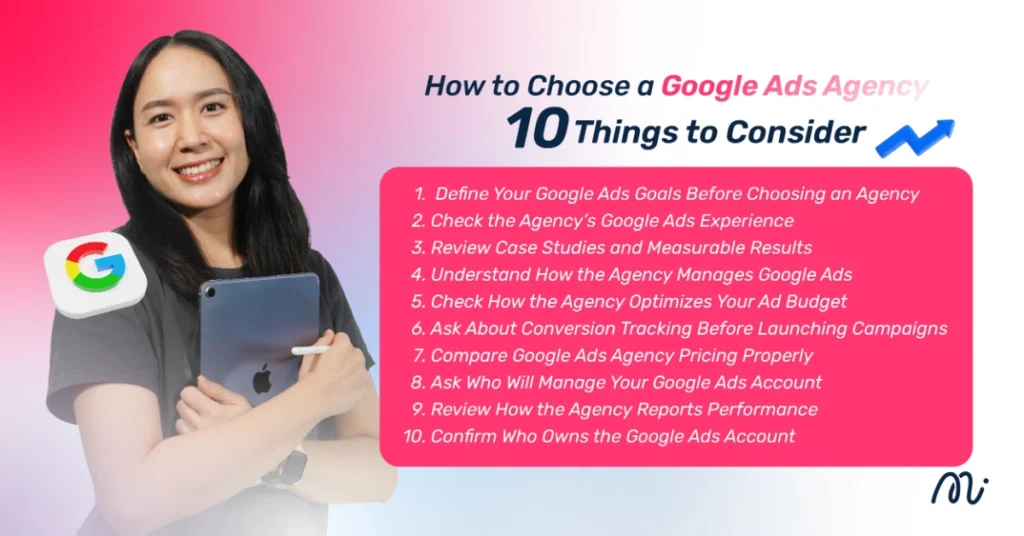
How to Choose a Google Ads Agency: 10 Things to Consider
1. Define Your Google Ads Goals Before Choosing an Agency
Before evaluating potential partners, clearly define what success looks like for your business. Aligning your objective with an agency’s core expertise is crucial—an agency specializing in E-commerce growth may not be the best fit for B2B lead generation.
Common primary goals include:
- Lead Generation: Acquiring qualified inquiries or phone calls.
- E-commerce Sales: Increasing online store purchases and overall revenue.
- Efficiency Metrics: Improving ROAS (Return on Ad Spend) or reducing CPA (Cost Per Acquisition).
- Brand Awareness & Offline Traffic: Driving store visits or video views.
2. Check the Agency’s Google Ads Experience
Years in business do not automatically equal platform mastery. Evaluate whether the agency has practical experience relevant to your specific operational scale and setup.
Key factors to evaluate:
- Industry Relevance: Experience within your sector or adjacent markets.
- Budget Management: A track record of managing ad spend comparable to your budget.
- Campaign Types: Proven execution across Search, Shopping, Display, YouTube, and Performance Max.
- Business Models: Direct experience with your business structure (B2B, B2C, or E-commerce).
3. Review Case Studies and Measurable Results
Client logos on a homepage offer little proof of competence. Look for detailed case studies backed by concrete performance data rather than superficial achievements.
Pay attention to hard metrics such as:
- ROAS and Revenue growth
- CPA and CPL (Cost Per Lead) reduction
- Conversion Rate improvements
- Lead Volume expansion
What Should You Look for in a Google Ads Case Study?
A valuable case study provides clear context. It should break down the Challenge, Strategy, Execution, and Result, explaining precisely how the team diagnosed a problem, adjusted campaign strategies, and achieved measurable growth.
4. Understand How the Agency Manages Google Ads
Ask for a breakdown of their end-to-end workflow from initial research to daily optimization. A reliable agency should demonstrate a systematic approach rather than relying on automated settings or claiming to use a “secret formula.”
Their day-to-day management should cover:
- Ongoing keyword research and negative keyword management
- Continuous ad copy testing and bid strategy optimization
- Landing page performance analysis to prevent conversion bottlenecks
- Proactive budget re-allocation toward top-performing ad groups
5. Check How the Agency Optimizes Your Ad Budget
Inquire directly about how the team decides where your money goes. A competent agency monitors performance continuously to scale winning campaigns and quickly pause non-converting search terms. They prioritize business outcomes—such as high-quality leads and sustainable ROAS—over superficial metrics like total clicks or impressions.
Ask how the agency validates conversion data and selects the appropriate Smart Bidding strategy based on campaign goals and performance.
6. Ask About Conversion Tracking Before Launching Campaigns
Proper measurement is the bedrock of any successful digital campaign. Before committing an ad budget, ensure the agency conducts a thorough audit of your measurement stack.
An agency must accurately configure and verify:
- Google Tag Manager (GTM) and GA4 integration
- Form submissions and phone call tracking
- E-commerce purchase events and revenue values
- Qualified lead stages within your CRM
Why Is Conversion Tracking Important?
Without accurate conversion tracking, campaign optimizations are based on faulty data. Correct setup ensures every bidding decision, budget shift, and targeting adjustment relies on actual business results rather than guesswork.
Google’s website conversion measurement framework allows advertisers to evaluate the valuable actions visitors take after interacting with an ad.
7. Compare Google Ads Agency Pricing Properly
When evaluating a Google Ads marketing agency, looking solely at the management fee can be misleading. Always compare the full scope of deliverables included in their proposal.
A complete service agreement typically details:
- Setup Fees vs. Monthly Management Fees
- Tracking & Analytics Configuration
- Landing Page & Creative Support
- Reporting Frequency & Strategic Consultation
Cheapest vs. Best-Value Google Ads Agency
The cheapest option often comes with minimal campaign oversight or hidden add-on costs. Focus on identifying the best overall value—where the scope of work, level of expertise, and expected ROI justify the investment.
8. Ask Who Will Manage Your Google Ads Account
Clear accountability prevents misunderstanding after the contract is signed. Before finalizing a deal, ask direct questions regarding account oversight and team communication:
- Will a senior specialist directly manage the account, or is it assigned to a junior staff member?
- Do you have a dedicated account manager as a single point of contact?
- How frequently does the technical team review and optimize campaign performance?
- What channels are used for regular communication and updates?
9. Review How the Agency Reports Performance
Transparency in reporting separates top-tier partners from standard service providers. Effective reporting skips vanity metrics like impressions and focuses on real business impact—tracking Conversions, CPA, Revenue, and ROAS.
To maintain complete visibility, look for agencies that offer modern reporting solutions. For instance, similar to the approach taken by Minimice Group, agencies that provide a real-time performance dashboard allow clients to track live campaign metrics, spend, and conversion data at any time without waiting for monthly PDF summaries.
10. Confirm Who Owns the Google Ads Account
Always protect your business assets and historical data. Clarify account ownership terms in writing before beginning work.
Verify the following key points:
- Account Ownership: Ensure your business retains appropriate administrative access and clearly understands the account ownership and management arrangements.
- Admin Access: Your team must retain top-level Admin access at all times.
- Historical Data: All campaign history, conversion setups, and structural data remain your property if you decide to end the contract.
If an agency uses a manager account, confirm in writing that its access does not prevent your company from retaining control over Google Ads account ownership.
Questions to Ask Before Hiring a Google Ads Agency
Use this 10-question checklist during your agency vetting process to evaluate technical capability, transparency, and strategic alignment:
- What experience do you have with businesses in our industry?
Look for a team that understands your buyer journey, audience intent, and industry-specific competition.
- Which types of Google Ads campaigns do you specialize in?
Ensure their technical mastery aligns with your channel needs, whether that is Search, Shopping, Display, YouTube, or Performance Max.
- How do you determine the right campaign strategy?
A qualified agency builds custom frameworks grounded in your business goals and market data, rather than relying on automated pre-made templates.
- How will you track conversions and revenue?
Verify that they will audit or configure GA4, Google Tag Manager (GTM), and phone/form conversion events before spending any budget.
- Which KPIs will you use to measure success?
Ensure their primary focus rests on bottom-line metrics like ROAS, CPA, and revenue, rather than vanity metrics like clicks or impressions.
- How often will you optimize our campaigns?
Clarify their routine schedule for reviewing negative search terms, bid adjustments, creative testing, and budget re-allocation.
- How will campaign performance be reported?
Look for transparent communication that includes regular reviews alongside access to a real-time performance dashboard.
- Who will manage our Google Ads account?
Confirm whether a dedicated senior specialist directly oversees your campaigns or if management gets passed to junior staff.
- Will we retain full access and ownership of the account?
Ensure your company maintains top-level Admin access and retains all historical data if you ever change partners.
- What is included in your management fee?
Request a transparent breakdown showing whether creative assets, landing page recommendations, and tracking setup are included in the base price.
What Type of Google Ads Agency Is Right for Your Business?
There is no single “best” agency for every organization. The ideal partner depends entirely on your business model, target audience, and operational scale. Instead of searching for a one-size-fits-all provider, choose a team whose specializations match your specific operational needs.
For Small and Local Businesses
Local brands and small companies need a partner focused on hyper-targeted search and cost efficiency. Look for agencies that excel in geo-targeting, location extensions, and call tracking. For businesses with physical locations, Performance Max campaigns for store goals can help drive store visits, calls, and direction requests, depending on campaign setup and account eligibility.
For E-commerce Businesses
Online retailers require deep technical mastery of product catalogs and automated bidding. Seek agencies with proven experience in Google Shopping, Performance Max (PMax) campaigns, and Merchant Center feed management. They must understand how to optimize for conversion value, average order value (AOV), and target ROAS to keep campaign expansion profitable.
Strong feed management matters because product data helps Google match products with relevant customer queries and supports ad-serving optimization.
For B2B and Lead Generation Businesses
B2B companies deal with longer sales cycles, higher deal values, and complex buyer journeys. Choose an agency that prioritizes lead quality over raw volume. They should possess technical expertise in CRM integration, CPL optimization, and offline conversion tracking to measure how search ad clicks turn into actual sales pipeline value.
For Growing and Enterprise Businesses
Large-scale organizations need an agency capable of handling high-budget complexity and multi-campaign structures. Look for partners equipped to manage advanced data tracking, cross-channel strategies, and continuous A/B testing. An enterprise-ready team provides custom data analysis, granular reporting, and dedicated strategic oversight to support sustained growth.
Red Flags to Watch Out for When Choosing a Google Ads Agency
Spotting warning signs during the vetting process saves time and ad budget. Avoid agencies that display these red flags:
- Refusing to Give Account Access: If an agency denies you top-level Admin access or holds your ad account hostage, you risk losing all historical campaign data if the relationship ends.
- Guaranteeing Specific Results: No agency controls Google’s bidding auction or market shifts. Be cautious of agencies that guarantee top ad positions or specific returns without assessing campaign data, competition, and business goals.
- Ignoring Conversion Tracking Setup: An agency that launches campaigns without configuring accurate conversion tracking is firing blind, making optimizations based on assumptions rather than real data.
- Reporting Only Vanity Metrics: Be cautious if monthly reviews focus exclusively on clicks, impressions, and CTR while avoiding bottom-line numbers like cost-per-acquisition (CPA) and total revenue.
- Vague Optimization Processes: A qualified team can clearly articulate their workflow. Broad statements like “it’s handled by our algorithm” often mask a lack of active, hands-on management.
- Hiding Account Managers: If an agency refuses to disclose who handles day-to-day optimizations or quietly offloads work to unsupervised junior staff, accountability disappears.
Conclusion
Choosing the right agency requires looking far beyond management fees alone. Knowing how to choose a Google Ads agency comes down to thoroughly evaluating their proven experience, strategic depth, conversion tracking accuracy, optimization workflow, transparent reporting, clear communication, and full account ownership. The right partner does not just manage clicks—they clearly demonstrate how your ad spend connects directly to measurable business outcomes, utilizing a transparent, data-driven process built for sustainable growth.
Scale Your Campaigns with Minimice Group
Looking for a partner that prioritizes real business growth over vanity metrics? Minimice Group delivers data-driven Google Ads management designed to maximize ROI. From keyword and audience analysis to conversion-focused optimization, landing page A/B testing, AI-driven automation, and real-time performance reporting, we align every campaign with your bottom line.
Discover how our Google Ads Agency Service – Minimice Group can transform your paid search strategy into a predictable revenue engine.
FAQ
How much does a Google Ads agency charge?
Agency pricing typically ranges from a flat monthly fee ($1,000–$5,000+) or 10%–20% of monthly ad spend, depending on account complexity. Pricing reflects the team’s strategic depth, campaign scope, tracking setup, and ongoing creative support.
Should I hire a Google Ads agency or manage ads in-house?
Hire an agency if you need immediate expertise, advanced tools, and proven strategies without full-time hiring overhead. Managing in-house works best if you already have dedicated internal specialists and low campaign complexity.
How often should a Google Ads agency optimize campaigns?
A competent team conducts daily monitoring for ad spend pacing, paired with weekly optimizations for negative keywords, bids, and ad copy. Major structural adjustments occur monthly once sufficient conversion data builds statistical significance.
How long does it take to see results from Google Ads?
Initial clicks and traffic begin immediately upon campaign launch. However, achieving sustainable ROI and peak conversion efficiency typically requires 1 to 3 months of continuous data gathering, testing, and Smart Bidding machine learning.
What is the difference between a PPC agency and a Google Ads agency?
A Google Ads agency specializes exclusively in Google’s ecosystem, including Search, Shopping, YouTube, and Performance Max. A PPC agency manages pay-per-click advertising across broader platforms, including Bing, Meta, LinkedIn, and Amazon.