
Key Takeaway
- B2B targeting can be less precise when it relies too heavily on job titles without considering company, industry, buying role, and previous behavior.
- Low-quality leads, weak CTR from relevant prospects, and overlapping audiences can indicate that an audience needs to be reviewed.
- To improve B2B targeting accuracy, define the buying committee, combine company and first-party data, build relevant exclusions, and segment retargeting audiences based on engagement level.
Facebook Ads can support B2B marketing by helping businesses reach relevant professionals, generate awareness, drive website visits, and collect leads. However, B2B targeting is more complex than B2C targeting because the person who sees or clicks an ad may not be the final decision-maker.
A B2B purchase can involve users, influencers, managers, decision-makers, and budget holders. This means a campaign that targets only one job title may still reach people who are not involved in the purchase. Understanding how Facebook ads for B2B marketing fit into the wider buying journey is therefore important before building an audience.
How Does B2B Targeting on Facebook Differ from B2C?
B2B Buying Decisions Involve Multiple Steps
B2B purchases often take longer than typical B2C purchases because the decision may involve several stages, from identifying a business problem to researching solutions, comparing vendors, evaluating requirements, and obtaining approval.
There may also be multiple people involved in one B2B deal. For example, an employee may identify a problem, a manager may evaluate potential solutions, a technical team may review requirements, and a budget holder may approve the purchase.
As a result, Facebook ads for B2B may reach someone who sees or clicks an ad but is not the final decision-maker. LinkedIn’s research on B2B buying groups also highlights the influence of multiple stakeholders and hidden buyers throughout the buying process.
Facebook’s Limitations for B2B Audience Targeting
Facebook can provide useful audience signals, but those signals do not necessarily describe a person’s complete professional buying context.
Job Title or Interest alone may not be enough for B2B targeting. Two people with the same title can work for companies with completely different business models, company sizes, industries, and purchasing needs. This is why B2B targeting in Facebook ads should be considered as a combination of signals rather than a single targeting condition.
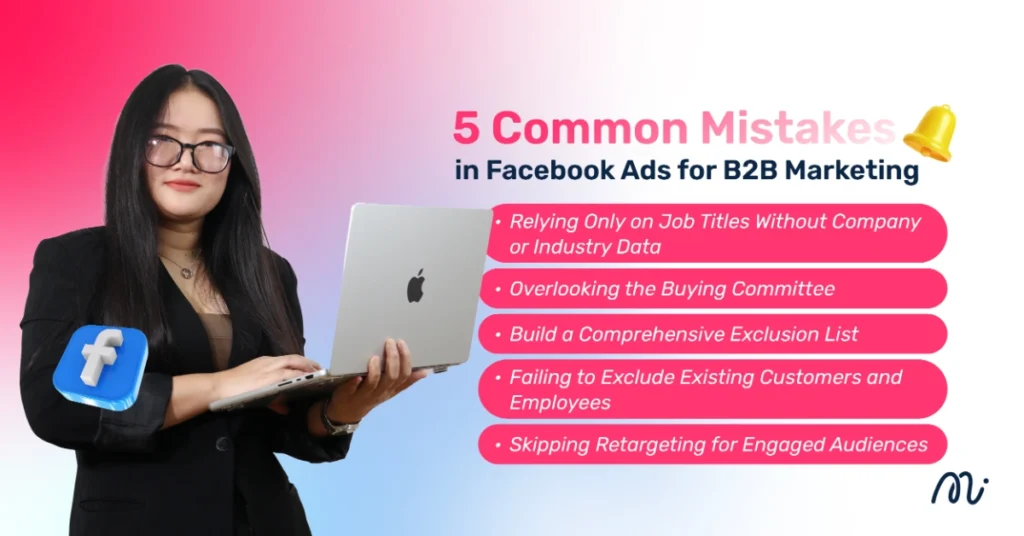
5 Common Mistakes in Facebook Ads for B2B Marketing
1. Relying Only on Job Titles Without Company or Industry Data
A common mistake when running Facebook ads for B2B marketing is relying too heavily on Job Title to define the target audience. While job titles can provide useful context, the same Job Title can represent very different business needs depending on the company and industry.
For example, a Marketing Manager at a SaaS company may focus on lead generation, product adoption, and recurring revenue, while a Marketing Manager at a retail company may focus more heavily on customer acquisition, promotions, and store or e-commerce performance.
For this reason, B2B advertisers should consider:
- Company Size
- Industry
- Business Type
- Job Function
Job Title should therefore be treated as one targeting signal rather than the only qualification criterion.
2. Overlooking the Buying Committee
B2B purchases often involve different roles, including:
- User: the person who will use the product or service
- Influencer: someone who influences the evaluation or recommendation
- Decision-Maker: someone involved in the final purchasing decision
- Budget Holder: the person responsible for approving or controlling the budget
A person who clicks Facebook ads for B2B may be a User or Influencer rather than the person who approves the purchase.
Before creating a B2B audience, define the Buying Committee and understand what each role needs to know. The advertising message should then be adapted to the role. A technical user may need product information, while a decision-maker may care more about business outcomes, implementation, or cost considerations.
3. Build a Comprehensive Exclusion List
A strong B2B targeting strategy should consider both who to reach and who to exclude from acquisition campaigns. One practical approach is to build a Comprehensive Exclusion List using Custom Audiences, based on the audience sources available in Meta.
- Customer List: Upload an appropriate customer list from your CRM to create a Custom Audience that can be excluded from acquisition campaigns.
- Employee List: Upload employee email addresses to create an audience for ad exclusion.
- Website Custom Audience: Create audiences from relevant website behavior. For example, visitors to pages such as a Career Page or Customer Login Page may represent people who should not be included in certain acquisition campaigns.
- Lead Form / Engagement Audience: Exclude people who have already submitted a lead form or interacted with previous campaigns, so they are not repeatedly targeted by Acquisition ads.
Keep Customer Lists updated as new customers are added so the exclusion audience remains useful over time. For setup details, advertisers should refer directly to the Meta Business Help Center, since available audience and exclusion options can change with platform updates.
4. Failing to Exclude Existing Customers and Employees
Acquisition campaigns can waste impressions and budget when ads repeatedly reach existing customers or a company’s own employees instead of new prospects. For B2B advertisers, using exclusions as part of the campaign setup can help keep Acquisition audiences focused on potential new customers.
Importantly, when running Facebook Ads for B2B, Meta no longer supports Detailed Targeting Exclusions based on Interest, Job Title, or Behavior. Advertisers should not rely on these criteria to exclude specific groups. Where supported, exclusions should instead be built using Custom Audiences.
Examples of Custom Audiences that can be used for exclusion include:
- Customer List: Upload customer email addresses or phone numbers to exclude existing customers from Acquisition campaigns.
- Employee List: Upload employee email addresses to exclude the company’s own employees.
- Lead Form Audience: Exclude people who have already submitted a lead form so they are not repeatedly targeted by Acquisition ads.
- Website Audience: Exclude people who have visited relevant pages, such as a Thank You Page or Career Page.
Advertisers should also check for Audience Overlap when multiple Ad Sets use similar audiences. Significant overlap can cause Ad Sets to compete for the same users, making budget allocation and campaign performance harder to interpret.
Do not use Interest, Job Title, or Behavior criteria to exclude audiences, such as excluding students or job seekers, because these Detailed Targeting Exclusions are no longer available.
5. Skipping Retargeting for Engaged Audiences
A B2B buying journey rarely ends with the first impression or click. Someone who has watched a video, visited a website, submitted a form, or engaged with previous content may already have some awareness of the business.
With Facebook ads for B2B marketing, potential Retargeting Audiences can include:
- Website Visitors
- Video Viewers
- Lead Form Audiences
- Engagement Audiences
The message should also change according to the funnel stage, for example:
Awareness, Case Study, Demo / Contact Sales
Rather than showing the same introductory advertisement repeatedly, advertisers can use retargeting to provide more relevant information as prospects move through the buying journey. The retargeting window and exclusions should match the B2B sales cycle. A high-consideration B2B service may require a different timeframe from a relatively simple business purchase.
Signs Your Facebook B2B Campaign Is Targeting the Wrong Audience
Unusually Low CTR Despite Strong Creative
A low CTR does not automatically mean the creative is weak. Advertisers should compare CTR with engagement, audience characteristics, and campaign context to determine whether the problem is the creative or the audience. If an advertisement receives impressions but relevant prospects rarely interact with it, your B2B targeting Facebook ads may need to be reviewed.
Leads Are Not the Right Decision-Makers
Lead volume alone does not indicate whether a B2B targeting Facebook ads is reaching the right people.
Review information such as:
- Job Title
- Company
- Industry
- Buying Role
If a campaign generates many leads but few match the Ideal Customer Profile (ICP), both audience targeting and lead qualification may need adjustment.
Overlapping Audiences Are Competing for Ad Budget
Multiple Ad Sets can unintentionally target similar people. Advertisers should check whether different Ad Sets are reaching the same or highly similar audiences. Reducing unnecessary overlap and separating audiences according to Objective or Funnel Stage can make campaign structure easier to manage and analyze.
How to Improve Facebook B2B Targeting Step by Step
1. Define Your Buying Committee Before Launch
For B2B targeting Facebook ads, start by identifying everyone who may participate in the buying process, such as Users, Influencers, Decision-Makers, and Budget Holders. Then identify the Pain Points and information needs of each role. This information can be used to divide audiences and create messages that reflect the role each person plays in the B2B buying journey.
2. Combine Company-Based Targeting With Custom Audiences
Start by defining the ICP using factors such as Industry, Company Size, Business Type, and relevant Job Functions or professional characteristics. Then use available first-party data and Custom Audiences to complement the audience strategy. Separating Prospects from Existing Customers is also important because acquisition, retention, and upsell campaigns can have different objectives. This approach gives Facebook ads for B2B more context than relying on Job Title alone.
3. Build a Comprehensive Exclusion List
Create exclusions for audiences that should not receive acquisition messaging, such as Existing Customers, Employees, people who have already submitted a lead form, and other audiences that are not potential customers. Review each Ad Set to identify audience overlap and update exclusion lists when new customer data becomes available.
4. Segment Retargeting Audiences by Engagement Level
Not every engaged user has the same level of interest. For B2B targeting Facebook ads, consider separating Website Visitors, Video Viewers, people who have engaged with content, and Lead Form users, then create messages based on their level of engagement.
For example, someone who has only watched part of a video may need educational content, while someone who has visited a product or service page may be ready for a case study or sales conversation. Retargeting duration and exclusions should align with the B2B Sales Cycle rather than using the same timeframe for every campaign.
Facebook Ads for B2B Marketing Checklist Before Launch
- ICP is clearly defined by Industry, Company Size, Business Type, and relevant professional characteristics.
- Buying Committee is identified, including Users, Influencers, Decision-Makers, and Budget Holders where relevant.
- Job Title is not being used as the only targeting signal.
- Prospect and Existing Customer audiences are separated where appropriate.
- Customer and Employee exclusion audiences are prepared.
- Lead Form and relevant Website Custom Audiences are considered for exclusions or retargeting.
- Multiple Ad Sets have been checked for Audience Overlap.
- Retargeting audiences are segmented by engagement level.
- Messages match the user’s Funnel Stage and Buying Role.
- Retargeting windows reflect the expected B2B Sales Cycle.
- Lead qualification criteria are ready before measuring lead volume.
- Campaign performance will be evaluated using lead quality as well as CTR and conversion volume.
Summaries
Facebook Ads for B2B marketing can support awareness, lead generation, website traffic, and retargeting, but B2B audience planning requires more context than typical consumer targeting. Job Title alone may not identify the right prospect, as people with the same title can have different industries, responsibilities, and buying needs. Advertisers should consider Buying Committee roles, company information, first-party data, Custom Audiences, exclusions, and engagement signals to build a more relevant audience strategy.
Because B2B buyers may need multiple interactions before contacting a sales team, retargeting and lead quality should be considered alongside CTR, engagement, and conversion volume. For businesses looking to improve their B2B acquisition strategy, Minimice Group provides Facebook Ads and digital marketing services, including campaign strategy, audience targeting, performance optimization, and broader digital marketing support.
FAQs
Is Facebook Ads effective for B2B marketing?
Facebook Ads can support B2B marketing, particularly for awareness, website traffic, lead generation, and retargeting. However, effectiveness depends on factors such as audience definition, creative, offer, campaign objective, and lead qualification.
Should B2B businesses use Facebook Lead Ads or website traffic campaigns?
It depends on the campaign objective. Lead Ads can reduce friction when the goal is lead generation, while website traffic campaigns can be useful when prospects need more information before converting. For complex B2B products, combining traffic, content, and retargeting may support a longer buying journey.
Should B2B audiences be segmented by company size?
Often, yes. Company Size can be a useful B2B segmentation signal because businesses of different sizes may have different budgets, processes, decision-making structures, and requirements. It should be combined with Industry, Business Type, and other relevant signals rather than used alone.
When should you use retargeting for Facebook B2B Ads?
Use retargeting when prospects have already shown relevant engagement, such as visiting the website, watching videos, engaging with content, or submitting a lead form. The retargeting message should reflect their previous interaction and the expected B2B sales cycle.