


Key Takeaway
- How Franchise SEO Can Prevent Locations From Competing With Each Other: Assign clear keyword ownership to national, city, and branch pages so each URL serves a distinct search intent.
- Key Elements of a Strong Local SEO Strategy for Franchise Brands: Use accurate local data, useful location-specific content, clear site architecture, and consistent Google Business Profiles.
- How Minimice Group Manila Supports Franchise Growth: The team builds scalable SEO structures that help new locations strengthen the network without creating duplicate or competing pages.
Expanding a franchise across multiple Philippine cities can create new growth opportunities, but it also increases SEO complexity. As more location pages are added, brands can face overlapping keywords, duplicate content, and branches competing for the same search visibility. A strong franchise SEO strategy solves this by assigning clear search intent to each page and building a structure that can scale with the network.
The “Sea of Sameness” Nightmare in Franchise Marketing SEO
The main problem is not having too many location pages, but having multiple pages that serve nearly the same purpose.
A common pattern is simple: duplicate one location template, change the city name, address, and phone number, then target the same service keyword again.
This creates several risks:
- National pages overlap with city pages
- City hubs compete with branch pages
- Several URLs rank for the same query
- Internal links send mixed signals
- More pages are indexed without adding real local value
The issue becomes more visible when every branch wants to rank for the same high-value keyword. At that point, the website may have no clear answer to a basic question: which URL should own that intent?
When Every Location Page Looks the Same
While a scalable template is useful, repeating the same content across every location is not.
Common signs include:
- Repeated service descriptions
- City-name swapping
- Identical FAQs
- Identical headings
- Thin local information
- Similar calls to action
Google’s spam policies on doorway abuse cite substantially similar city or regional pages—created mainly to capture similar queries—as examples of this practice.
A practical test is simple: remove the city name from the page. If the remaining content could belong to any branch, the page probably needs more local value.
Keyword Cannibalization Is Usually a Strategy Problem First
Cannibalization does not automatically mean a penalty. It often means several URLs serve similar search intent.
Watch for:
- Multiple URLs ranking for the same query
- Frequent URL switching in Search Console
- Branch pages ranking for national terms
- City pages competing with individual locations
- Similar titles and headings across pages
The first question should be:
Which URL should own this search intent?
Once that is clear, content, internal links, redirects, and technical signals become easier to manage.
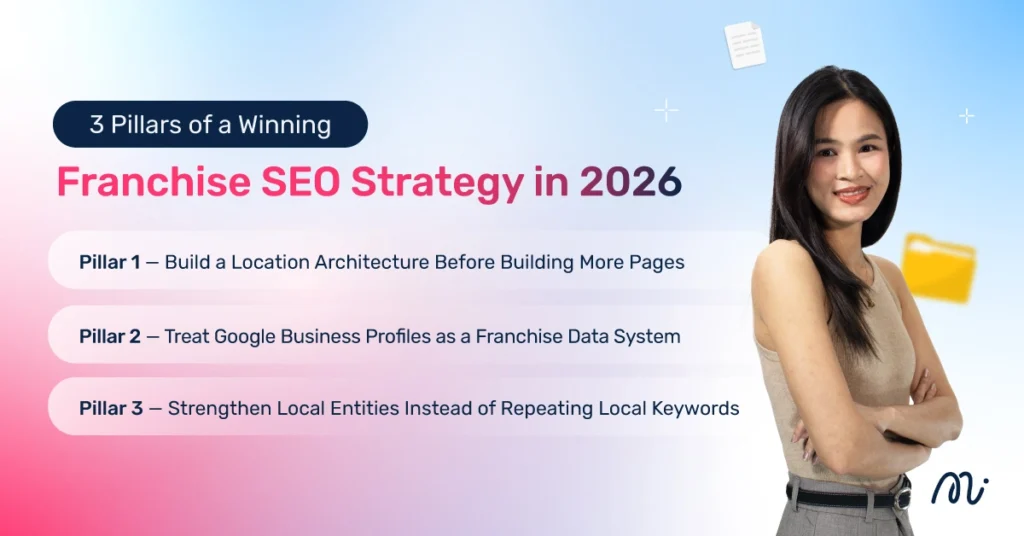
3 Pillars of a Winning Franchise SEO Strategy in 2026
A strong SEO franchise framework should work at network level, not page by page.
When architecture and search intent are defined clearly, new branches can follow the same system instead of creating new SEO conflicts each time the network expands.
Pillar 1 — Build a Location Architecture Before Building More Pages
Before publishing another location page, define its role.
Decide:
- What national pages target
- What city pages target
- When a branch needs its own indexable page
- Which keyword cluster belongs to each URL
- How locations connect through internal links
- Which geographic pages are unnecessary
A scalable structure could look like:
/locations/
/locations/metro-manila/
/locations/metro-manila/bgc/
/locations/cebu/
/locations/davao/
Not every franchise needs every level. A city hub should exist only when it serves a distinct search need.
Give Every Location Page a Reason to Exist
Unique content is not just rewritten copy.
A useful branch page should include information specific to that location such as:
- Services available at the branch
- Opening hours
- Contact details
- Service areas
- Directions
- Nearby landmarks
- Location-specific photos
- Real local FAQs
- Local offers when applicable
The page should help someone evaluate that branch specifically.
Pillar 2 — Treat Google Business Profiles as a Franchise Data System
For a franchise, Google Business Profiles should be managed as one connected data system.
Problems often appear when headquarters, local teams, and franchisees edit information independently.
Governance should cover:
- Business naming
- Addresses
- Phone numbers
- Categories
- Branch URLs
- Opening hours
- Review management
- User access
- Approval processes
Google’s Business Profile guidelines for chains and locations emphasize accurate real-world information and consistent representation across locations.
The key issue is ownership. Someone needs to control which data is correct and who can change it.
Optimize for Relevance Without Trying to Fake Distance
A franchise cannot change the physical distance between a branch and a searcher.
What it can improve is relevance and data accuracy.
Google explains local ranking through relevance, distance, and prominence in its guidance on how Google determines local rankings.
Focus on:
- Accurate categories
- Complete branch information
- Genuine addresses
- Relevant landing pages
- Consistent service details
- Strong local reputation signals
Do not create virtual locations just to expand ranking coverage.
Pillar 3 — Strengthen Local Entities Instead of Repeating Local Keywords
Repeating a city name more often does not automatically strengthen local relevance.
For multi-location SEO, search engines need clear relationships between:
Brand → Location → Address → Services → URL → Business Profile
Priorities include:
- Matching page data with Business Profile data
- Keeping branch URLs crawlable
- Using consistent organization and location relationships
- Maintaining clean internal links
- Implementing relevant LocalBusiness structured data
Google’s LocalBusiness structured data documentation shows how structured data can describe business details such as location and operating hours.
Schema should clarify information, not act as a ranking shortcut.
How AI Search and GEO Are Changing Local Discovery for Franchises
GEO does not replace SEO.
Google’s current guide to optimizing for generative AI search continues to emphasize crawlability, useful content, technical foundations, and clear site structure.
For franchises, this matters because a poor GEO strategy can recreate the same duplication problem as poor Local SEO.
From “Best Franchise Near Me” to Complex Local Questions
Users can now search with more context in one query.
A search may combine:
- Location
- Service
- Availability
- Operating hours
- Specific requirements
That makes accurate branch-level information more important.
The website should clearly show which branch offers which service, where it operates, and when it is available.
GEO Does Not Mean Creating Hundreds of AI-Optimized Pages
A separate page is not needed for every possible AI prompt.
Instead:
- Build comprehensive resources
- Avoid duplicated city variations
- Add useful operational insight
- Keep content crawlable
- Update existing pages when the intent is the same
For franchise marketing SEO, this prevents AI Search from becoming another source of unnecessary URL growth.
Make Each Franchise Location Easy for Machines to Understand
Each location should have clear, consistent information across the website and local profiles.
Focus on:
- Crawlable branch pages
- Consistent NAP
- Clear headings
- LocalBusiness structured data
- Correct categories
- Contextual internal links
- Accurate operating hours
- Original branch images
- Clear parent-brand relationships
Franchises preparing for AI-driven discovery can also connect this work with AI Search SEO services.
How to Prevent Franchise Locations From Cannibalizing Each Other
Start with search intent before technical fixes.
A practical audit:
- Export landing pages and queries from Search Console.
- Group queries by topic, location, and intent.
- Identify queries triggering multiple URLs.
- Assign one preferred URL to each important intent.
- Decide whether overlapping pages should be differentiated, merged, redirected, or repositioned.
- Review internal links.
- Review titles and headings.
- Check canonical signals.
- Check sitemap inclusion.
- Monitor which URLs rank after changes.
If the team cannot decide which page should own a query, the site structure is probably not clear enough.
Create a Keyword-to-URL Ownership Map
Assign each keyword cluster to one primary destination:
- Brand or National Intent → Main service page
- City Intent → City hub
- Branch Intent → Individual location page
- Informational Intent → Blog or guide
- AI Search Topic → Comprehensive expert resource
The difficult part is not publishing another page. It is deciding what intent that page should have.
Know When to Merge, Differentiate, or Keep a Page
Use a simple decision framework:
- Keep: The page represents a real location and provides useful local information.
- Differentiate: The page serves a valid market but overlaps another URL.
- Merge: Two pages serve essentially the same search need.
- Redirect: An old location has a clear replacement.
- Noindex or remove: The page no longer has a useful organic-search role.
Every location page should answer three questions:
Who is this page for? What intent does it have? Why should it exist separately?
Common Franchise SEO Mistakes We See as Networks Grow
- Targeting the same primary keyword across every branch: Separate national, city, and branch intent instead of making every page target the same term.
- Duplicating location page content: Changing only the city name and contact details does not create meaningful local value.
- Creating too many city pages without real local value: A city page should serve a clear search purpose, not exist only to target another location keyword.
- Using inconsistent Google Business Profile information: Keep naming, URLs, categories, hours, and contact details consistent across the network.
- Sending every Google Business Profile to the homepage: Link profiles to the most relevant branch page when one exists.
- Building internal links without clear page ownership: Internal links should reinforce the relationship between national, city, and branch pages.
- Trying to fix cannibalization by adding more content: Check intent and URL ownership before making competing pages longer.
- Measuring franchise SEO only by rankings: Also track organic traffic, leads, conversions, local visibility, and query overlap.
- Launching new locations before planning the SEO structure: Define the URL, target intent, internal links, Business Profile, and local content before publishing.
For Minimice Group Manila, effective franchise SEO means giving every location a clear role within the wider network.
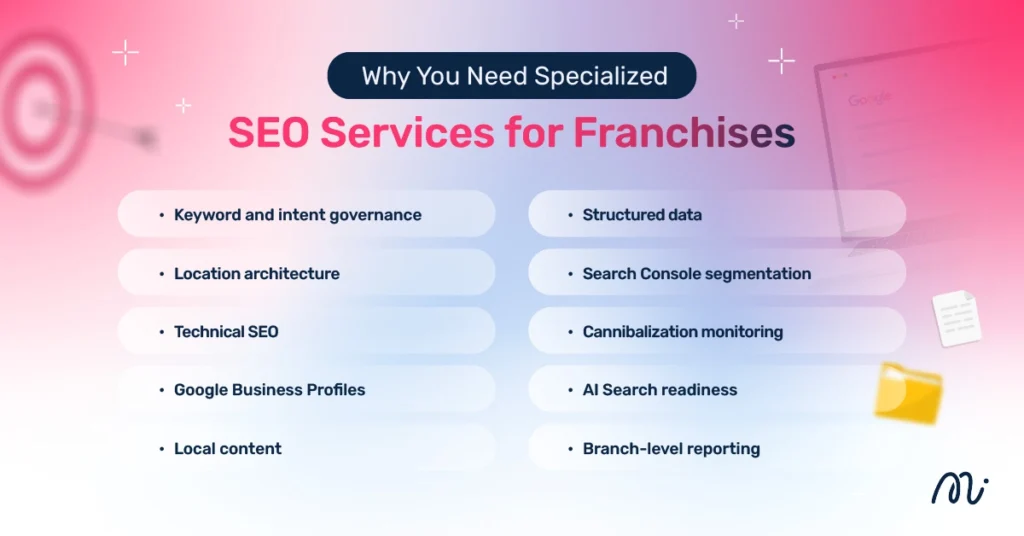
Why You Need Specialized SEO Services for Franchises
Franchise SEO requires coordination across multiple areas at once:
- Keyword and intent governance
- Location architecture
- Technical SEO
- Google Business Profiles
- Local content
- Structured data
- Search Console segmentation
- Cannibalization monitoring
- AI Search readiness
- Branch-level reporting
This is why SEO services for franchises need to work at the network level rather than optimizing each branch in isolation.
A Franchise SEO Partner Should Think Beyond Rankings
Rankings matter only when they support business demand.
A franchise SEO partner should evaluate:
- Whether local rankings match actual service coverage
- Whether traffic produces qualified demand
- Whether the location structure can scale
- Whether teams use consistent business data
- Whether organic visibility leads to useful actions
Minimice Group Manila’s SEO services in the Philippines combine Local SEO with technical, content, and conversion-focused strategy for businesses operating across multiple markets.
A Practical Franchise SEO Checklist Before Entering a New Philippine City
- Confirm the location is operational.
- Research city-level search intent.
- Assign target keywords to a specific URL.
- Decide whether a city hub is necessary.
- Prepare useful local information.
- Set up or verify the correct Google Business Profile.
- Connect the profile to the relevant branch URL.
- Check NAP consistency.
- Implement relevant structured data.
- Add contextual internal links.
- Update XML sitemaps.
- Validate indexability.
- Track queries and landing pages.
- Monitor overlap with existing locations.
- Review AI Search visibility alongside traditional organic performance.
Conclusion
Scaling across multiple Philippine cities requires more than publishing more location pages. Strong franchise SEO depends on clear keyword ownership, useful local content, accurate business data, and a structure that allows new branches to grow without competing with existing pages.
At Minimice Group Manila, our approach to franchise SEO starts by understanding how the entire network fits together before optimizing individual pages in isolation. That means defining search intent, organizing location architecture, strengthening local signals, and building a system that can continue working as the franchise enters new markets.
For franchise brands looking for SEO services for franchises built around sustainable multi-location growth, explore Minimice Group Manila’s SEO solutions and build a search strategy designed to scale with the business.
FAQ
What is Franchise SEO?
Franchise SEO is an SEO strategy for businesses with multiple locations. It combines Local SEO, technical SEO, location-page optimization, Google Business Profiles, and content planning so branches can rank without competing unnecessarily with the parent brand or each other.
How is Franchise SEO different from regular Local SEO?
Local SEO may focus on one location. Franchise SEO must coordinate national pages, city hubs, and multiple branches across the same website.
Can franchise locations compete with each other on Google?
Yes. This often happens when several location pages target the same keywords and serve similar intent. A keyword-to-URL ownership map helps clarify which page should rank.
Should every franchise location have its own webpage?
Only when the page represents a real location and provides useful branch-specific information. A separate page should not exist only to target another city keyword.
How much unique content does each franchise location page need?
There is no fixed word count. The page should contain enough real local information to make it useful on its own, such as services, hours, contact details, directions, photos, and local FAQs.