

Key Takeaway
- Why Information Gain SEO Matters for B2B Content: It gives readers information competitors do not already provide through first-party knowledge, expert judgment, local context, and practical decision frameworks.
- How Businesses Should Use Generative AI for Content Creation: Use AI to accelerate research, clustering, outlining, and drafting. Human review should add fact-checking, business judgment, original insights, and Philippines market context.
- How Minimice Group Manila Supports SEO and GEO Growth: The team connects Technical SEO, search intent, content differentiation, and AI Search visibility so each page has a clear role in sustainable organic growth.
Generative AI has made content creation faster, but it has also created a sea of sameness where many B2B articles repeat the same ideas. In the Philippines market, simply publishing more content is no longer enough. Information Gain SEO focuses on adding something genuinely useful through first-party knowledge, local context, expert judgment, and practical insight. Instead of using Generative AI for Content Creation as the final output, businesses should use it as a starting point to create content that gives both readers and generative engines a clear reason to choose it.
The Problem with Generic AI Content in B2B Marketing
The problem is not AI. The problem is content that gives readers no reason to choose one article over another.
A common B2B structure is:
Definition → Benefits → Best Practices → CTA
That structure is not inherently weak, but it becomes generic when every section repeats information already available elsewhere.
Key risks include:
- AI lowers the cost of producing acceptable content.
- Competitors can reproduce generic explanations quickly.
- Completeness does not equal originality.
- A 2,000-word article can still add very little information.
- Generative engines can summarize common knowledge before users visit individual websites.
Google’s guidance on generative AI content focuses on accuracy, quality, relevance, and user value rather than whether AI was involved.
A pattern that often appears during content audits is that polished articles still struggle because every section answers the same questions in almost the same way as competing pages.
The “Sea of Sameness” Problem
The sea of sameness appears when brands use similar public sources and ask AI to summarize the same information.
Typical results include:
- Similar definitions
- Similar examples
- Similar listicles
- Similar recommendations
- Similar conclusions
The issue is not writing quality. It is the lack of new knowledge or decision value.
Strong content should answer the difficult part of the problem and reduce the reader’s need to keep searching.
Detecting AI Content Is Not the Real SEO Problem
Detecting AI content should not be the goal of an SEO strategy.
Google does not prohibit content simply because AI helped create it. The policy concern is automation used primarily to manipulate rankings at scale while adding little value. Google’s Search spam policies address this under scaled content abuse.
The better editorial question is:
What did we add that was not already present in the generated draft?
Human review should check:
- Accuracy
- Relevance
- Missing context
- Weak assumptions
- Local applicability
- Original insight
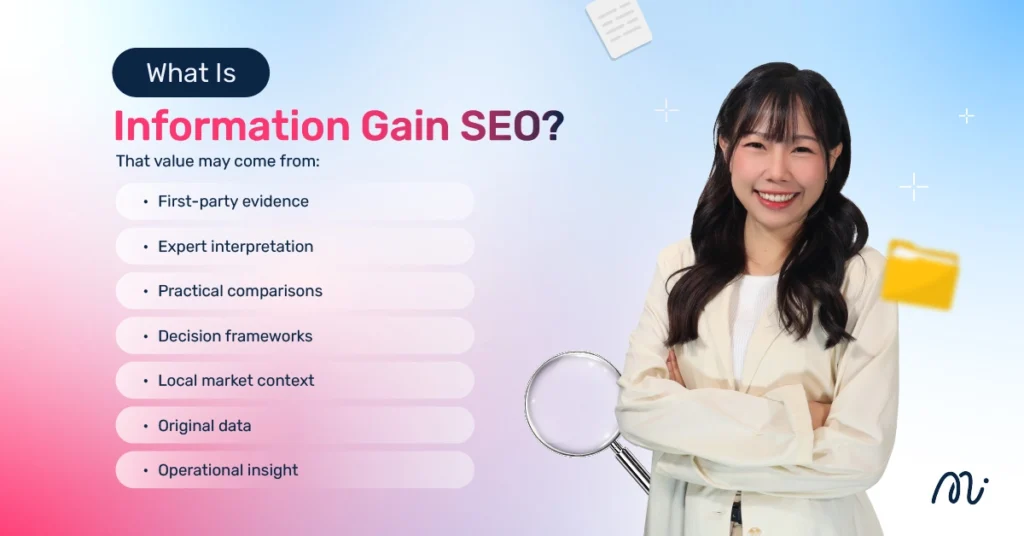
What Is Information Gain SEO?
Information Gain SEO asks one question:
What does this page add beyond what the reader can already find?
That value may come from:
- First-party evidence
- Expert interpretation
- Practical comparisons
- Decision frameworks
- Local market context
- Original data
- Operational insight
Google’s patent on contextual information gain describes an information gain score based on additional information a document provides beyond information already presented to a user.
That does not confirm a current standalone ranking factor called “Information Gain SEO.” It is better treated as a content strategy principle.
Information Gain Is Not the Same as Content Length
More words do not automatically create more value.
A 3,000-word article that repeats common advice may be less useful than a 1,500-word article with a clear decision framework.
Add sections only when they:
- Answer a new question
- Explain an exception
- Add evidence
- Compare alternatives
- Help the reader make a decision
Information density matters more than artificial length.
Information Gain vs. Keyword-First Content
Keyword research still matters, but it should not be the final step.
A stronger process is:
- Keyword research identifies demand.
- SERP analysis shows what is already covered.
- Information gain identifies what the business can add.
Strong SEO combines all three.
Avoid creating separate pages for every small query variation. Google’s current AI Search guidance warns against large-scale page creation designed mainly to influence rankings or generative responses.
Why Information Gain Matters for GEO
Generative engines synthesize information from multiple sources to produce answers. Content therefore needs to be not only discoverable, but also clear, useful, and supported by information that adds meaningful value. The original GEO research frames the goal around improving content visibility within generative engine responses.
For content teams, this means focusing on information that helps a page contribute something useful to the answer:
- Make important facts easy to identify.
- Support claims with evidence.
- Add useful context or original insight.
- Use clear comparisons where relevant.
- Explain reasoning behind conclusions.
- Avoid burying important information in unnecessary text.
None of this guarantees an AI citation.
SEO Is Still the Foundation of GEO
GEO still depends on core SEO foundations:
- Crawlability
- Indexability
- Relevance
- Helpful content
- Technical SEO
Google’s guide to optimizing for generative AI features states that SEO best practices remain foundational to generative AI visibility.
A practical sequence is:
Technical SEO → Search Intent → Useful Content → Information Gain → GEO Visibility
3 Ways to Inject Information Gain into Your Corporate Content
1. Turn Internal Knowledge into First-Party Insight
The most defensible information is often already inside the business.
Useful sources include:
- Sales teams
- Customer support
- Product specialists
- Service teams
- Management
- Implementation teams
Look for:
- Questions prospects ask repeatedly
- Common misconceptions
- Trade-offs customers underestimate
- Implementation problems
- Variables that change recommendations
- Situations where standard advice fails
- Internal decision frameworks
One of the most overlooked content sources is the knowledge already sitting inside sales calls, implementation discussions, and internal decision-making processes.
2. Add Decision-Making Value, Not Just More Information
B2B readers often need help deciding rather than another definition.
Instead of stopping at:
What is SEO?
Add questions such as:
- When should a company prioritize SEO over paid acquisition?
- When is SEO a poor short-term fit?
- Which metrics should management review before increasing investment?
- When is the problem technical rather than editorial?
- When does publishing more content create diminishing returns?
Information Gain Principle: Help the reader make a better decision rather than simply learn another definition.
3. Use Generative AI for Content Creation as an Accelerator, Not the Source of Differentiation
AI can support:
- Research organization
- Topic clustering
- Outlining
- Question discovery
- Drafting
- Editing
- Repurposing
Human expertise should add:
- Fact verification
- Business judgment
- First-party evidence
- Philippines context
- Nuance
- Prioritization
- Original conclusions
A practical workflow is:
AI Draft → Fact Check → Expert Review → Local Context → Information Gain → Final Edit
The quality gap usually appears after the first draft. Publishing immediately often preserves generic assumptions. Reviewing and challenging the draft is where real differentiation begins.
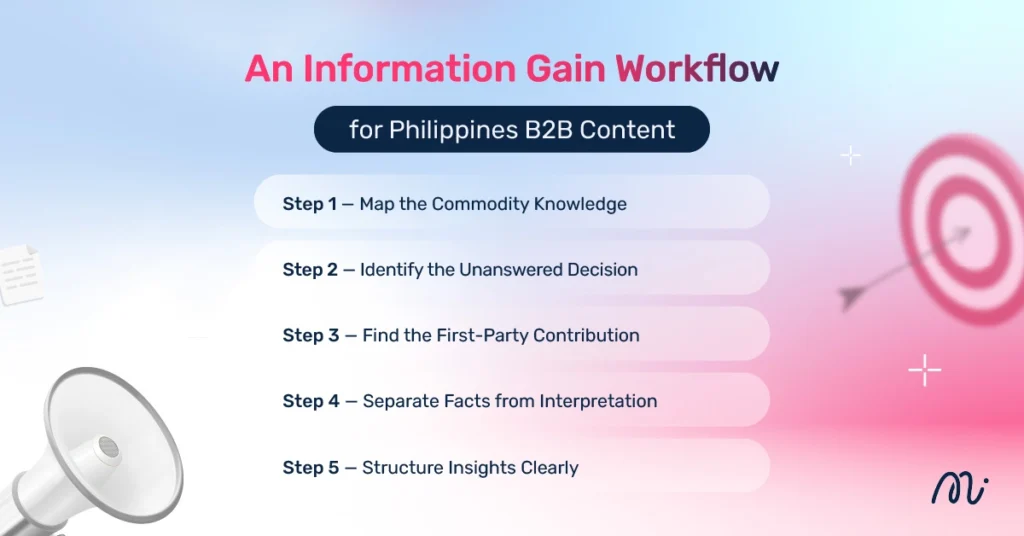
An Information Gain Workflow for Philippines B2B Content Teams
Step 1: Map the Commodity Knowledge
Identify what competing pages repeat:
- Definitions
- Examples
- Statistics
- Recommendations
- Article structures
Step 2: Identify the Unanswered Decision
Ask:
- What does the reader still not know?
- Where could two experts disagree?
- What depends on context?
- What could make standard advice fail?
Step 3: Find the First-Party Contribution
Use:
- Internal subject-matter experts
- Business data
- Product usage patterns
- Customer questions
- Process documentation
- Original research where available
Step 4: Separate Facts from Interpretation
Distinguish between:
- External evidence
- Internal observations
- Professional judgment
- Hypotheses
Step 5: Structure Insights Clearly
Use:
- Clear headings
- Direct definitions
- Bullet points
- Useful comparison tables
- Evidence close to claims
- Descriptive anchor text
- Concise summaries
- Original conclusions
How to Measure Whether Your Content Actually Adds Information Gain
Do not invent an “Information Gain Score.”
Evaluate content through editorial quality and performance.
Editorial Checks
Ask:
- Does the article contain an insight not easily found on competing pages?
- Can the original contribution be identified clearly?
- Does it explain why recommendations change by context?
- Are important claims supported?
- Does it help the reader make a decision?
SEO Indicators
Monitor:
- Search impressions
- Ranking distribution
- Non-brand query growth
- Organic engagement
- Assisted conversions
- Qualified leads
GEO Indicators
Where measurable, track:
- Brand mentions in AI answers
- Citation frequency
- URLs receiving citations
- Topics that trigger visibility
- Differences across AI platforms
Do not treat citation as the final business outcome.
Retrieval → Citation → Visit → Conversion are separate stages.
Why the Philippines Market Makes Information Gain Especially Relevant
AI is already becoming part of professional workflows in the Philippines. Microsoft’s 2026 Work Trend Index findings for the Philippines show that among Filipino AI users surveyed:
- 65% identified critical thinking as the most important human skill as AI takes on more work.
- 59% prioritized quality control of AI output.
- 93% treated AI output as a starting point rather than a final answer.
For Philippines B2B teams, the implication is clear: faster AI-assisted production increases the importance of human judgment, local context, and quality control.
AI Efficiency + Human Judgment + Local Context + First-Party Knowledge

Stop Writing for Bots. Start Optimizing for Generative Engines with Minimice Group
Publishing more content is not automatically a growth strategy.
A stronger SEO and GEO process should examine:
- Technical barriers
- Search demand
- Search intent
- Content quality
- Duplicate or overlapping pages
- Information gaps
- First-party knowledge
- Conversion relevance
- AI Search visibility
Information Gain SEO should connect to commercial intent. Original content is still weak if it answers a question that does not matter to the audience or business.
Minimice Group Manila approaches SEO as a growth system rather than a publishing race, connecting technical foundations, search demand, content differentiation, and business intent. Businesses looking to build a sustainable SEO strategy with Minimice Group Manila can use this approach to ensure every new page has a clear role in supporting search visibility and long-term growth.
Conclusion
Generative AI has made content easier to produce, but differentiation now matters more. Information Gain SEO helps B2B businesses create content that adds first-party knowledge, local context, expert judgment, evidence, or practical decision value. GEO adds another visibility layer, but the foundation remains the same: strong technical SEO, clear search intent, trustworthy information, and content worth retrieving.
Minimice Group Manila helps businesses approach SEO from that foundation: understanding where visibility is being lost, identifying what users actually need, building content that adds genuine information, and connecting organic visibility with sustainable business growth.
FAQs
How Can Businesses Apply Information Gain SEO to Existing Content?
Businesses can improve existing content by identifying what competitors already cover, then adding missing value through first-party knowledge, local context, expert judgment, practical comparisons, or clearer decision-making guidance. The goal is not to make the page longer, but to make it more useful and harder to replicate.
Is Information Gain a confirmed Google ranking factor?
No. Google patents discuss information gain concepts, but Google has not confirmed Information Gain as a standalone ranking factor. It is better treated as a useful content strategy principle rather than a confirmed ranking signal.
Why Is Information Gain SEO Important for GEO?
Information Gain SEO is important for GEO because generative engines favor useful, distinct information they can retrieve and synthesize. Content with original insight, evidence, and clear context is more valuable than pages that simply repeat existing information.
Does Google penalize AI-generated content?
No. Google does not penalize content simply because it is AI-generated. The main concern is whether the content is helpful, original, accurate, and created to serve users rather than manipulate search rankings.
Is Detecting AI Content Important for SEO?
AI-generated content does not automatically hurt SEO. What matters more is whether the content is helpful, accurate, original, and aligned with search intent.