
Key Takeaway
- Cost per lead (CPL) is your ad spend divided by the number of leads you got from that spend.
- There is no single “good” CPL for every business. A good CPL is one your deal value, margin and close rate can afford.
- You can work out your own break-even and target CPL with three numbers you already have: average deal value, gross margin and close rate.
- Cheap leads are not always good leads. Track cost per qualified lead and ROI alongside CPL so you do not cut the campaigns that bring in customers.
“Is our cost per lead too high?” is one of the first questions business owners ask once their ads start bringing in inquiries. The honest answer is that it depends. What is a good cost per lead for a dental clinic can be very different from what works for a solar installer or a law firm, because each earns a different amount from a new customer. This guide explains what CPL means, how to calculate it, and how to work out a target that fits your own numbers instead of someone else’s.
This guide is written by the Minimice Group team in Manila, a Google Premier Partner that plans and runs Google Ads and social media ads for businesses in the Philippines.
Minimice team tip: before you judge any CPL, ask your sales team one question: “Out of the last 20 leads, how many became paying customers?” That single number changes how every CPL figure looks.
Cost per Lead Meaning: What CPL Tells You
The cost per lead meaning is simple: it is how much you paid, on average, to get one person to raise their hand. A lead can be a form submission, a call from your ad, a message or a booked consultation, as long as you count it the same way every time.
In cost per lead in digital marketing, CPL sits between your ad metrics (clicks, cost per click) and your business results (customers, revenue, profit). It shows whether your ads produce inquiries at a sensible cost, but says nothing about whether those inquiries turn into sales.
Google Ads uses a slightly different name for the same idea. In its help article on return on investment, Google explains that the amount it costs you to get a lead is known as cost per action (CPA) (Google Ads Help). In your reports you will often see this as cost per conversion. The same article describes conversions as customer actions you consider valuable, such as purchases, signups or leads, and notes that conversion tracking helps you track costs per conversion (Google Ads Help).
The Cost per Lead Formula
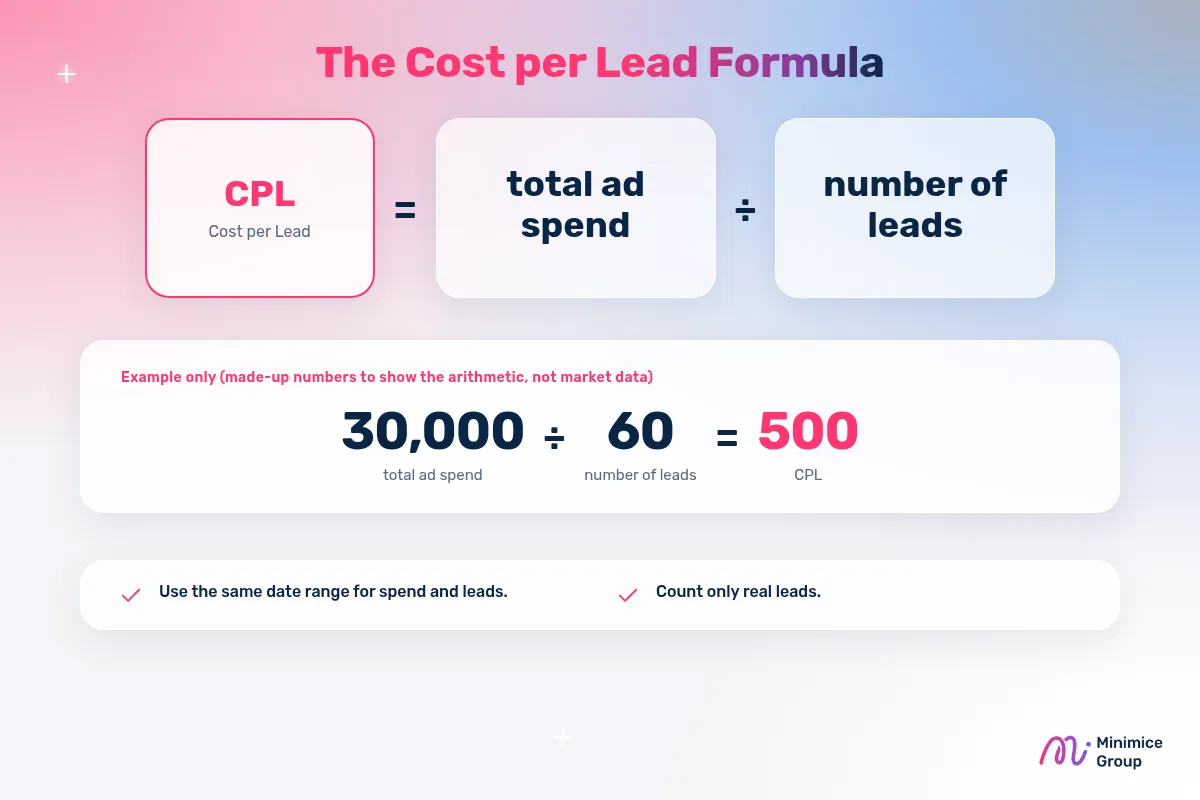
The cost per lead formula is:
CPL = total ad spend ÷ number of leads
Example only (made-up numbers to show the arithmetic, not market data): if a campaign spent 30,000 in a month and brought in 60 leads, the CPL is 30,000 ÷ 60 = 500.
Two rules keep this number honest:
- Use the same date range for spend and leads. Mixing a full month of spend with two weeks of leads makes CPL look worse than it is.
- Count only real leads. Spam form fills, duplicate entries and wrong numbers should be removed, or your CPL will look better than it is.
What Is a Good Cost per Lead? It Depends on Your Numbers
We do not list “average CPL” figures by industry here. A number that is fine for one business can be a loss for another, and figures from other markets or years can lead to bad decisions. A good cost per lead is one your business can afford while still making a profit on the customers those leads become.
Three numbers decide what you can afford:
- Average deal value: how much revenue a typical new customer brings in (or their first-year value, if they buy again).
- Gross margin: the share of that revenue left after the direct cost of delivering the product or service.
- Close rate: the share of leads that become paying customers.
Google uses the same logic in its own example. If you make one sale for every 10 leads and a typical sale is worth 20 dollars, each lead generates 2 dollars on average (Google Ads Help). Your CPL has to stay below what each lead is worth to you.
How to Work Out Your Own Target CPL, Step by Step
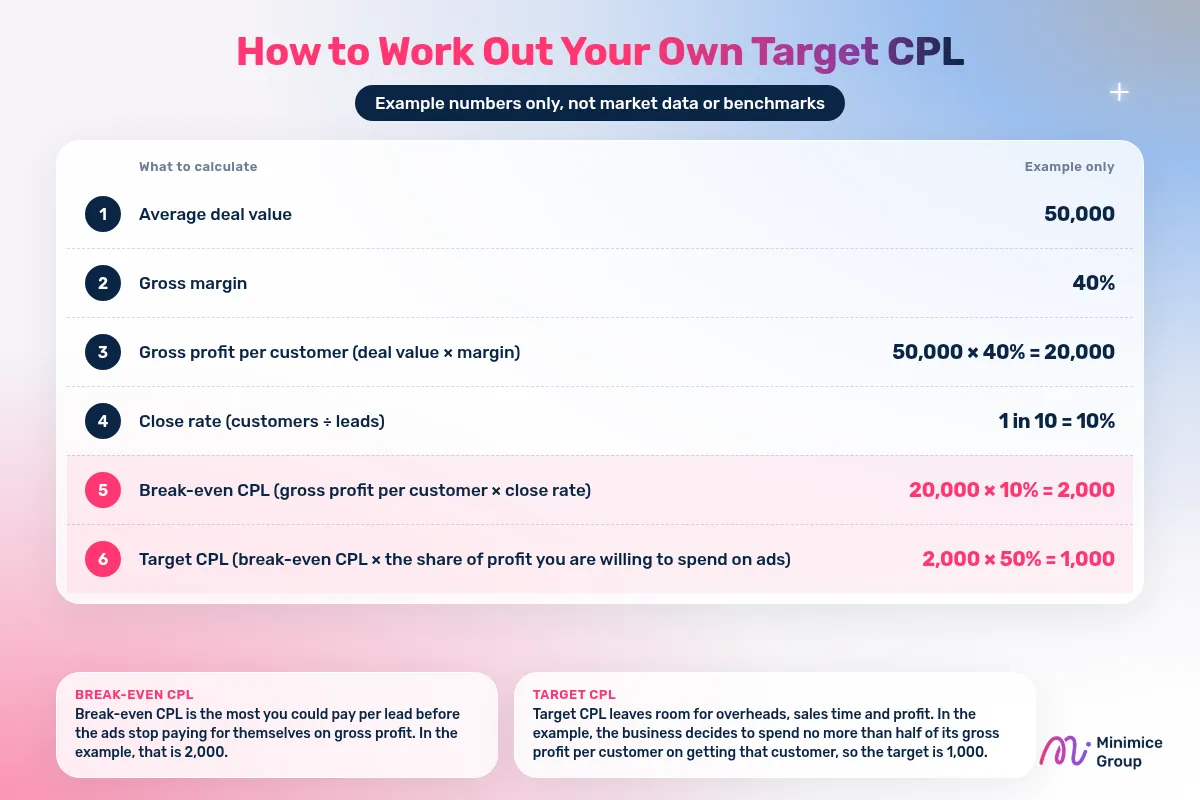
The figures below are example numbers only, chosen to make the arithmetic easy to follow. They are not market data or benchmarks. Replace them with your own figures in pesos.
| Step | What to calculate | Example only |
|---|---|---|
| 1 | Average deal value | 50,000 |
| 2 | Gross margin | 40% |
| 3 | Gross profit per customer (deal value × margin) | 50,000 × 40% = 20,000 |
| 4 | Close rate (customers ÷ leads) | 1 in 10 = 10% |
| 5 | Break-even CPL (gross profit per customer × close rate) | 20,000 × 10% = 2,000 |
| 6 | Target CPL (break-even CPL × the share of profit you are willing to spend on ads) | 2,000 × 50% = 1,000 |
What this example tells you:
- Break-even CPL is the most you could pay per lead before the ads stop paying for themselves on gross profit. In the example, that is 2,000.
- Target CPL leaves room for overheads, sales time and profit. In the example, the business decides to spend no more than half of its gross profit per customer on getting that customer, so the target is 1,000.
- Close rate matters as much as ad cost. If the same business improved its close rate from 1 in 10 to 1 in 5, its break-even CPL would double, without touching the ads at all.
The share in step 6 is a business decision, not a rule. A business with strong repeat purchases might accept a higher share; one with thin margins might set it lower.
A Simple Cost per Lead Calculator You Can Build
You do not need a special tool for a cost per lead calculator. A spreadsheet with these columns is enough:
- Month and channel (for example, Google Search, Facebook and Instagram, TikTok).
- Ad spend for that channel and month.
- Leads, qualified leads and customers from your CRM or sales log.
- CPL = spend ÷ leads.
- Cost per qualified lead = spend ÷ qualified leads.
- Cost per customer = spend ÷ customers.
- Break-even CPL and target CPL, using the steps above.
Update it monthly. After a few months you will have your own baseline, which is more useful than any outside average.
Minimice team tip: add a “lead source” field to your form or ask “How did you hear about us?” on the first call. It makes the customer column in your calculator much more reliable.
Cost per Lead on Google vs Meta vs TikTok
Each platform reports cost per lead a little differently, and each attracts people at a different stage. That is why comparing raw CPL across platforms can mislead you. Compare cost per qualified lead and cost per customer instead.
Google Ads
Google Search ads reach people who are actively searching, so leads often arrive with clearer intent. If you already know your target CPL, Google’s Target CPA bid strategy lets you set your desired average cost per conversion. Google notes that some conversions may cost more than your target and some may cost less, but overall it will try to keep your cost per conversion equal to the target you set (Google Ads Help). It is a good fit for accounts that already track leads reliably, and your target CPL gives you a starting point.
Google also offers lead form assets, which let people submit their details directly from the ad (Google Ads Help).
Meta (Facebook and Instagram)
What is a good cost per lead on Meta ads? The same answer applies: the one your margin and close rate can support. Meta ads often reach people before they start searching, so leads may need more follow-up, and quick instant forms can lower quality if they ask too little. Our guide to Meta ads metrics and KPIs for lead generation explains which numbers to watch beyond CPL.
TikTok
TikTok’s lead generation objective is designed to collect leads through instant forms or your website. TikTok recommends setting a daily budget for each ad group of at least 10 times your expected cost per action (TikTok Ads Manager Help). If your target CPL is high, plan how many ad groups your budget can test at once.
If you are deciding where to start, our overview of lead generation ads compares Google, Meta and TikTok lead forms side by side.
CPL vs Cost per Qualified Lead
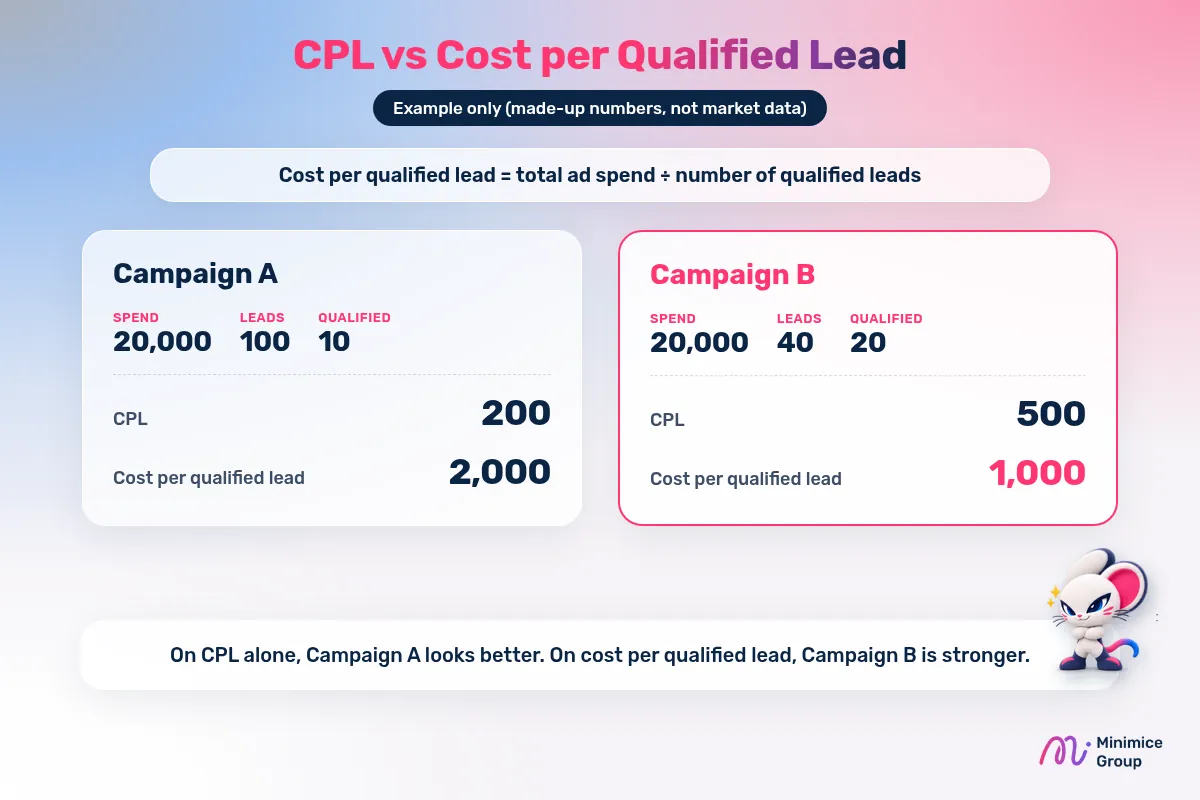
A lead is anyone who submits a form or calls. A qualified lead is one that matches your criteria, for example the right location, budget and need. The formula is:
Cost per qualified lead = total ad spend ÷ number of qualified leads
Example only (made-up numbers, not market data): Campaign A spends 20,000 and gets 100 leads, so its CPL is 200. Only 10 are qualified, so its cost per qualified lead is 2,000. Campaign B spends the same 20,000 and gets 40 leads, so its CPL is 500. But 20 are qualified, so its cost per qualified lead is 1,000.
On CPL alone, Campaign A looks better. On cost per qualified lead, Campaign B is stronger. That is why we look at both, and agree on what “qualified” means with the sales team before launch.
To feed this back into your ads, you can import offline conversions into Google Ads, so the platform learns which clicks led to qualified leads or sales, not just form fills (Google Ads Help). Meta offers a similar route through its Conversions API (Meta for Developers).
ROAS vs ROI: Which Should You Track?
Beyond CPL, the ROAS vs ROI question matters because the two answer different questions.
- ROAS (return on ad spend) compares revenue to ad spend. Google’s example: if your goal is 5 dollars in sales for every 1 dollar spent on ads, your target ROAS is 5 ÷ 1 × 100% = 500% (Google Ads Help).
- ROI (return on investment) compares profit to cost. Google describes ROI as the ratio of your net profit to your costs, and one way to calculate it is (revenue − cost of goods sold) ÷ cost of goods sold (Google Ads Help).
ROAS is easier to track inside ad platforms, especially when you assign values to your conversions (Google Ads Help). ROI is closer to what a business owner cares about, because it accounts for the cost of delivering what you sold.
For lead-based service businesses, revenue usually comes later, offline, so ROAS is hard to measure in the ad account unless you import sales data. A practical approach: use CPL and cost per qualified lead to manage campaigns week to week, and review ROI monthly or quarterly, once you know which leads became customers.
How to Lower Your Cost per Lead Without Hurting Lead Quality
Lowering CPL is only useful if quality holds. These changes usually help on both fronts:
- Fix tracking first. If conversions are missing or counted twice, every CPL figure is wrong. In Google Ads, check your conversion actions under Goals, then Conversions, then Summary (Google Ads Help).
- Match the landing page to the ad. A page that repeats the ad’s promise and makes the next step obvious turns more clicks into leads.
- Cut wasted spend. Exclude search terms that bring clicks from people who will never buy.
- Ask the right number of questions. Too few form questions can bring in low-quality leads, and too many can put people off. Test one change at a time.
- Follow up fast. Slow replies lower your close rate, and with it your break-even CPL.
- Bid on what matters. Once you import qualified leads or sales, consider optimizing toward those instead of raw form fills (Google Ads Help; Google Ads Help).
Minimice team tip: when CPL rises, check close rate and lead quality before cutting budget. Sometimes the ads are fine and the issue is follow-up speed.
Conclusion
There is no universal answer to “what is a good cost per lead”. The useful answer comes from your own numbers: deal value, margin and close rate. Work out your break-even and target CPL, track cost per qualified lead next to it, and review ROI once sales data catches up, so you keep the campaigns that bring in customers, not just cheap form fills.
Minimice Group is a Google Premier Partner team in BGC, Taguig, behind 300+ clients’ success (Minimice Group). We plan Google Ads and Facebook ads around the numbers that matter to your business, not just the numbers in the ad account. If you’d like help setting a realistic target CPL, talk to our team. No fluff, just a clear plan.
FAQ
What is a good CPL for my business?
A good CPL is lower than your break-even CPL, which is your gross profit per customer multiplied by your close rate. Set your target below that number so there is room for overheads and profit.
How do you calculate CPL?
Divide your total ad spend by the number of leads from that spend, using the same date range for both. Remove spam and duplicate leads first.
Is a low CPL always a good sign?
No. A low CPL can come with poor-quality leads that rarely become customers. Check cost per qualified lead and cost per customer before deciding a campaign is working.
How often should I review my CPL?
Check it weekly to spot problems early, and review it against close rate and ROI monthly, once you know which leads became customers.