
Key Takeaway
- Performance Max is a goal-based Google Ads campaign type that reaches YouTube, Display, Search, Discover, Gmail and Maps from a single campaign, using Google AI to find conversions based on your goals.
- Performance Max and Search do different jobs and work well together. A Search exact-match keyword identical to the search takes priority over PMax, so your core queries stay under your control.
- Search works best for new accounts with smaller budgets or limited conversion data. Performance Max campaigns become a strong next step once steady conversion data and reliable tracking are in place.
- Performance Max works best with clear conversion goals, accurate tracking and lead-quality data, while Search is the best fit when you want keyword-level control over which searches trigger your ads.
Every time you log in, Google Ads suggests the same thing: try Performance Max campaigns. Maybe a colleague in Makati swears by it. But is it right for your business? Performance Max campaigns can be a strong addition to your account, and they shine when the conditions are right.
This guide covers what PMax is, how it compares with Search, when each works best, and its strengths and considerations, so you can see where Performance Max Google Ads campaigns fit your plan.
What Is Performance Max in Google Ads?
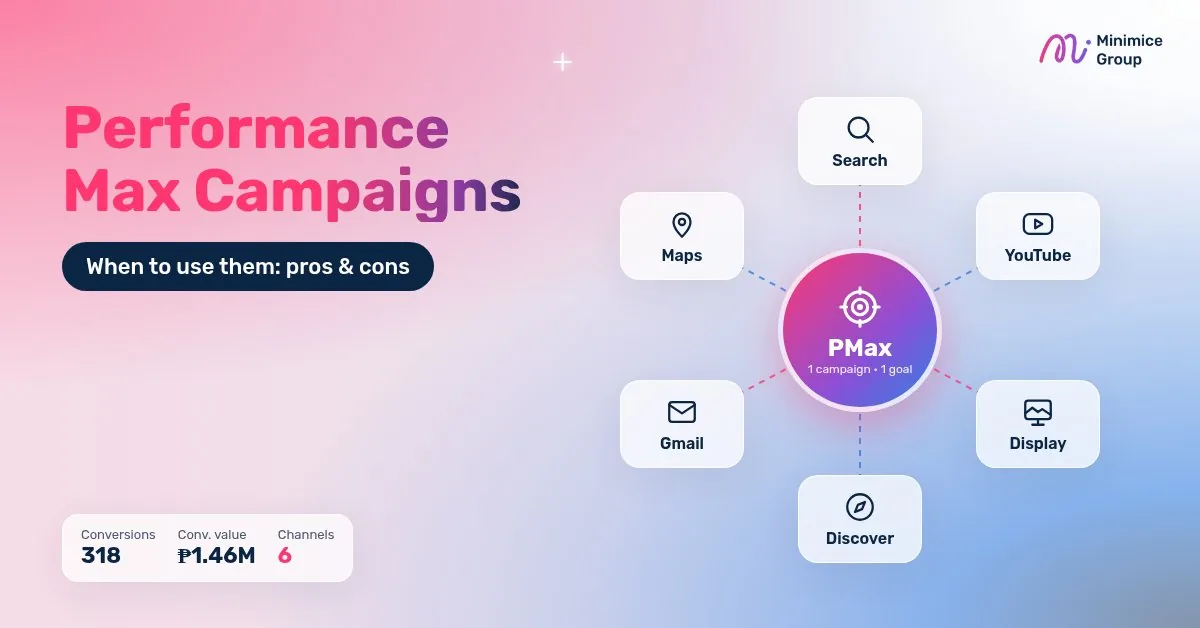
So, what is Performance Max in Google Ads? According to Google Ads Help, it is a goal-based campaign type that gives you access to all Google Ads inventory, including YouTube, Display, Search, Discover, Gmail and Maps, from a single campaign. Google AI then works to find conversions based on the goals you set, such as leads or online sales.
In short, a Performance Max Google Ads campaign is built around outcomes, not channels, and is meant to complement keyword-based Search.
How Performance Max Campaigns Work
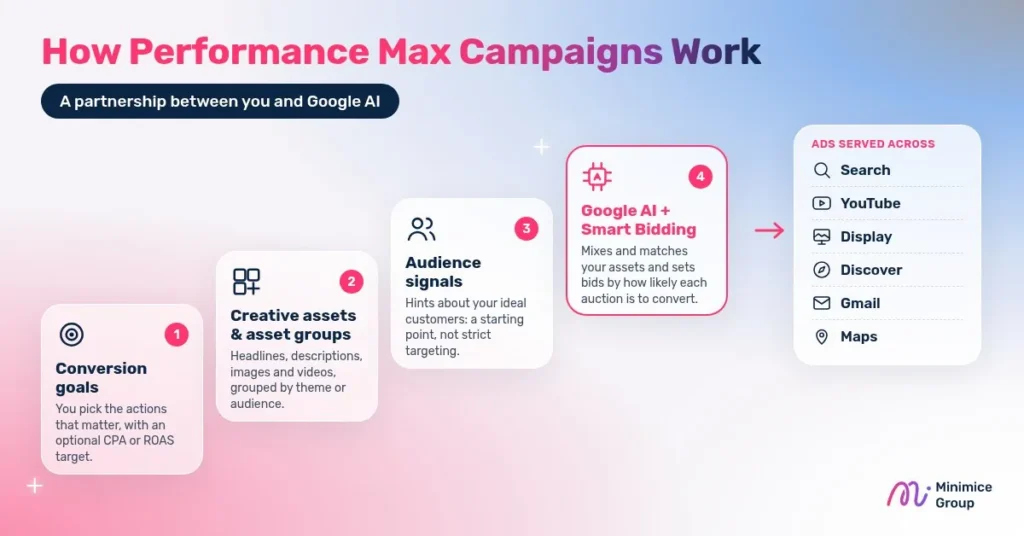
Performance Max campaigns work as a partnership. Here is how the work is split, per How Performance Max works in Google Ads Help:
- Conversion goals: you pick the actions that matter, with an optional CPA or ROAS target.
- Creative assets: you provide headlines, descriptions, images and videos.
- Asset groups: sets of creative assets built around one theme or audience.
- Audience signals: hints about your ideal customers. They give the AI a starting point, not strict targeting.
- Google AI: mixes and matches your assets and serves ads where conversions look likely.
Behind the scenes, PMax uses Smart Bidding to set bids based on how likely each auction is to lead to a conversion.
Minimice team tip: treat audience signals as a hint, not a target list. It is normal for ads to reach people outside your list.
Why Performance Max Matters More in 2026
PMax sits at the heart of the AI-powered ads Google offers. In its May 2026 announcement of new Search ad formats, Google advises building a strong foundation with AI Max for Search, AI Max for Shopping campaigns and Performance Max to make the most of them. For more context, read our Google Marketing Live SEA 2026 recap.
Performance Max vs Search Campaigns: When to Use Each
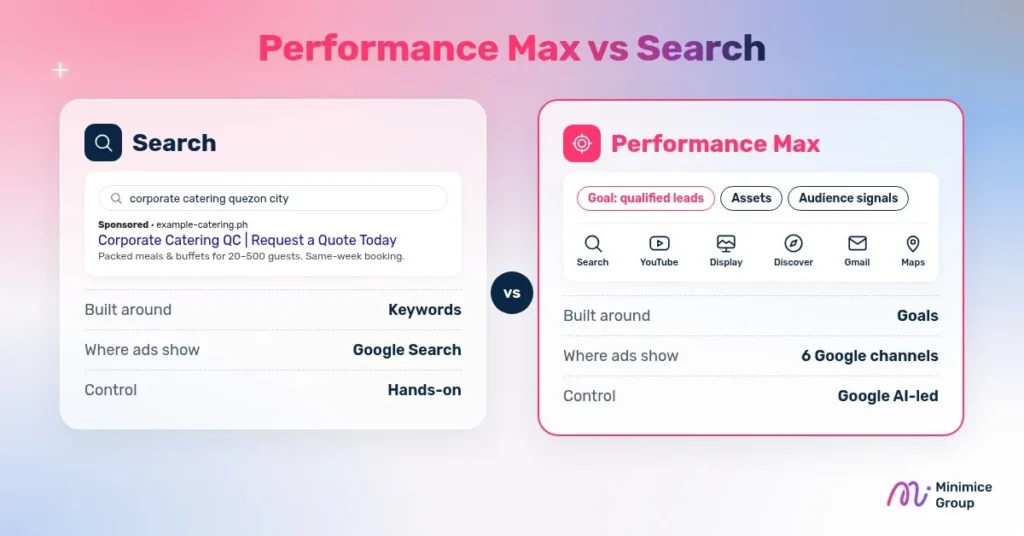
The performance max vs search campaign decision is about which job you need done, not which option wins. Performance Max is goal-based: Google AI decides channels, placements and ad combinations. In any pmax vs search debate, both can share one account, each with a clear role.
Per Google Ads Help, a Search campaign with a keyword that exactly matches the search (including spell-corrected searches) is preferred over Performance Max; otherwise, the higher Ad Rank serves.
| Factor | Search Campaigns | Performance Max |
|---|---|---|
| How targeting works | Keywords and match types you choose | Conversion goals, creative assets, audience signals and optional search themes |
| Where ads can show | Google Search results | YouTube, Display, Search, Discover, Gmail and Maps from one campaign |
| Control | Hands-on: you choose keywords, ad copy and landing pages | Guided: you steer Google AI with goals, assets, audience signals, brand exclusions and negative keywords |
| Reporting | Keyword and search-term level data | Insights plus asset, asset group and channel reporting, focused on overall conversions and value |
| Best fit when | You want clear, high-intent searches, or the account is still building conversion data | Goals, tracking and conversion data are in place and you want extra reach and conversions |
*Table sources: Google Ads Help and Search Engine Land.
Which Campaign Shows When PMax and Search Target the Same Search?
When both could show for the same query, Google follows the order in its ad group and asset group prioritization article:
- An exact-match Search keyword identical to the search comes first.
- Identical includes spell-corrected searches, but not plurals or synonyms.
- PMax search themes carry the same priority as phrase and broad match keywords.
- If no keyword is identical to the search, Google AI picks the most relevant ad group or asset group, and Ad Rank decides between options of equal priority.
So keep your most important, high-intent queries as exact-match keywords in Search.
Minimice team tip: review the search terms of both campaigns regularly to spot overlap early.
How to Run Performance Max and Search Campaigns Together
PMax and Search are not either-or. Google Ads Help describes PMax as a way to complement keyword-based Search campaigns. Follow these steps to give each campaign a clear role:
- Lock in your core queries in Search. Add your most important, high-intent searches as exact-match keywords. Identical exact-match keywords take priority over PMax, so these searches stay under your full control.
- Create the PMax campaign with a clear objective. Choose Leads, Website traffic or Local store visits and promotions, then define which conversion actions count, with an optional CPA or ROAS target.
- Build focused asset groups. Organize headlines, descriptions, images and videos by service in Asset groups, and add Audience signals to guide early learning.
- Guide intent with Search themes. Search themes point Google AI toward valuable searches and carry the same priority as phrase and broad match keywords, so your exact-match terms still come first.
- Reduce overlap. Add Brand exclusions and Negative keywords to prevent overlaps and block unwanted queries, then review the budget panel on the campaign review page for daily budget recommendations.
- Review both campaigns together. Check Channel performance, Asset group reporting and Placement reports for PMax alongside your search terms. Track the new conversions PMax adds beyond branded and returning traffic, since Search Engine Land suggests focusing PMax on net new customers.
When to Use Performance Max Campaigns (and When Search May Be the Better Fit)
Before you shift budget, check when to use performance max campaigns in your account. As Menachem Ani explains in Search Engine Land, Search works best for new accounts with smaller budgets or limited conversion data, because Performance Max relies on machine learning and historical data.
When Performance Max Campaigns Work Best
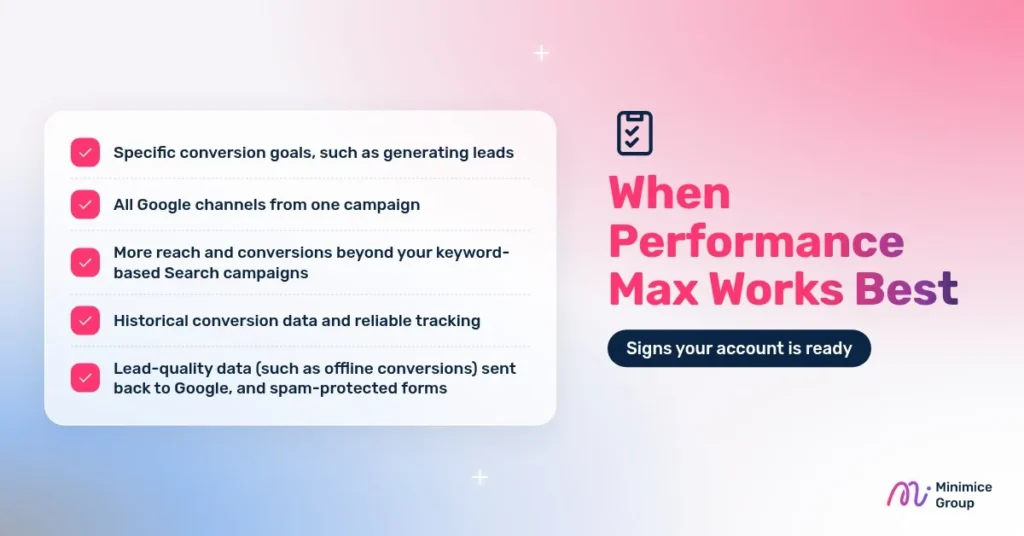
PMax is likely a strong fit when these apply (the first three from Google Ads Help, the last two from Search Engine Land):
- You have specific conversion goals, such as generating leads.
- You want all Google channels from one campaign, without restricting where ads appear.
- You want more reach and conversions beyond your keyword-based Search campaigns.
- Your account already has historical conversion data and reliable tracking.
- For lead generation, you can send lead-quality data (such as offline conversions) back to Google and your forms have spam protection.
What does that look like in practice? These illustrative scenarios (not client results) show where PMax is often a strong fit for Philippine businesses:
- A professional services firm in BGC that already gets steady inquiries from Search and records which leads become clients. Sending that lead-quality data back to Google as offline conversions helps PMax look for more of the right prospects, per Search Engine Land.
- A home services business with branches in Metro Manila and Cebu that wants to appear on Google Maps. Search Engine Land notes that PMax is the primary way to access local placements such as Maps, where calls and direction requests can count as conversions.
- A B2B supplier in a niche market whose core keywords have limited search volume. Once Search conversions are steady, PMax can reach likely buyers beyond those keywords, which Search Engine Land calls scaling beyond intent.
When Search Campaigns May Be the Better Fit
Based on Search Engine Land guidance from the same author, Search works best for:
- New accounts still building historical data.
- Smaller budgets, where Search builds data step by step.
- Limited monthly conversions. The author describes this as typically under 30 conversions a month (a practitioner rule of thumb, not a Google rule).
- Lead-gen accounts still setting up lead-quality inputs, such as CRM integration, spam guards and offline conversions.
- Businesses wanting close control over which searches trigger which message.
Minimice team tip: start with a focused Search campaign, get tracking right, then test PMax once the data is there.
Performance Max Strengths and Considerations
When people look up performance max pros and cons, what they really want to know is where PMax shines and what it works best with.
Strengths
- Wide reach. Ads can appear across YouTube, Display, Search, Discover, Gmail and Maps from one campaign, per Google Ads Help.
- New audiences beyond the keywords you would think of, which Search Engine Land calls scaling beyond intent.
- Automatic creative combinations from one set of text, images and videos.
- Simpler management built around your business goals.
- Useful insights. Rising search trends and asset reporting help guide creative and strategy.
- An easy way to test new channels like YouTube, according to Search Engine Land.
Considerations
- Works best when you are comfortable guiding Google AI with goals and signals, rather than choosing exactly where each ad shows.
- Best fit when you judge success on overall conversions and value, as reporting shows keyword themes and placements rather than keyword-level cost.
- Works best with time to learn. Per Search Engine Land, it can take three to six weeks to get somewhere meaningful, longer for new accounts.
- Works best with accurate conversion tracking, since the AI optimizes for whatever you count as a conversion.
- For lead generation, works best with spam protection and lead-quality data.
- Works best alongside a well-structured Search campaign, with core queries in exact match.
Minimice team tip: agree on the learning period and success metrics with stakeholders before launch, so nobody pauses too early.
What to Check Before You Launch a Performance Max Campaign
Before you go live, confirm:
- Conversion tracking counts the right actions, such as qualified form leads rather than page views.
- One clear conversion goal for the campaign.
- Enough strong headlines, descriptions, images and videos for Google AI to combine.
- Brand exclusions and negative keywords set where needed, per the campaign controls in Google Ads Help.
- Your most important queries covered by exact-match keywords in Search.
- Budget and expectations agreed for the learning period.
Minimice team tip: do a quick tracking audit before launch, because PMax learns from whatever data you give it.
How Minimice Group Helps Businesses Get More from Google Ads
Minimice Group is a full-service digital marketing agency in the Philippines that started as a team of SEO specialists, and we are proud to be a Google Premier Partner. Every campaign starts with in-depth business and competitor analysis and an account structure built for ongoing optimization.
Our Google Ads services cover keyword research selected together with you, ad creation and campaign management, A/B landing page testing, remarketing and real-time dashboard reporting, with AI and automation built in.
Conclusion
Performance Max campaigns offer a goal-based way to reach every major Google channel from one campaign. They work alongside Search, where identical exact-match keywords take priority. PMax works best with clear goals, accurate tracking and enough conversion data; Search suits newer accounts, smaller budgets and keyword-level control. Its strengths are reach and new audiences, and it rewards patience.
Not sure whether PMax, Search or a mix suits you? Through our Google Ads management services, we can review your setup and map out a clear plan together.
FAQ
What is Performance Max in Google Ads?
Performance Max is a goal-based Google Ads campaign type that gives you access to all Google Ads inventory, including YouTube, Display, Search, Discover, Gmail and Maps, from a single campaign. You provide conversion goals, creative assets and audience signals, and Google AI uses them to find conversions, according to Google Ads Help.
When should you use Performance Max campaigns?
Knowing when to use performance max campaigns comes down to readiness. Performance Max works best when you have specific conversion goals such as leads, reliable tracking and enough historical conversion data. Google Ads Help recommends it when you want to reach all Google channels from one campaign and grow beyond keyword-based Search.
Should you choose Performance Max or Search campaigns?
In the performance max vs search campaign decision, each option suits a different job, and many accounts run both. Search gives keyword-level control over high-intent queries, while Performance Max adds reach and automation. Per Google Ads Help, a Search exact-match keyword identical to the search takes priority over Performance Max.
What are the main strengths of Performance Max, and what does it work best with?
According to Google Ads Help, Performance Max offers reach across YouTube, Display, Search, Discover, Gmail and Maps from one campaign and helps you find new audiences beyond your keywords. It works best with clear goals, accurate conversion tracking, time to learn, and a team comfortable guiding Google AI instead of setting every keyword.
What’s the advantage of adopting Performance Max alongside Search campaigns?
The advantage is that each campaign does a different job. Search keeps your core, high-intent queries under your control, because a Search exact-match keyword identical to the search takes priority over Performance Max, per Google Ads Help. Performance Max complements that Search campaign by adding reach across YouTube, Display, Discover, Gmail and Maps from one campaign, and by helping you find audiences beyond the keywords you already cover, which Search Engine Land describes as scaling beyond intent.
Can you run Performance Max and Search campaigns at the same time?
Yes. Google Ads Help positions Performance Max as a complement to keyword-based Search campaigns, and both can run in the same account. Keep your core, high-intent queries as exact-match keywords in Search, then use brand exclusions and negative keywords in Performance Max to prevent overlap and block unwanted queries.
Can new Google Ads accounts use Performance Max?
Yes, though timing matters. Search works best for new accounts with smaller budgets or limited conversion data, because Performance Max relies on machine learning and historical data, as Search Engine Land explains. Performance Max Google Ads campaigns become a strong next step once Search brings in steady conversions and tracking is reliable.