
Key Takeaway
- SEO (Search Engine Optimization) is the practice of improving your website’s organic ranking on search engines. It involves optimizing content and technical elements to earn free, consistent traffic over time.
- Google Ads is a pay-per-click (PPC) advertising platform where you pay to appear at the very top of search results. It provides instant visibility and highly targeted traffic as soon as you launch a campaign.
- SEO builds long-term trust and free traffic but takes time and ongoing effort. Google Ads delivers fast results and precise targeting, but costs can rise quickly—and traffic stops once you stop paying.
- Choose Ads for fast, short-term sales, testing markets, or new product launches. Choose SEO to build long-term dominance and lower acquisition costs, though using both simultaneously is the most effective strategy.
Every business owner asks the same question: SEO vs Google Ads, which one actually delivers? While one offers a ‘fast track’ to the top of Google, the other builds a lasting digital empire. To help you decide, we’ve broken down the key differences. Whether you’re a startup or an established brand, here is how to choose the strategy that aligns with your vision.
What is SEO?
Search Engine Optimization (SEO) is the strategic process of enhancing a website’s structure, content, and authority to improve its ranking in organic (non-paid) search results. By boosting visibility, SEO drives high-quality, targeted traffic to a site, ultimately strengthening brand reputation and accelerating business growth on Google.
Key Advantages of SEO
- Growth in Organic Traffic: Securing top positions on Search Engine Results Pages (SERPs) captures more clicks from users actively searching for your solutions—without the need for ad spend.
- Long-Term Cost Efficiency: Unlike paid ads that stop generating leads the moment the budget runs out, SEO provides a sustainable foundation for ongoing visibility and traffic.
- Enhanced Credibility: Ranking on the first page acts as a “stamp of approval” from search engines, signaling to users that your brand is a trustworthy industry leader.
- Superior User Experience (UX): SEO forces technical improvements—such as faster loading speeds, mobile optimization, and intuitive navigation—making your site more engaging for every visitor.
- Higher Conversion Potential: By targeting intent-based keywords, SEO attracts visitors who are further along in the buying journey, resulting in higher-quality leads and better sales.
- Data-Driven Refinement: Using tools like Google Analytics, SEO provides actionable insights into user behavior, allowing you to fine-tune your marketing strategy based on real performance data.
Key Components of SEO
- On-Page SEO: This involves fine-tuning individual web pages—including content quality, headers, and meta tags—to ensure they align perfectly with user search intent and relevance.
- Off-Page SEO: This focuses on building external authority and reputation. By earning high-quality backlinks and social signals, you demonstrate to search engines that your site is a trusted resource.
- Technical SEO: This is the backend foundation. It ensures search engines can easily crawl and index your site while optimizing for speed, security, and mobile responsiveness to provide a seamless user experience.
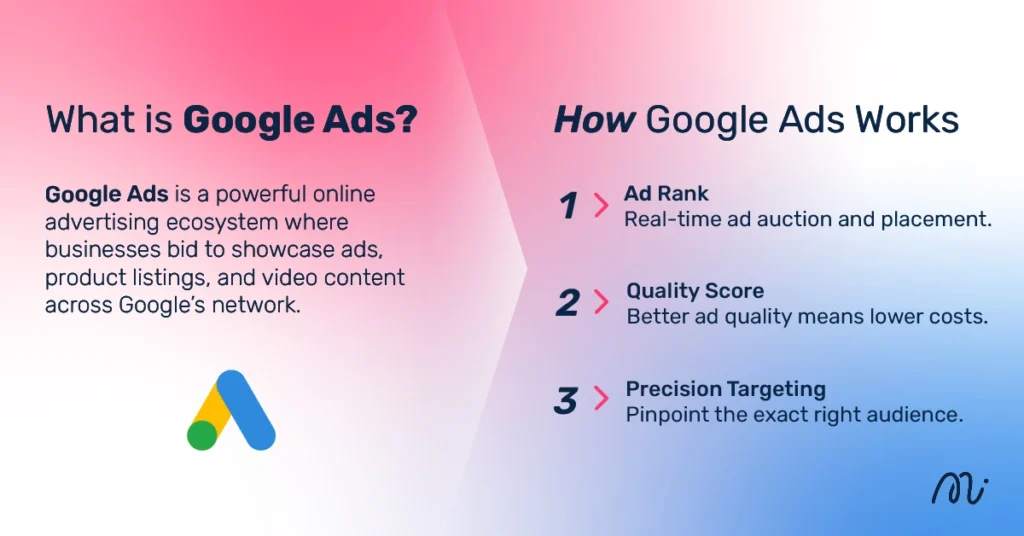
What is Google Ads?
Google Ads is a powerful online advertising ecosystem where businesses bid to showcase ads, product listings, and video content across Google’s network. Operating primarily on a Cost-Per-Click (CPC) auction model, it leverages precise keyword targeting to drive high-intent traffic, generate leads, and boost sales across Search, YouTube, and partner websites.
How Google Ads Works
- The Auction Mechanism: Every time a user searches, Google runs an instantaneous auction. Your Ad Rank is determined by a combination of your maximum bid, ad relevance, and the expected impact of your extensions and formats.
- Quality Score: Google evaluates your ads on a scale of 1–10 based on keyword relevance and landing page quality. A higher Quality Score often results in better ad placement at a lower cost.
- Precision Targeting: Advertisers can narrow their reach based on specific keywords, geographic locations, device types, and detailed user demographics or interests.
- Budgetary Control: You maintain full control over your spending by setting daily or monthly limits. You only incur costs when a user interacts with your ad, such as clicking a link or watching a video.
SEO vs. Google Ads: The Ultimate Comparison
| SEO | Google Ads | |
| Speed of Results | Long-term strategy. Typically takes 3-6 months to see significant ranking improvements and traffic growth. | Instant results. Traffic can be generated within hours or days of launching a campaign. |
| Cost Structure | No direct cost-per-click. Requires upfront investment in high-quality content, SEO tools, and expert teams. | Pay-per-Click (PPC). You are billed for every click or based on your pre-set daily/monthly budget. |
| Sustainability | High sustainability. Once ranked, traffic tends to flow consistently even if you temporarily reduce your efforts. | Low sustainability. Once you stop paying, your ads disappear and traffic stops immediately; requires ongoing budget. |
| Click-Through Rate (CTR) | Higher average CTR. Users generally trust organic results more, leading to a higher volume of natural clicks. | Lower average CTR. Usually ranges between 5–10% depending on industry competition and ad quality. |
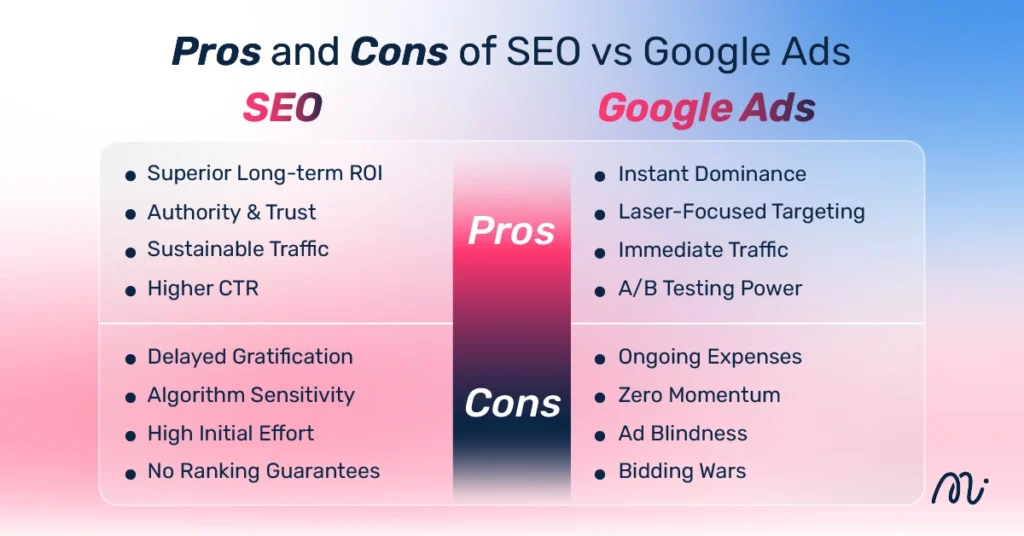
Pros and Cons of SEO vs Google Ads
SEO
Pros
- Superior Long-term ROI: Delivers a higher return on investment over time as you stop paying for every individual visitor.
- Authority & Trust: Building organic rankings establishes your brand as a credible leader in your industry.
- Sustainable Traffic: Once established, rankings provide a consistent flow of visitors that doesn’t disappear overnight.
- Higher CTR: Users naturally gravitate toward organic results, often trusting them more than labeled advertisements.
Cons
- Delayed Gratification: It is a slow process, typically requiring 3–12 months to see measurable impact.
- Algorithm Sensitivity: Your rankings are subject to the whim of search engine updates, which can cause sudden fluctuations.
- High Initial Effort: Requires significant upfront labor in content creation, technical fixes, and link building.
- No Ranking Guarantees: Despite your best efforts, achieving the #1 spot is never 100% guaranteed.
Google Ads
Pros
- Instant Dominance: Achieves immediate top-of-page visibility the moment your campaign goes live.
- Laser-Focused Targeting: Allows you to filter audiences by precise demographics, geography, time of day, and intent.
- Immediate Traffic: Ideal for “turning on the tap” for new product launches or time-sensitive promotions.
- A/B Testing Power: Provides fast data to test which headlines or offers convert best before committing to long-term SEO.
Cons
- Ongoing Expenses: Every click has a price tag; your marketing costs scale directly with your traffic volume.
- Zero Momentum: The moment you stop funding the account, your visibility and traffic vanish instantly.
- Ad Blindness: Some users intentionally skip ads, leading to lower trust compared to organic listings.
- Bidding Wars: In competitive niches, the cost-per-click (CPC) can become unsustainably high.
Who Should Choose What? Finding Your Match
When to Prioritize SEO
Investing in SEO is the ideal choice if you are focused on sustainable, long-term growth and aim to reduce advertising dependency. Once your rankings are established, you gain a steady stream of traffic without the need for a monthly ad spend. It is perfect for businesses with a limited daily budget but the patience to invest in high-quality content and site optimization, leading to a significantly lower cost-per-lead over time.
Prioritize SEO if:
- Long-Term Demand: Your business relies on consistent searches (e.g., insurance, clinics, maintenance services, or local brick-and-mortar shops).
- Asset Building: You prefer building “digital assets” (content and authority) rather than “renting” space through clicks, and can wait 3–6 months for results.
- Authority & Trust: You want to be seen as an industry expert; organic rankings often carry more credibility than “Sponsored” labels.
- Viable Competition: Your target keywords have healthy search volume without being completely dominated by global giants, giving you a realistic chance to rank within 6–12 months.
When to Start with Google Ads
Google Ads is built for speed. It is the best starting point when you need traffic and sales within days—not months. Because campaigns go live almost instantly after approval, you gain total control over your budget and audience targeting. Furthermore, it serves as a powerful market-testing tool to identify which keywords and landing pages actually convert before you commit to a long-term SEO roadmap.
Start with Google Ads if:
- New Launches: You are introducing a new product or brand that lacks existing search recognition and needs immediate awareness.
- Time-Sensitive Offers: You are running short-term promotions (e.g., 7-day flash sales, holiday deals, or grand openings) that require an instant traffic spike.
- Market Testing: You need to verify “Product-Market Fit” or test which offers resonate with your audience before investing heavily in content production.
- High-Competition Niches: You are entering a market where SEO is hyper-competitive; Ads allow you to capture demand immediately while your organic strategy matures in the background.
How Artificial Intelligence Impacts SEO and Ads
- AI in SEO
- The Surge of Zero-Click Searches: AI-generated summaries (AI Overviews) now address user queries directly on the search page.
- Context Over Keywords: Modern algorithms have moved beyond simple keyword matching. They now prioritize the contextual meaning and specific intent behind a user’s search.
- The E-E-A-T Standard: To compete with AI-generated noise, search engines prioritize content that demonstrates Experience, Expertise, Authoritativeness, and Trustworthiness (E-E-A-T).
- Strategic Automation: AI tools are now essential for technical SEO, automating complex tasks like site speed optimization, link health monitoring, and adapting content for Voice Search and natural language queries.
- AI in Google Ads
- Smart Bidding & Real-Time Targeting: AI-driven platforms analyze user behavior in milliseconds, adjusting bids and ad placements instantly to ensure maximum conversion efficiency.
- Creative Evolution (RSAs & DCO): Through Responsive Search Ads (RSAs) and Dynamic Creative Optimization (DCO), AI automatically tests thousands of combinations of headlines, descriptions, and imagery to deliver the most effective ad to each specific user.
- The “AI Overview” Challenge: Similar to organic results, AI Overviews can push paid advertisements further down the page. In 2025, data showed a drop in paid CTR for informational queries when AI summaries were present, forcing advertisers to be more strategic with their targeting.
- Predictive Performance: Advertisers now use Predictive Analytics to forecast campaign outcomes and trends, allowing for proactive budget shifts rather than reactive adjustments.
SEO vs Ads: Which One Should You Choose?
Choose Google Ads for immediate traffic and rapid testing, or SEO for long-term credibility and sustainable ROI. While Ads offer instant visibility, SEO can deliver up to 3.7x higher returns over time, maintaining traffic even after you stop investing.
SEO vs Google Ads, which one actually delivers?
- SEO best for: Long-term growth and building brand authority.
- Google Ads best for: Immediate visibility, urgent sales, and testing new products.
Conclusion
Choosing between SEO vs Google Ads depends on your timeframe: SEO builds a lasting digital empire, while Ads provide a fast track to the top. SEO delivers sustainable, organic growth and higher trust, though it typically takes 3–6 months to show significant ROI. In contrast, Google Ads offers instant visibility and precise targeting, making it ideal for immediate sales or testing new markets. While SEO maintains traffic after investment stops, Ads require a continuous budget to stay visible on the search results page. Ultimately, your choice should align with whether you prioritize long-term brand authority or immediate, high-speed traffic.
If you are looking for a partner to accelerate your online business, Minimice Group is a leading digital agency offering comprehensive marketing solutions. From strategic planning and SEO to expert ad management, they provide data-driven results backed by prestigious accolades like Google Premier Partner and The Growth Champion Award. They deliver measurable solutions and sustainable results to help your brand dominate the digital landscape. With a focus on precision and expertise, they are the trusted choice for long-term online success.
FAQs
Does Google Ads help SEO rankings?
While Google Ads doesn’t directly boost your organic SEO rankings, it offers powerful indirect benefits. Running ads increases brand visibility and provides valuable keyword data that can refine your SEO strategy. Additionally, having both an ad and an organic listing on the same page can significantly improve your overall click-through rate. In short, Ads and SEO work better together to capture more traffic.
Can I use SEO and Google Ads together?
Combining SEO and Google Ads is a high-performance strategy that balances instant visibility with long-term organic authority. Using them in tandem maximizes your SERP real estate, significantly increasing both brand trust and conversion rates. While Ads deliver immediate results, SEO builds a sustainable foundation that lowers your future acquisition costs. This integrated approach ensures your brand dominates the search landscape from every angle.
Can SEO replace Google Ads completely?
SEO cannot entirely replace Google Ads because they serve distinct strategic roles. While SEO builds long-term organic trust and cost-effective traffic, Google Ads provides the immediate visibility and precise targeting that SEO lacks in the short term. For most businesses, these tools are far more powerful when used as complementary assets rather than substitutes.
Is SEO still relevant now that AI is changing Google Search?
SEO remains vital in 2026, though it has transitioned from traditional keyword ranking to a holistic “search everywhere” approach. This evolution focuses on Answer Engine Optimization (AEO) and Generative Engine Optimization (GEO) to meet the demands of AI-driven search. To stay relevant, brands must now prioritize providing direct, authoritative answers across all generative platforms.